
 Thomas Nail reflects on the politics of the mask at the Huffington Post (reposted at critical-theory.com). You can also read my piece ‘V for Visibility‘ online.
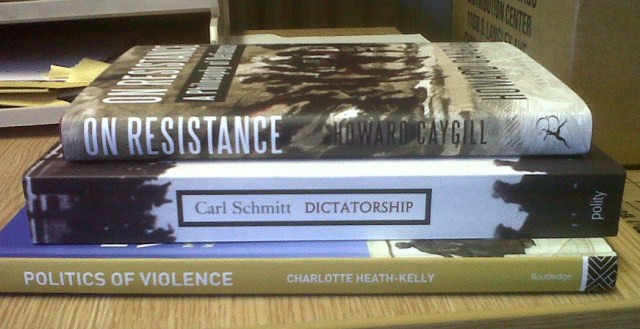 Howard Caygill, On Resistance (see also Jacqueline Rose’s review here); Carl Schmitt’s Dictatorship; and Charlotte Heath-Kelly’s Politics of Violence.
At Sage Connection, some useful advice on journal publishing. Well worth a read – even experienced people miss some of these things. Here’s one answer:
8. What should a person submitting an article for consideration NEVER do?
I think you can probably glean from the above, but never send your full article to the editor outside of the submission process; never be rude to an editor; never try to find out who is reviewing your article; never assume you know who is reviewing your article – as I’ve heard from nearly every editor, likely, you are wrong even if you are sure you’re right; and if your article has been rejected, never email the editor immediately after receiving a rejection. Even if you have questions or feel like there was a major issue in the process, take at least a week and then reread the decision letter. If you still feel like you should write an email, have a diplomatic colleague review it before hitting “send.” And never, ever submit your paper to multiple journals at the same time. Wait for a rejection from one before submitting to another.
Durham’s International Boundaries Research Unit has the story of the ICJ’s judgement on a dispute between Cambodia and Thailand that hit the news a few years ago.
In a unanimous Judgment delivered on 11 November 2013, the International Court of Justice decided that it had jurisdiction over Cambodia’s 2011 Request for interpretation of the Court’s 1962 Judgment which found that the Temple of Preah Vihear is situated in territory under the sovereignty of Cambodia, and ruled that the area under Cambodian sovereignty is “the whole territory of the promontory of Preah Vihear”. [continues]
A good piece on books and their impact on our lives and homes.
A really interesting conversation between Butler and West on the tenth anniversary of Said’s death. Thanks to Sławek Królak for the link.
Duke University Press have a page up for Gastón R. Gordillo‘s new book Rubble: The Afterlife of Destruction. Little there yet, beyond an August 2014 publication date, and this endorsement from Anna Lowenhaupt Tsing:
At the edges of the dreamscapes put forward by the state and capital, Gastón R. Gordillo shows us haunted places where phantoms and curses join human bones and broken bricks: rubble. The Argentine Chaco becomes a magical landscape wrapped in multiple pasts and presents. Simultaneously erudite and evocative, Rubble remakes the stories we tell about knowledge and history—and the legacy of violent conquest from the Spanish empire to the soy boom.
In the meantime, check out his blog at spaceandpolitics – some posts in Spanish; some in English. One of the things I am hoping to find time for soon is to start asking him some questions as an interview for the Society and Space open site.
Early Modern Literary Geographies is a new book series with Oxford University Press, under the editorship of Julie Sanders and Garrett A. Sullivan, Jr. I’m delighted to be part of their advisory board. Here’s the series description:
Influenced by the work of cultural and human geographers, literary scholars have started to attend to the ways in which early modern people constructed their senses of the world out of interactions among places, spaces, and embodied practices. Early Modern Literary Geographies will feature innovative research monographs and agenda-setting essay collections that partake of this “spatial turn.” The term “literary geographies” is to be understood capaciously: we invite submissions on any form of early modern writing that engages with the topics of space, place, landscape and environment. Although English literature is at its center, Early Modern Literary Geographies will feature scholarship that abuts a range of disciplines, including geography, history, performance studies, art history, musicology, archaeology and cognitive science. Subjects of inquiry might include cartography or chorography; historical phenomenology and sensory geographies; body and environment; mobility studies; histories of travel or perambulation; regional and provincial literatures; urban studies; performance environments; sites of memory and cognition; ecocriticism; and oceanic or new blue studies.
This book is now published.
Sue Middleton’s book Henri Lefebvre and Education: Space, Theory, History is forthcoming in November with Routledge.
During his lifetime Henri Lefebvre (1901-1991) was renowned in France as a philosopher, sociologist and activist. Although he published more than 70 books, few were available in English until The Production of Space was translated in 1991. While this work – often associated with geography – has influenced educational theory’s ‘spatial turn,’ educationalists have yet to consider Lefebvre’s work more broadly.
This book engages in an educational reading of the selection of Lefebvre’s work that is available in English translation. After introducing Lefebvre’s life and works, the book experiments with his concepts and methods in a series of five ‘spatial histories’ of educational theories. In addition to The Production of Space, these studies develop themes from Lefebvre’s other translated works: Rhythmanalysis, The Explosion, the three volumes of Critique of Everyday Life and a…
View original post 106 more words
A call for papers for the first issue of Literary Geographies – and check out the blog of the same name which has really useful bibliographies of existing work in this area.
Literary Geographies is an interdisciplinary open-access e-journal that provides a forum for new research and collaboration in the field of literary/geographical studies.
The journal features work combining topics and methods from literary studies, cultural geography, cartography, and spatial theory. Recognising that the term ‘literary geography’ itself (along with its variants in other languages) has multiple meanings and is practised in a variety of ways within different academic traditions, the journal takes a broad view of its subject matter. The journal is fully refereed, and welcomes submissions (in English) from scholars at all career stages, and from all parts of the world.


