Foucault’s 1972 lecture at Minnesota – summary now available

Foucault - Ceremonie, Thêatre et politiqueIn a previous post, I discussed the summary of a 1972 lecture Foucault gave in Minneapolis, entitled “Cérémonie, théâtre et politique au XVIIe siècle”. As far as I am aware the text of the lecture remains in Foucault’s own papers and was never published. It was published in a brief English summary, written by Stephen Davidson, in Acta: Proceedings of the fourth annual conference of XVIIth century French Literature, pp. 22-3. Given the text is so hard to find, I wanted to ask Davidson for permission to put this summary on this site, but sadly I heard he died some years ago. 

I’ve therefore gone ahead with make the summary available – in pdf. If anyone knows of a way of making this more legitimate please let me know.

Thanks to Kai Bosworth, Gerald Moore, Arun Saldanha and Garnet Kindervater for detective work.

Incidentally, the question was raised as to why I’d labelled this lecture summary ‘almost unknown’. I appreciate that people who were there may have long memories of the event, and that the lecture is listed in some bibliographies – i.e. Daniel Defert’s ‘Chronology’. But the summary was difficult to get hold of – not a single UK institution appears to have the proceedings, so I had to request it from the Bibliotheque Nationale, who took six weeks to track it down and send it. So it is pretty obscure. Hopefully posting it here makes it more widely accessible.

Posted in Michel Foucault | 2 Comments

Geo-metrics – audio recording of lecture at Balsillie School

In late September I gave the keynote address to the workshop Regimes of Calculation and Global Governance at the Balsillie School of International Affairs in Waterloo, Ontario. The title of the talk was ‘Geo-metrics’ and you can listen to the audio recording here.

Posted in Bartolus of Sassoferrato, Conferences, Elizabeth Grosz, Martin Heidegger, Territory | 1 Comment

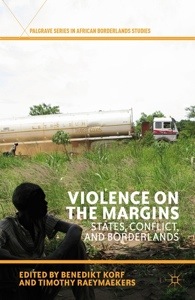
Korf and Raeymaekers (eds.), Violence on the Margins: States, Conflict, and Borderlands

20131010-103327.jpgWhile in Zurich I was given a copy of Benedikt Korf and Timothy Raeymaekers’s new edited book, Violence on the Margins: States, Conflict, and Borderlands. It’s in a series on African Borderlands Studies, but also has quite a lot of treatment of Asia, and looks to be of interest for those interested in borders, territory and politics much more generally.

This boldly multidisciplinary volume surveys African and Asian conflicts through individuals’ lived experiences of territorial borders, as well as the ways these experiences affect political configurations. The contributions gathered here depict borderlands not just as the objects of globalized or state-driven processes, but as actual political units that generate their own actions and outcomes. In particular, these studies demonstrate the explicit transboundary character of conflict and peace. In this way, they explore alternatives to the still-dominant model of contemporary state formation as a centrally guided, top-down process – a model that has led to a deep misunderstanding of borderlands as marginal spaces that either are fraught with savagery and rebellion or linger in dark oblivion.

Posted in Uncategorized | Leave a comment

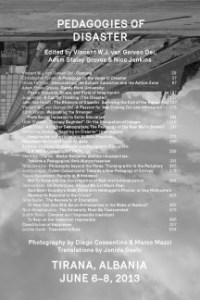
Pedagogies of Disaster

Cover_Final_English_Web-216x324 (1)Newly published by Punctum books, Pedagogies of Disaster – authored by The Department of Eagles, edited by Vincent W.J. van Gerven Oei, Adam Staley Groves, Nico Jenkins.

We live in an era where the university system is undergoing great changes owing to developments in financing policies and research priorities, as well as changes in the society in which this system is embedded. This change toward a more market-oriented university, which also has immediate effects in academic peripheries such as the Balkans, the Middle East, or South-East Asia, is of great influence for the pedagogical practice of “less profitable” academic areas such as the Humanities: philosophy, languages, sociology, anthropology, history.

Because of the absence of a historically grounded establishment of the Humanities, academic peripheries, usually accompanied by a weak civil society infrastructure, seem to offer the most fertile ground for rethinking the Humanities, their pedagogical practice, and their politics, as well as the greatest threats, such as the ongoing capitalization of research, and profitability as the norm of educational achievement. The sprawling presence of for-profit universities and in academic peripheries such as Albania and Kosovo is indicative of this problematic, as are consistent underfunding of universities and the relentless budget cuts in American and English, and to a lesser extent European, universities. Motivations for this ongoing attack on the university are often driven by a political system or a politics with an aggressive stance to critical thought.

At the same time, such an absence of historical grounding may inspire a rejuvenation and reinvigoration of research in the Humanities, such as may be seen in academic centers around Asia, as many young scholars are attracted to an educational environment which is not yet completely petrified in bureaucratic procedures. In this case, a different set of questions appear concerning the place of the scholar in societies with semi-democratic or even authoritarian rule. For civil society to flourish, an educational system that reflects and interrogates the values and concepts that underlie a healthy social fabric are of crucial importance.

This volume comprises papers culled from continent. journal’s Pedagogies of Disaster conference held in Tirana, Albania, hosted by The Department of Eagles (Departamenti i Shqiponjave) in June 2013, and organized to address the fate of relation and the future of pedagogical practice in the University, and especially as it concerns the humanities. The papers gathered here seek to address the infrastructural or interpersonal changes in the modes of production as it relates to current academia, examining the elements and spaces of the rifts opening up in the polis of the University—its students, professors and administrators. The volume further addresses the pedagogical horizon at a critical limit, asking: for whom or for what are we teaching and from whom or from what are we learning?

Authored by The Department of Eagles
Edited by Vincent W.J. van Gerven Oei, Adam Staley Groves, Nico Jenkins

Posted in Books, Politics, Publishing, Universities | 1 Comment

Madeleine Fagan – Ethics and Politics after Poststructuralism Levinas, Derrida and Nancy

undefinedMy Warwick colleague Madeleine Fagan’s book Ethics and Politics after Poststructuralism: Levinas, Derrida and Nancy has now been released by Edinburgh University Press.

This groundbreaking book offers a fresh and innovative perspective on ethics and politics after poststructuralism. Madeleine Fagan argues that the ‘ethical’ should not be understood as a label; it does not mean ‘good’ or ‘right’, and is not an evaluation or guide. Rather, both the ethical and the political are descriptions of the context in which we find ourselves. Fagan offers an account of the inseparability of ethics and politics that challenges existing accounts of poststructuralist ethics and shows the need for a practice-based rethinking of the ethico-political. Drawing on the work of Emmanuel Levinas, Jacques Derrida and Jean-Luc Nancy, Ethics and Politics after Poststructuralism puts forward a radical and far-reaching critique of both foundational and non-foundational ethical theory.

Posted in Books, Emmanuel Levinas, Jacques Derrida, Jean-Luc Nancy | Leave a comment

A Feeling for Things: A Conversation around the work of Jane Bennett – audio recordings

Backdoor Broadcasting Company have made available the audio recordings from the Jane Bennett workshop on 5th October. Contributions from Jane Bennett, Lisa Baraitser, Michael O’Rourke, Joao Florencio, Eileen Joy, Nigel Clark, and Eszter Timár.

Posted in Conferences, Jane Bennett | 1 Comment

Two days in Zurich

Just back from two very nice days in Zurich. Yesterday I gave a lecture entitled ‘Earth: Re-grounding Geopolitics’, and today there was a seminar on my work – particularly ‘Land, Terrain, Territory’ and ‘How should we do the history of territory?’, as ways into the wider project of The Birth of Territory. The lecture was recorded on video, so will hopefully be available soon. The seminar was held in the boat house on the side of the lake – a great setting. I’m very grateful that people came from all over Switzerland for this. My thanks to Benedikt Korf, Timothy Raeymaekers, Christine Schenk, Juliet Fall, Christine Bichsel and many others for hosting me and such good discussions. Even the cold I came down with on Monday evening didn’t spoil things too much.

Posted in Conferences, The Birth of Territory | Leave a comment

Interview with Adrian Johnston on Transcendental Materialism

Peter Gratton interviews Adrian Johnston on the Society and Space open site.

Posted in Uncategorized | Leave a comment

Bradley Garrett’s urban pictures in The Atlantic

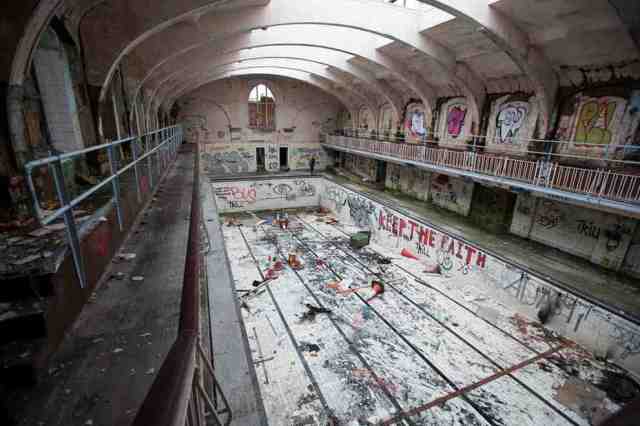
Most of these are in Explore Everything, so this photo story in The Atlantic is a good visual taste of what that excellent book offers…

s_g06_00000007 s_g20_00000006

Posted in urban/urbanisation | 1 Comment

Books received – Indiana University press sale

IUP booksThree books by or about Heidegger, and Colin Koopman’s Genealogy as Critique.

Posted in Martin Heidegger, Michel Foucault | 1 Comment