Powerful piece from Richard Jackson on his life and work, as part of the Methodology and Narrative mini forum at The Disorder of Things.

Guest Authors's avatarThe Disorder Of Things

Richard JacksonRichard Jackson offers the fifth post in the Methodology and Narrative mini-forum. Richard is Professor of Peace Studies and Deputy Director of the National Centre for Peace and Conflict Studies, University of Otago, New Zealand. He is the author of Writing the War on Terrorism: Language, Politics and Counterterrorism (Manchester University Press, 2005), Conflict Resolution in the Twenty-first Century: Principles, Methods and Approaches (Ann Arbor MI: Michigan University Press, 2009; co-authored with Jacob Bercovitch), Terrorism: A Critical Introduction (Palgrave-Macmillan, 2011; co-authored with Marie Breen Smyth, Jeroen Gunning and Lee Jarvis), and numerous related articles. He is also the Editor-in-Chief of the journal, Critical Studies on Terrorism. He blogs at Richard Jackson Terrorism Blog, where part of this post originally appeared.


Any scholar who has ever reflected on their academic career can identify a number of key transformative turning points along the way – those moments when some new…

View original post 3,930 more words

Posted in Uncategorized | Leave a comment

Tim Morton’s next book, Hyperobjects.

Jeremy Schmidt's avatarJeremy J Schmidt

Tim Morton has a new book coming out with the University of Minnesota Press. The cover really caught my eye; here it is with a draft blurb, for the back cover, I believe, that I scooped from Tim’s blog.

Morton_Hyperobjects_cover

BLURB:

The world as we know it has already come to an end.

Having set global warming in irreversible motion, we are facing the possibility of ecological catastrophe. But the environmental emergency is also a crisis for our philosophical habits of thought, confronting us as it does with a problem that seems to defy not only our control but also our understanding. Global warming is perhaps the most dramatic example of what Timothy Morton calls “hyperobjects”—entities of such vast temporal and spatial dimensions that they defeat traditional ideas about what a thing is in the first place. In this book, Morton explains what hyperobjects are and what they mean for…

View original post 176 more words

Posted in Uncategorized | Leave a comment

Free Downloads – some additions and reorganisation

I’ve updated the links to my work available online. There are now separate pages for articles and chapters, interviews; audio and video; and reading lists.

Posted in My Publications | 1 Comment

New review at the Society and Space open site.

Posted in Uncategorized | Leave a comment

Gregory on Benhabib on Butler.

Derek Gregory's avatargeographical imaginations

BUTLER Parting waysWhen I first became interested in critical theory (an age ago now), I found Seyla Benhabib‘s work – and especially Critique, norm and utopia (1986) – wonderfully clear and immensely helpful. She has recently published an extended review essay on Judith Butler‘s Parting Ways: Jewishness and the critique of Zionism in Constellations (2012) (open access – at least for now).  It’s a characteristically careful, lapidary essay, which works towards this climactic conclusion:

Is there any hope then? I believe there is but not through boycott, divestment and sanctions movements, which are based upon a false analogy between the Israeli-Palestinian conflict and the South African struggle, but through continued, sustained, and deep engagement with all countries in the region. Even if the Arab Spring in Egypt brought into power a conservative Islamist party, building and drawing upon its years of resistance to the Mubarrak regime, it was a new…

View original post 559 more words

Posted in Uncategorized | Leave a comment

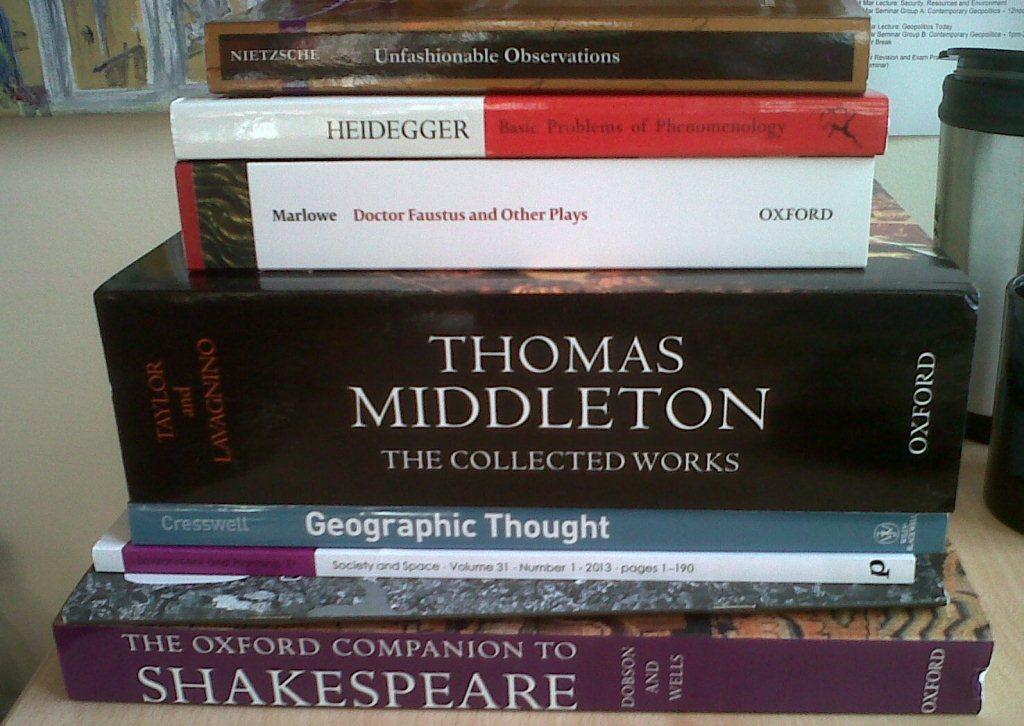
Books received

Books received 14 March 2013Mainly in recompense for some review work for OUP for the Shakespeare project, but also an early Heidegger lecture course, Tim Cresswell’s Geographic Thought, the new issue of Society and Space, a journal I didn’t know before called CRIOS (Critica degli ornamenti spaziali), and the Stanford UP translation of Nietzsche’s Unfashionable Observations(though I have to say I prefer Untimely Meditations as a translation of the title).

Posted in Books, Friedrich Nietzsche, Martin Heidegger, Shakespearean Territories, William Shakespeare | 1 Comment

Landscape Futures

Geoff Manaugh of BLDGBLOG has a new edited collection coming out – lots of images available at the blog.

Landscape-Futuresfinal-1Ground-penetrating radar used to map buried cities. Ghost tectonic plates subsiding beneath the American West, revealed by seismic tomography. Lensless cameras that measure WiFi networks to see through walls. Laser-jamming dazzle devices. Retroreflective prisms on the moon. These and other instruments reveal the strange and often unexpected landscapes invisibly present all around us.
Landscape Futures: Instruments, Devices and Architectural Inventions, edited by Geoff Manaugh, based on his exhibition of the same name at the Nevada Museum of Art, explores the future of landscape studies by way of the technical intermediaries the instruments, devices and architectural inventions through which humans have come to understand the built and natural environments.From autonomous tools for remote archaeology to radio telescopes scanning electromagnetic events in space, by way of colorful mechanisms allowing children to experience the animal superpowers of other species, Landscape Futures looks at the world of extraordinary scientific machines and their hypothetical alternatives that filter, augment, clarify, and transformatively reproduce the world they survey.Featuring exclusive work specially commissioned for Landscape Futures including ambitious new pieces by architects Smout Allen, David Gissen, Chris Woebken & Kenichi Okada, Liam Young, Lateral Office, and The Living this book also brings together a series of essays, short stories, and provocative new research agendas by such writers as Sam Jacob, Alexander Trevi, Jan Zalasiewicz, Scott Geiger, James R. Fleming, Elizabeth Ellsworth, Jamie Kruse, and Rob Holmes. The result is much more than a catalog of projects past. This book, instead, is a manual for invention, a DIY spur for future workshops, courses, exhibitions, and essays for new instruments and spatial devices both practical and imaginative, informed as much by speculative archaeology as by geological narratives of an Earth yet to come.This is the challenge of worlds unrealized and the perceptual tools through which we ll invent them: this is the world of landscape futures.

Posted in Books | 2 Comments

Ben Woodard – On an Ungrounded Earth

page-0Ben Woodard’s book On an Ungrounded Earth: Towards a New Geophilosophy is available to download or buy from Punctum Books.

For too long, the Earth has been used to ground thought instead of bending it; such grounding leaves the planet as nothing but a stage for phenomenology, deconstruction, or other forms of anthropocentric philosophy. In far too much continental philosophy, the Earth is a cold, dead place enlivened only by human thought—either as a thing to be exploited, or as an object of nostalgia. Geophilosophy seeks instead to question the ground of thinking itself, the relation of the inorganic to the capacities and limits of thought. This book constructs an eclectic variant of geophilosophy through engagements with digging machines, nuclear waste, cyclones and volcanoes, giant worms, secret vessels, decay, subterranean cities, hell, demon souls, black suns, and xenoarcheaology, via continental theory (Nietzsche, Schelling, Deleuze, et alia) and various cultural objects such as horror films, videogames, and weird Lovecraftian fictions, with special attention to Speculative Realism and the work of Reza Negarestani. In a time where the earth as a whole is threatened by ecological collapse, On an Ungrounded Earth generates a perversely realist account of the earth as a dynamic engine materially invading and upsetting our attempts to reduce it to merely the ground beneath our feet.

Posted in Books, Publishing | Leave a comment

The London International Boundary Conference 2013

King’s College London, Volterra Fietta and UK Hydrographic Office have organised The London International Boundary Conference 2013, a two day event 18-19 March 2013 with a pre-conference technical workshop. It’s expensive, but has a heavily discounted rate for students.

The Conference speakers are among the world’s leading experts and practitioners in the resolution and management of territorial disputes. They will examine recent developments in disputed “hotspots” around the world, and discuss new and emerging ideas for the resolution and management of territorial disputes, from legal, geopolitical, technical, commercial and other viewpoints. The Conference will examine how these varied, emerging perspectives might inform a more integrated approach to international boundary and territorial disputes. The Conference, which will be attended by delegates and speakers from all over the world, will provide a unique and multidisciplinary insight into the complex world of international boundary and sovereignty disputes and will attract all those with an interest in international boundary and sovereignty issues. Please click on the links below for further information.

• List of Speakers • Schedule • Participation fee •
• Registration •

Posted in Boundaries, Conferences, Politics, Territory | Leave a comment

Interview with Cynthia Enloe

IR theorist Cynthia Enloe is interviewed at E-IR. One brief answer from a very interesting interview.

e-IR: What is the most important advice you could give to young scholars of IR?

Read widely. Read fiction, read anthropology, read history. Make sure you have friends who are not academics. Choose your advisors carefully. But never let the ghosts of your dissertation committee haunt your classrooms. Learn from your students. Love teaching.

Posted in Politics, teaching | 1 Comment