
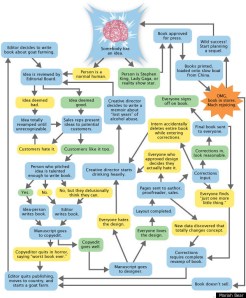
Jason Weidemann of University of Minnesota Press on ‘What do university presses do?’ The particular example is the process of turning Matthew Wolf-Meyer’s dissertation into the book The Slumbering Masses.
Jason Weidemann of University of Minnesota Press on ‘What do university presses do?’ The particular example is the process of turning Matthew Wolf-Meyer’s dissertation into the book The Slumbering Masses.
Never seen these before – thanks to Clare at Foucault News for the links.
French Television Coverage of Michel Foucault in 1984 (pt 1)
French Television Coverage of Michel Foucault in 1984 (pt 2)
Peter Gratton with some local details about my trip to Newfoundland next week.
He notes his schedule here. He first goes out to Corner Brook, near Gros Morne National Park, which is said to be one of most beautiful places in Canada (and for you Canadians, ipso facto, in the world). Next Thursday he takes up the prestigious George Storey lecture, which the Dean of Arts will introduce. Then on Friday, we’ll switch up our usual pub-based discussion series (where we usually look at specific papers and chapters in the history of philosophy) and have Stuart go over his project on Shakespearean territories as part of our public lecture series–at the Peter Easton Pub. (For those in St. John’s, it’s become our favorite dive bar–great room in the back and cheap drinks in the front. We meet there just about each week for the “Jockey Club.”) Then we’ll do a reception for him at my place downtown. We’ll try to send him…
View original post 117 more words
Adam Ramadan on his current and future teaching, which puts my work in some august company.
Eyal Weizman reviewed in Antipode – with news of book reviews being available open access.
 Today we’ve posted reviews by Ghent University’s Omar Jabary Salamanca and the University of Minnesota’s Basil Mahayni. Omar reviews Eyal Weizman’s The Least of All Possible Evils: Humanitarian Violence from Arendt to Gaza, Basil reviews Bassam Haddad’s Business Networks in Syria: The Political Economy of Authoritarian Resilience, and both are available here.
 All Antipode book reviews are now freely available online – not only those on AntipodeFoundation.org but also our back catalogue in Wiley Online Library. From January 2013 we no longer publish new book reviews in the journal: all now appear exclusively on AntipodeFoundation.org. This move allows us to feature not only more reviews, but also more substantive reviews (in the style, say, of the London Review of Books), more quickly. It will, we hope, transform the book reviews section into a more capacious ‘Book reviews, etc.’ section, that may now feature, in addition…
View original post 43 more words
 I’m giving a few lectures at Memorial University of Newfoundland next week. The main reason I am going is to give the George M. Storey lecture in the Humanities, but a few other events have been arranged including a visit to the campus on the other side of the island at Corner Brook. I’ve never been to Newfoundland before, and so looking forward to seeing a few things too – while out at Corner Brook I will visit Gros Morne National Park.
  The political geographer in me is intrigued by St. Pierre et Miqualon, just off the Burin Peninsula. This is the oldest French overseas territory and the only remaining part of New France. I doubt I will be able to get there – the island is a lot bigger than it looks.
18 March 2013, “Shakespearean Territories: Laws, Economies, Agriculture and Banishment in Richard II“, Grenfell Campus, Corner Brook, Memorial University of Newfoundland.
21 March 2013, “‘Knowledge, Truth, Power: The Politics of Foucault’s Leçons sur la volonté de savoir’“, George M. Storey lecture in the Humanities, St John’s Campus, Memorial University of Newfoundland.
There will also be a public lecture, in the Peter Easton Pub (!), on 22 March 2013 in St John’s, under the title of “Why should people interested in territory read Shakespeare?”
Citizenship after Orientalism: enacting Europe in times of crisis
Wednesday, 27 March 2013 (All day), European Parliament (morning) and European Economic and Social Committee (afternoon), Brussels
2013 as the European Year of Citizens is a time to reflect on the current crisis and the future of European citizenship. The Oecumene team is organising an event that will respond to a double purpose. Divided in two sessions, the aim of the morning session is to hold a debate on how European citizenship is constructed, and how it can become genuinely open. The afternoon conference will open a dialogue between academics and activists on a wide range of issues, such as migration, security, feminism, democracy.
These topics will be addressed by a wide range of speakers including:
Engin Isin, The Open University
Rosi Braidotti, Utrecht University
Rui Tavares, MEP
Please see this site for a full presentation of the event and a preliminary programme.
Registration is required for this event. Please email oecumene-project@open.ac.uk for more details.
The event is organised by: Teresa Pullano, within the framework of the EUCITISPACE Marie Curie IEF Project, Iker Barbero, Jack Harrington, Niccolo Milanese of European Alternatives, and Amandine Scherrer.
Bill Connolly’s new book, The Fragility of Things, is coming out in August.
A blog post from 2010 discusses the topic; as does this talk at McGill University.
Short responses to a series of questions on blogging by David Beer (who runs the Thinking Culture blog).
Journal of Critical Globalisation Studies – call for editors and papers.

Our friends and colleagues over at the Journal of Critical Globalisation Studies (which, you will recall, is a fully open access, student-and-junior-faculty-run critical IR journal) have just issued two calls: one for new members of the Editorial Team, and another for papers to fill Issue 7 on the theme of ‘Modelling Capitalism’.
Prospective Editorial Team members can find full details here. The positions are suitable for early-career lecturers, postdoctoral researchers, or PhD candidates currently in the first two years of their study and will be considered on a rolling basis. Meanwhile, the blurb for Issue 7 (deadline for submissions: 1 August 2013) is as follows:
Frequently held in suspicion by critical thinkers, modelling and simulation technologies are nonetheless more and more integral to how the world works, utilised by international bodies, governments, financial firms, and large corporations. This special issue wishes to approach in a synoptic fashion some of big themes raised…
View original post 111 more words


