Books I’m looking forward to in 2025

Some of the academic books I’m looking forward to in 2025:

Some of these were published in late 2024 but I haven’t seen them yet, or come out in paperback in 2025. Here are the lists of books I liked from previous years – 2013201420152016201720182019202020212022, 2023 and 2024.

Posted in Uncategorized | Leave a comment

My favourite academic books of 2024

At the end of each year I’ve posted a list of academic books I liked. The criteria was that they were published in that year (or late the previous one), and that I read and liked them. Many of the most interesting books I read this year were published years ago; some of the 2024 ones I’ve bought or have been sent remain unread.

Some of those featured are books I reviewed or endorsed, and others are by friends and colleagues. Certain publishers, especially those I review for, feature disproportionately. It’s of course biased by my interests and prejudices. So while there are doubtless many other good books from each of these years, I can at least say I think these ones are worth reading.

Here are the lists from 2013201420152016201720182019202020212022 and 2023.

  1. Peter Adey, Evacuation: The Politics and Aesthetics of Movement in Emergency (Duke)
  2. Perry Anderson, Disputing Disaster: A Sextet on the Great War (Verso)
  3. Valentina Antoniol, Foucault et la guerre: À partir de Schmitt, contre Schmitt (Mimesis)
  4. Maan Barua, Plantation Worlds (Duke)
  5. Michael C. Behrent, Becoming Foucault: The Poitiers Years (Pittsburgh) – review forthcoming in Journal of Modern History
  6. Beverley Best, The Automatic Fetish: The Law of Value in Marx’s Capital (Verso)
  7. Arthur Bradley, Staging Sovereignty: Theory, Theater, Thaumaturgy (Columbia)
  8. Marta Dyczok, Ukraine not ‘the’ Ukraine (Cambridge)
  9. Philipp Felsch, How Nietzsche Came in from the Cold: Tale of a Redemption, trans. Daniel Bowles (Polity)
  10. Michel Foucault, Nietzsche: Cours, conférences et travaux, ed. Bernard Harcourt (Seuil/Gallimard/EHESS) and What is Critique? and the Culture of the Self, trans. Clare O’Farrell (Chicago)
  11. Stefanos Geroulanos, The Invention of Prehistory: Empire, Violence and our Obsession with Human Origins (Liveright)
  12. Mary Gilmartin, Phil Hubbard, Rob Kitchin & Sue Roberts (eds.), Key Thinkers on Space and Place, third edition (Sage)
  13. Emily Herring, Herald of a Restless World: How Henri Bergson Brought Philosophy to the People (Hachette)
  14. Marcelo Hoffman, Foucault in Brazil: Dictatorship, Resistance, and Solidarity (Pittsburgh) – review in Political Theory
  15. Michael Hughes, Feliks Volkhovskii: A Revolutionary Life (Open Book – open access)
  16. Fredric Jameson, The Years of Theory: Lectures on Modern French Thought (Verso)
  17. Burak Kadercan, Shifting Grounds: The Social Origins of Territorial Conflict (Oxford)
  18. Martijn Konings, The Bailout State: Why Governments Rescue Banks, Not People (Polity)
  19. Claude Lévi-Strauss, Les plus vastes horizons du monde: Textes et images brésiliens (1935-1942) suivis de cinq films coréalisés avec Dina Dreyfus – eds. Samuel Titan and Carlos Augusto Calil (Éditions Chandeigne)
  20. Bruce Lincoln, Secrets, Lies and Consequences: A Great Scholar’s Hidden Past and his Protégé’s Unsolved Murder (Oxford)
  21. Gail Lythgoe, The Rebirth of Territory (Cambridge) – which I endorsed
  22. Oscar Mazzoleni, Territory and Democratic Politics (Palgrave)
  23. Eduardo Mendieta, The Philosophical Animal: On Zoopoetics and Interspecies Cosmopolitanism (SUNY – open access)
  24. Samuel Moyn, Liberalism Against Itself: Cold War Intellectuals and the Making of Our Times (Yale)
  25. Amín Pérez, Bourdieu and Sayad Against Empire: Forging Sociology in Anticolonial Struggle, trans. Andrew Brown (Polity)
  26. Douglas Porch, Resistance and Liberation: France at War 1942-1945 (Cambridge)
  27. Gillian Rose, Marxist Modernism: Introductory Lectures on Frankfurt School Critical Theory, eds. James Gordon Finlayson and Robert Lucas Scott (Verso)
  28. Gillian Rose, Love’s Work (Penguin, reissue)
  29. Cristina Vatulescu, Reading the Archival Revolution: Declassified Stories and their Challenges (Stanford)
  30. Owen Ware, Indian Philosophy and Yoga in Germany (Routledge)
Posted in Claude Lévi-Strauss, Eduardo Mendieta, Fredric Jameson, Friedrich Nietzsche, Gillian Rose, Karl Marx, Michel Foucault, Mircea Eliade, Stefanos Geroulanos, Territory, Theory, Uncategorized | 3 Comments

Books received – Foucault, Greimas, Lévi-Strauss, Derrida, Vernant, Lejeune

Most of these bought on a recent Paris trip, and a couple from online second-hand stores. Spectres of Marx is a new edition, including a debate with Étienne Balibar; Du même à l’autre is the most recent seminar volume, including two 1963 courses on Husserl. The two Foucault books are part of the re-edition of the lecture courses, this time being done in chronological order. Claude Lévi-Strauss, Les plus vastes horizons du monde: Textes et images brésiliens (1935-1942) suivis de cinq films coréalisés avec Dina Dreyfus was edited by Samuel Titan and Carlos Augusto Calil and includes photographs, early texts and film transcripts. The book gives you access to the films themselves too.

Études mycéniennes is the proceedings of an April 1956 conference edited by Michel Lejeune, which both Benveniste and Dumézil attended. Linear B was only deciphered a couple of years before this event. Benveniste takes part in the discussions, but neither he nor Dumézil seems to have given a formal paper, even though both used the language as an example in their teaching. I will say more about this event in a future post since it’s an interesting story. (Update the discussion of the 1956 conference is now here.)

Posted in Claude Lévi-Strauss, Emile Benveniste, Georges Dumézil, Jacques Derrida, Michel Foucault | 1 Comment

C.L.R. James, interviewed by Stuart Hall, introduction by Phoebe Braithwaite – complete unaired BBC interview from 1976, in The New York Review

C.L.R. James, interviewed by Stuart Hall, introduction by Phoebe Braithwaite – complete unaired BBC interview from 1976, in The New York Review – requires subscription or free registration to read just this piece

In May 1976, the Jamaican-born cultural theorist Stuart Hall sat down in the BBC’s studios in West London to interview the Trinidadian-born intellectual C.L.R. James. They were being filmed by Mike Dibb, who had produced John Berger’s Ways of Seeing four years earlier, for a planned BBC Two broadcast commemorating James’s seventy-fifth birthday. Hall was forty-four. The conversation was a torch-passing of sorts, from one West Indian intellectual who made his name in Britain to another.

The tape of that interview was lost before it was ever aired. More accurately, it was destroyed—wiped before transmission… A transcript, however, survives in several copies scattered across archives, including James’s papers at Columbia and the C.L.R. James Library in East London… What follows is, to my knowledge, the transcript’s first unabridged publication, drawn from the Columbia copy, lightly edited for clarity and to minimize repetitions.

Stuart Hall and C.L.R. James; illustration by Molly Crabapple
Posted in C.L.R. James, Stuart Hall, Uncategorized | 2 Comments

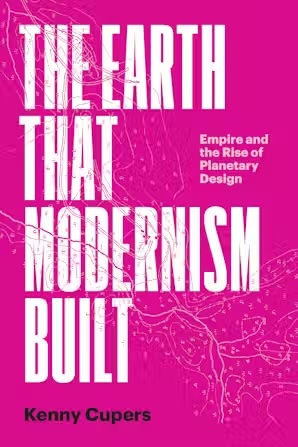
Kenny Cupers, The Earth That Modernism Built: Empire and the Rise of Planetary Design – University of Texas Press, 2024 and New Books discussion

Kenny Cupers, The Earth That Modernism Built: Empire and the Rise of Planetary Design – University of Texas Press, 2024 

New Books discussion with Miranda Melcher. Thanks to dmf for the link.

An intellectual history of architectural modernism for an age of rising global inequality and environmental crisis.

The Earth That Modernism Built traces the rise of planetary design to an imperialist discourse about the influence of the earthly environment on humanity. Kenny Cupers argues that to understand how the earth became an object of design, we need to radically shift the terms of analysis. Rather than describing how new design ideas and practices traveled and transformed people and places across the globe, this book interrogates the politics of life and earth underpinning this process. It demonstrates how approaches to modern housing, landscape design, and infrastructure planning are indebted to an understanding of planetary and human ecology fueled by settler colonialism and imperial ambition. 

Cupers draws from both canonical and unknown sources and archives in Germany, Namibia, and Poland to situate Wilhelmine and Weimar design projects in an expansive discourse about the relationship between soil, settlement, and race. This reframing reveals connections between colonial officials planning agricultural hinterlands, garden designers proselytizing geopolitical theory, soil researchers turning to folklore, and Bauhaus architects designing modern communities according to functionalist principles. Ultimately, The Earth That Modernism Built shows how the conviction that we can design our way out of environmental crisis is bound to exploitative and divisive ways of inhabiting the earth.

Posted in Uncategorized | Leave a comment

My publications in 2024

Canguilhem, Dumézil, Hyppolite: Georges Canguilhem and his Contemporaries”, Revue Internationale de Philosophie, No 307, 2024, 27-48 – special issue on Georges Canguilhem beyond Epistemology and the History of Science, edited by Federico Testa.

Foucault and Dumézil on Antiquity”, Journal of the History of Ideas, Vol 85 No 3, July 2024, 571-600 (open access until end of January 2025).

Georges Dumézil, Mitra-Varuna: An Essay on Two Indo-European Representations of Sovereignty, translated by Derek Coltman, critical edition and introduction by Stuart Elden, afterword by Veena Das, HAU books, 2024 (Introduction and Afterword are open access on the HAU site).

Alexandre Koyré and the Collège de France”, History of European Ideas, online first (open access).

Three of these four publications were completed before last year’s health problems and revisiting them for copy-editing and proofs was a bit strange. The fourth was conceived, written, reviewed and published in a much shorter period of just a few months this year.

The vast majority of what I’ve written in 2024 – and really since mid-2022 – is for the book manuscript under the working title Mapping Indo-European Thought in Twentieth-Century France, on which I’ve been sharing research updates through the year. The articles above all connect to this project, even though none of them use parts of the text. So far, I’ve not excerpted material for separate publication.

A couple of other things are forthcoming, again both completed some time ago, along with a couple of more recent book reviews and a chapter on “Foucault and Structuralism”. I’m hoping that I will complete a first draft of Mapping Indo-European Thought by the end of 2025 – that’s the entire focus again, and talks next year will all present parts of that work.

Posted in Uncategorized | Leave a comment

Things Hidden: The Life and Legacy of René Girard (full documentary)

Things Hidden: The Life and Legacy of René Girard (YouTube)

Website and trailer at the film’s site – Things Hidden

Posted in Uncategorized | Leave a comment

Dan Davies, The Unaccountability Machine: Why Big Systems Make Terrible Decisions—and How the World Lost Its Mind – University of Chicago Press, 2024

Dan Davies, The Unaccountability Machine: Why Big Systems Make Terrible Decisions—and How the World Lost Its Mind – University of Chicago Press, 2024

Longlisted for the 2024 Financial Times Book of the Year. How life and the economy became a black box—a collection of systems no one understands, producing outcomes no one likes.

Passengers get bumped from flights. Phone menus disconnect. Automated financial trades produce market collapse. Of all the challenges in modern life, some of the most vexing come from our relationships with automation: a large system does us wrong, and there’s nothing we can do about it.

The problem, economist Dan Davies shows, is accountability sinks: systems in which decisions are delegated to a complex rule book or set of standard procedures, making it impossible to identify the source of mistakes when they happen. In our increasingly unhuman world—lives dominated by algorithms, artificial intelligence, and large organizations—these accountability sinks produce more than just aggravation. They make life and economy unknowable—a black box for no reason.

In The Unaccountability Machine, Davies lays bare how markets, institutions, and even governments systematically generate outcomes that no one—not even those involved in making them—seems to want. Since the earliest days of the computer age, theorists have foreseen the dangers of complex systems without personal accountability. In response, British business scholar Stafford Beer developed an accountability-first approach to management called “cybernetics,” which might have taken off had his biggest client (the Chilean government) not fallen to a bloody coup in 1973.

With his signature blend of economic and journalistic rigor, Davies examines what’s gone wrong since Beer, including what might have been had the world embraced cybernetics when it had the chance. The Unaccountability Machine is a revelatory and resonant account of how modern life became predisposed to dysfunction.

Posted in Uncategorized | 5 Comments

Foucault’s Christmas

I’ve shared this before, but was thinking again about Daniel Defert’s memories of Foucault’s working routines in this interview – ‘The Materiality of a Working Life‘ (open access; original French).

No no, weekends didn’t exist! We would go to see art exhibitions on the Saturday afternoon, certainly, but the very notion of the weekend didn’t exist… Especially a public holiday, a Christmas day without writing, that was impossible! Foucault rarely put dates on his writings, but he would have been quite capable of putting “December 25th” on something, that being a day when, as he said, “nothing has happened for several thousand years.”

Interviewed by Alain Brosset and Philippe Chevalier; translated by Colin Gordon.

Posted in Michel Foucault, The Early Foucault | Leave a comment

My favourite music of 2024

The music I enjoyed this year, either bought in physical form, often through Burning Shed, or digitally through bandcamp.

  1. 212°, Transmissions
  2. Anchor & Burden, Extinction Level Afterglow EP
  3. The Aristocrats, Duck
  4. Nik Bärtsch’s Ronin, Spin & Ronin Rhythm Clan, Moonday EP
  5. Bass Communion, The Itself of Itself
  6. BASta!, III
  7. Big Big Train, The Likes of Us
  8. Black Country Communion, V
  9. Tim Bowness, Powder Dry
  10. Caligula’s Horse, Charcoal Grace
  11. Jon Durant, Momentarily
  12. Fractal Sextet, Sky Full of Hope
  13. Frost*, Life in the Wires
  14. Gavin Harrison and Antoine Fafard, Perpetual Mutations
  15. Neal Morse, Joseph Part II: The Restoration
  16. Neal Morse and the Resonance, No Hill for a Climber
  17. Opeth, The Last Will and Testament
  18. PAKT, No Steps Left to Trace
  19. The Pineapple Thief, It Leads to This and Last to Run EP
  20. Pure Reason Revolution, Coming Up to Consciousness
  21. Quartet Diminished, Deerand
  22. Trevor Rabin, Rio
  23. Stefan Thelen and Markus Reuter, Rothko Spaces Volume 2
  24. Stefan Thelen and David Torn, Rothko Spaces Volume 1
  25. Devin Townsend, Powernerd
  26. Tears for Fears, Songs for a Nervous Planet
  27. Transatlantic, The Absolute Whirlwind
  28. Whom Gods Destroy, Insanium
  29. Weather Systems, Ocean without a Shore
  30. Mark Wingfield, The Gathering

For previous years: 2023, 2022202120202019201820172016201520142013 and 2012.

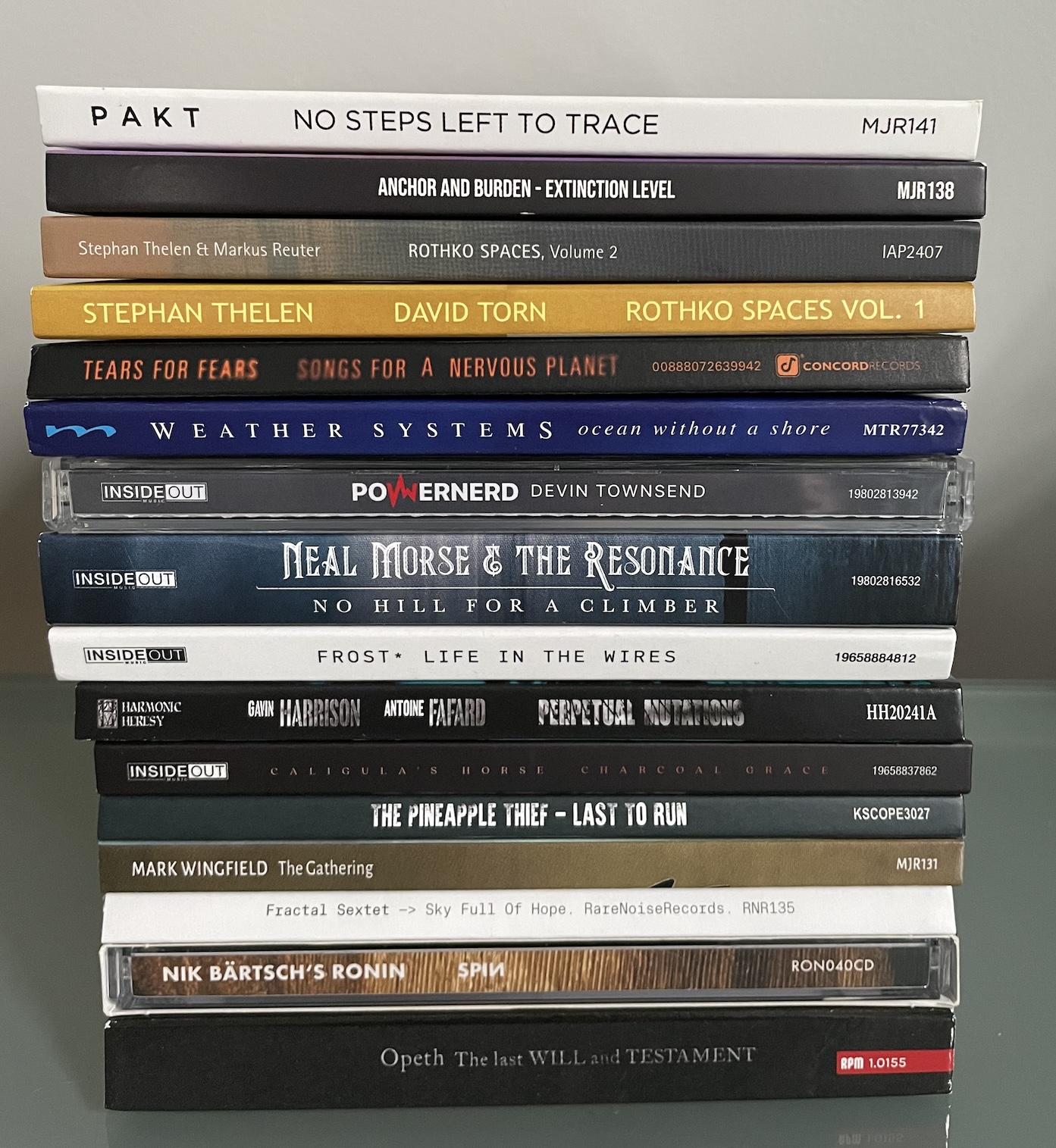
A photograph of some of the cds mentioned above
Posted in Uncategorized | 1 Comment