Jacob Klein, Gilles Deleuze and Francis Bacon

At New APPS, an intriguing post on Jacob Klein, Gilles Deleuze and Francis Bacon by Jeff Bell.

1972 tryptichIn an earlier post, I made reference to Jacob Klein’s essay about Husserl’s history of the origin of geometry. Klein’s own work is very impressive as well (Burt Hopkins has a recent book on both Klein and Husserl [a NDPR review is here), and reading through Klein’s book has helped me to see one reason why Deleuze so freely and regularly draws from both mathematics and art, though not just any mathematics or any art. Deleuze was interested in a problematic as opposed to axiomatic mathematics; and he was interested in a figural as opposed to figurative art. What the two have in common is a certain form of abstraction.

Posted in Gilles Deleuze, Jacob Klein | Leave a comment

Antoine Bousquet discusses War and Simulation at The Disorder of Things.

Antoine Bousquet's avatarThe Disorder Of Things

This post was originally given as a talk at the Urbanomic event Simulation, Exercise, Operations held in Oxford on the 11th July 2012. Thanks to Robin Mackay for the transcription of the talk that served as a basis for the present version.


85A5D67B19D6CB0050E258830ABD828E_1280_872

Upon reflecting on the meaning of simulation and the role it occupies in war, it strikes me that it is possible to distinguish between two distinct, if perhaps complementary, significations. There is a first signification which refers back to an older understanding of simulation and is a more etymologically faithful meaning of simulation in terms of deception, in terms of pretence, illusion, and false appearance that refers us back to the classical idea of the simulacrum as formulated by Plato. This conception of simulation invokes the notion of surface resemblance – a simulation is something that appears to be what in fact it is not. The history of the…

View original post 1,690 more words

Posted in Uncategorized | Leave a comment

Slavoj Žižek interview in Salon

Rather late linking to this.

Posted in Slavoj Zizek | 1 Comment

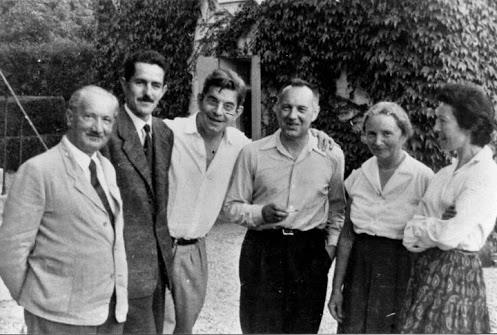
When Heidegger met Lacan

This photo has been doing the rounds on facebook (via Difundir Psicoanálisis). It is from Heidegger’s visit to Lacan’s home at Guitrancourt which he visited shortly before delivering the ‘What is Philosophy?’ lecture at Cerisy-la-salle in 1955. A young Kostas Axelos was the interpreter.

Heidegger, Axelos, Lacan et al

Left to right – Heidegger, Axelos, Lacan, Jean Beaufret (recipient of the Letter on Humanism), Elfriede Heidegger, Sylvia Bataille (by this time married to Lacan).

Axelos discusses the meeting in his interview with Dominique Janicaud in Heidegger en France II: Entretiens (Paris, Albin Michel, 2001).

Update June 2015: Axelos’s book, Introduction to a Future Way of Thought: On Marx and Heidegger has now been published by Meson Press. The book is open access online and print-on-demand.

Posted in Kostas Axelos, Martin Heidegger | 13 Comments

Good piece on the airport and the power of space.

Joe's avatarThe Disorder Of Things

The airport is a totalitarian space; sometimes the truth is hyperbolic.

You re-enter the United States, land of your birth, as part of the stream of arriving passengers. It is an everyday experience. You leave the airplane slowly, on stiff limbs, trickling with the mass of travellers into Newark airport.

The imperatives are issued as soon as you enter the terminal building. No smoking. No cell phones. Stand in line. Fill in your declaration form. Foreigner here. Citizen there. Wait behind the red line till you are called. The armed immigration officer checks your papers, holding the power to pronounce your worthiness to enter this sanctified space.

Border Control

With the imperatives come the questions. Where are you coming from? Where are you going? As if the answers are clear. As if these are simple questions. The man with the gun, holding your passport, asks, “Where are you flying next?” But he…

View original post 1,277 more words

Posted in Uncategorized | Leave a comment

History journal editors come out against RCUK policies on open access.

Posted in Uncategorized | Leave a comment

NDPR review of Philosophy of Physics: Space and Time

j9729NDPR have a very positive review of Tim Maudlin’s recently published Philosophy of Physics: Space and Time.

This is volume one of a two-volume survey of the philosophy of physics. The second volume of the series addresses foundational questions concerning the contemporary theory of matter, Quantum Mechanics. Here, in volume one, Maudlin is concerned with questions that lie at the foundation of space-time theories: What kinds of entities are presupposed by space-time theories, and what kind of structure do those entities (or the space, time or space-time that they make up) have? He surveys these questions in the context of the physics of Aristotle, through Galileo and Newton, to Special and General Relativity. He guides us through these theories in a way that carefully uncovers what he takes to be the answers to these questions in each context. The book covers a lot of familiar philosophical ground in philosophy of space and time. But it does so in a way that introduces the key background to contemporary debates. Philosophical discussion is threaded carefully and precisely though the presentation of the physics, and the ontological and conceptual commitments of the physics are almost always explicitly unpacked and clarified. Along the way Maudlin presents and develops some of the essential concepts that lie at the foundations of space-time theories required for understanding contemporary debates in the philosophy of space and time: topology, affine structure, metric structure, inertial coordinate systems, and gauge freedom, to name just a few.

Posted in Uncategorized | Leave a comment

Derek Gregory links to videos of a talk by and discussion with Judith Butler.

Derek Gregory's avatargeographical imaginations

Judith Butler‘s Wall Exchange‘Bodies on the street’, delivered at the Vogue Theatre in Vancouver last year, has now been posted on YouTube:

And a Q&A the following day with UBC faculty at the Peter Wall Institute for Advanced Studies is here:

You can access the text of an early version of the lecture here and here.

View original post

Posted in Uncategorized | 3 Comments

Michael Eldred on Heidegger and world

A short piece by Michael Eldred – Being Time Space – Heidegger’s Casting of World.

This essay gives an exposition of Heidegger’s late thinking on being, time and space, showing how each eventuates appropriately from the Ereignis (propriation). Three talks are drawn upon: ‘Time and Being’ (1962), ‘Building Dwelling Thinking’ (1951), and ‘The Thing’ (1950). Heidegger shows that both being and time are given by propriation, whereby the one gift, being, is ‘aufgehoben’ in the gift of four-dimensional time. Space is then ‘given space’ (eingeräumt) only within the three-dimensional time-clearing through the mediation of certain erected things (Bauten) that, as places, allow a site for space to be given its spaces. In the final section, the essay ventures beyond Heidegger’s casting of world as fourfold, to recast it as carousel of the world around the abyss. 

Posted in Martin Heidegger | 1 Comment

Juan Cole on The Middle East in 2013

At Informed Comment, Juan Cole offers some thoughts on prospects in the Middle East this year.

Posted in Politics | Leave a comment