IJURR review essay on Foucault and Geography

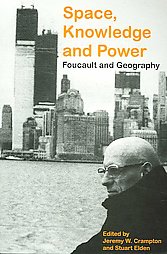
The latest issue of IJURR has a review essay on cities by Martina Löw that takes the Space, Knowledge and Power: Foucault and Geography collection that Jeremy Crampton and I edited as one of the three books under review.

The review is broadly appreciative though does make a small error. It suggests that

In 1976 Foucault addressed questions to the geographers of the French journal Hérodote, and they responded in an issue of the journal. However, the exchange did not appear in English until a translation was published in 1980. Members of the English-speaking community therefore read the interview only after having read Foucault’s works such as Discipline and Punish (1977) and The History of Sexuality (1978).

What actually happened was that Foucault was interviewed by the journal, for a piece that was indeed translated in 1980 for Colin Gordon’s Power/Knowledge collection – ‘Questions on Geography’. Foucault’s questions to the geographers (and some of the responses from Francophone geographers) were not translated until the collection under review. So while English-language readers had access to Foucault’s thoughts in 1980, they didn’t have access to his questions until 2007. It was making those questions, a selection of responses, and some new responses from English-language authors available that was the initial impetus behind this collection.
Posted in Jeremy Crampton, Michel Foucault, My Publications | Leave a comment

Interview with Alberto Toscano

Interesting interview with Alberto Toscano, which discusses his forthcoming co-authored book Cartographies of the Absolute, his previous work, and the state of universities today.

Posted in Alberto Toscano, Politics, Universities | Leave a comment

The State of the Field of Geography

Panel discussion on ‘The State of the Field of Geography’ at the Weatherhead Center for International Affairs, including Hashim Sarkis and Neil Brenner.

Posted in Conferences, Neil Brenner, Universities | Leave a comment

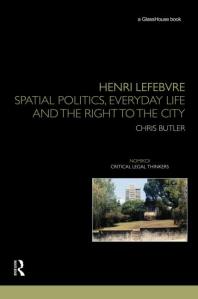
Chris Butler – Henri Lefebvre: Spatial Politics, Everyday Life and the Right to the City

Recently out with Routledge. Looks good, though shame about the price.

While certain aspects of Henri Lefebvre’s writings have been examined extensively within the disciplines of geography, social theory, urban planning and cultural studies, there has been no comprehensive consideration of his work within legal studies. Henri Lefebvre: Spatial Politics, Everyday Life and the Right to the City provides the first serious analysis of the relevance and importance of this significant thinker for the study of law and state power. Introducing Lefebvre to a legal audience, this book identifies the central themes that run through his work, including his unorthodox, humanist approach to Marxist theory, his sociological and methodological contributions to the study of everyday life and his theory of the production of space. These elements of Lefebvre’s thought are explored through detailed investigations of the relationships between law, legal form and processes of abstraction; the spatial dimensions of neoliberal configurations of state power; the political and aesthetic aspects of the administrative ordering of everyday life; and the ‘right to the city’ as the basis for asserting new forms of spatial citizenship. Chris Butler argues that Lefebvre’s theoretical categories suggest a way for critical legal scholars to conceptualise law and state power as continually shaped by political struggles over the inhabitance of space. This book is a vital resource for students and researchers in law, sociology, geography and politics, and all readers interested in the application of Lefebvre’s social theory to specific legal and political contexts.

Thanks to Nick Blomley for alerting me that this was now out.

Posted in Henri Lefebvre | 6 Comments

Antipode‘s 4th Institute for the Geographies of Justice – Durban

This looks a really interesting opportunity for PhD students and early career scholars. Full details here.

Antipode‘s 4th Institute for the Geographies of Justice (IGJ) will take place in Durban, South Africa, May 27th – June 1st 2013 (with a pre-Institute day in Johannesburg for those interested in  interacting with Achille Mbembe and his team at the Johannesburg Workshop on Theory and Criticism).

After Antipode’s first three successful Institutes held in Athens, Georgia, USA (2007), in Manchester, UK (2009), and again in Athens (2011) we are delighted to announce that the 4th Institute will be held in Durban, South Africa during the end of May/beginning of June 2013. The 4th IGJ will provide an exciting opportunity to engage leading edge theoretical, methodological, and research-practice issues in the field of radical geography and social justice (both broadly defined), along with a range of associated professional and career development matters. This international meeting will be specifically designed to meet the needs of new researchers, taking the form of an intensive, interactive workshop for 25 participants.

Posted in Conferences, Politics | Leave a comment

Shakespeare and War

Derek Gregory has followed up his post on Theatre of/and War with one on Shakespeare and War. Lots of good reading suggestions in both. I’d also suggest Simon Barker, War and Nation in the Theatre of Shakespeare and his Contemporaries. Derek kindly mentions my Shakespearean Territories project in the second post – and his suggestions on Shakespeare are timely as I’ve recently been writing on the geopolitical framings of Hamlet and Macbeth. I’ll be giving various talks on this project in coming months, and hope to have the chance to focus on different bits for different audiences (rather than repeat the same paper each time). The next outing is the Critical International and Political Studies annual lecture, University of Warwick in October, which is why I’ve turned my attention to Hamlet and Macbeth.

Several of Shakespeare’s plays are explicitly about war – the English history plays, for example. Richard III has a striking battle, as does Henry V, given a propaganda spin by Laurence Oliver in 1944 before another invasion of France.

Coriolanus has important battle scenes, and King Lear has an invasion – both of which I’ve already written about. Macbeth begins with the defeat of an invasion and the execution of traitors – it gives Macbeth his title as Thane of Cawdor – and ends with another invasion to overthrow him. Titus Andronicus has the return of a warrior, army and prisoners at the beginning, and another invasion at the end. This will also be discussed in the book. A number of other plays have wider conflicts that frame a story – Hamlet is the one that I’ve found most striking recently, but troops also return from war at the beginning of Much Ado About Nothing. I’m sure there are more, and obviously there are traces in the martial metaphors throughout.

Posted in Derek Gregory, Politics, Shakespearean Territories, Territory, William Shakespeare | Leave a comment

A People’s Guide to Los Angeles

People going to the Association of American Geographers in Los Angeles in 2013 may be interested in this book. Entitled A People’s Guide to Los Angeles, it has recently been published by University of California Press.

The book backcover blurb explains:

A People’s Guide to Los Angeles offers an assortment of eye-opening alternatives to L.A.’s usual tourist destinations. It documents 115 little-known sites in the City of Angels where struggles related to race, class, gender, and sexuality have occurred. They introduce us to people and events usually ignored by mainstream media and, in the process, create a fresh history of Los Angeles. Roughly dividing the city into six regions—North Los Angeles, the Eastside and San Gabriel Valley, South Los Angeles, Long Beach and the Harbor, the Westside, and the San Fernando Valley—this illuminating guide shows how power operates in the shaping of places, and how it remains embedded in the landscape.

The Los Angeles Review of Books has been running a series of pieces by the authors on the book (here, here, here and here); and a podcast interview. LA Weekly also has a review here. Thanks to Andrew Burridge for the links.

Posted in Uncategorized | Leave a comment

Gaston Gordillo – The Terrain as Medium of Violence

Also in the ‘Violence and Space’ AAG sessions, Gaston Gordillo on ‘The Terrain as Medium of Violence’. He’s posted the abstract here, and also talks about his intriguing sounding book The Afterlife of Places: Ruins and the Destruction of Space, forthcoming with Duke University Press. He makes the point that ‘terrain’ needs more theorisation as a category, and links it to debates around verticality. Given my previous paper ‘Land, Terrain, Territory’ and my forthcoming ‘Secure the Volume: Vertical Geopolitics and the Depth of Power’ (early version video here) I’m obviously very interested in what he will say. Should be ‘very lively’ as Derek Gregory suggests.

Posted in Politics, Territory | Leave a comment

Graham Harman on news that Tristan Garcia’s Form and Object will be out in English in a year or so.

doctorzamalek's avatarObject-Oriented Philosophy

The deal with PUF is now done, and it’s a big one: Garcia’s Forme et objet will appear in our Speculative Realism series at Edinburgh University Press.

Mark Allan Ohm and Jon Cogburn are the translators. Better yet, they’re already finished with a first draft of the entire translation, moving with startling speed since the end of the spring.

We are hopeful that you’ll be able to read Garcia’s big book in English in 2013, though perhaps it will slip into early 2014; we’ll know for sure in a few months. In any case, if you can’t (or don’t wish to) read the whole book in French, the Ohm/Cogburn version may be on sale in a year or so.

If you’d like to read my summary of the book in continent and haven’t already done so, click HERE to read it.

View original post

Posted in Uncategorized | Leave a comment

Quentin Meillassoux – ‘Iteration, Reiteration, Repetition’ text

Meillassoux’s 20th April 2012 lecture in Berlin is now online. Not sure how authorised this is, but Peter Gratton and Graham Harman have both linked to it. Graham has some thoughts in response in his post.

Posted in Graham Harman, Peter Gratton, Quentin Meillassoux | Leave a comment