‘Shakespearean Territories’ – abstract for Warwick

This is my abstract for the Critical International and Political Studies annual lecture, University of Warwick, October 3rd 2012.

This lecture shows how Shakespeare’s plays can help us to think about the multi-faceted nature of territory as word, concept and practice, and to shed light on the way we understand territory and territorial disputes today. Shakespeare only uses the word ‘territory’ twice, in King Lear and As You Like It, and the plural ‘territories’ twelve times in seven separate plays. It might thus appear that the idea was marginal to his work. Yet a number of his plays are structured around related issues of exile, banishment, land politics, spatial division, contestation, conquest and succession.

Drawing on the political and historical analyses of territory in Terror and Territory and the forthcoming The Birth of Territory, this lecture will examine the way that territorial concerns run through Shakespeare’s plays. While other parts of the larger project discuss legal, economic, corporeal, colonial, technical, and exiled aspects of territory, here the focus is on the question of vulnerability and external relations. Both Hamlet and Macbeth concern the court politics of a usurping monarch and the consequences of their actions and the wish for revenge, but they are also structured by external threats to the integrity of the state. In Hamlet this is the long running dispute between Denmark and Norway, where King Hamlet killed King Fortinbras on the day young Hamlet was born. While often dropped in stage and film adaptations, the role of the young Fortinbras and Norway more generally is a crucial geopolitical and territorial element of the play.

In Macbeth, the title character gains his initial prominence through a victory over Norway, Ireland and the traitors within Scotland. When Macbeth kills the king, and takes the throne, the rightful heir, Malcolm, flees to England, from which he later leads the invasion that deposes Macbeth. As in Hamlet, the geopolitical struggles and the ambitions of external forces are crucial to the plot, and relate to contests at the time between Scandinavian and British powers. Shakespeare was writing at the end of the sixteenth and beginning of the seventeenth century: a time when the modern conception of sovereign territory was emerging. He therefore helps us understand its variant aspects, tensions, ambiguities and limits.

Posted in Politics, Shakespearean Territories, Territory, Terror and Territory, The Birth of Territory, William Shakespeare | Tagged , | 2 Comments

Derek Gregory – Frithjof Voss Stiftung award

Speaking of Derek – congratulations are in order for the International Science Award of German Geography from the Frithjof Voss Stiftung. He has the details (and a good story or two) here.

Posted in Derek Gregory | 1 Comment

Derek Gregory on teaching and the start of the new academic year. Being in the UK means I have almost another month before this, though our ‘system’ means I’ve already had to do quite a lot of preparation. Don’t get me started on how early we need to specify assessments, give exam questions etc. Some interesting thoughts here on textbooks, writing essays, teaching practices, etc.

Derek Gregory's avatargeographical imaginations

The new term starts today, and while I’m determined to hang on to summer as long as I can – even as I feel it slipping between my fingers – there is something perfectly wonderful about starting a new year in September.  When I was in Cambridge there was something even more wonderful about starting in October, but either way I much prefer it to January when most (I originally wrote “normal”) people have to start their year.  At least it’s warm, even in Vancouver, there are still sunny days to linger over, the soft light is still there in the evening, and people are still relaxed enough to have time to talk.

I’ve been teaching full-time since I was 22, and honestly still enjoy it – particularly when I see the enthusiasm (mixed with trepidation) on the bright faces of new undergraduates and graduate students (I enjoy working with…

View original post 850 more words

Posted in Uncategorized | 1 Comment

Speculations III published

Free to download – either entire issue of 510 pages or individual articles here. You can also buy a paper copy here. Papers by Benjamin Norris, Levi Bryant, Christopher Norris, translations, reviews of Andy Merrifield, Bryant,  Harman etc. This is the first issue in association with Punctum Books.

Posted in Graham Harman, Levi Bryant, Publishing | Leave a comment

The New Ruralism…

urbanculturalstudies's avatarurbanculturalstudies

Henri Lefebvre did work in rural sociology before turning fully to urban matters (does the urban even exist ‘outside of’ the rural?)…

This new edited volume by Joan Ramon Resina and William R. Viestenz “The New Ruralism: An Epistemology of Transformed Space” seems to look at new stages in the dialectical relationship between the city and the country (mentioning Raymond Williams’ book by that title in its introduction) You can download the pdf of the introduction to The New Ruralism for free from the publisher’s site here.

Resina, Joan Ramon; Viestenz, William (eds.)
The New Ruralism: An Epistemology of Transformed Space.
Madrid / Frankfurt, 2012, Iberoamericana / Vervuert, 220 p., € 22.00
ISBN: 9788484896562
Presents new ways of understanding the old dichotomy city vs country in an effort to think through the epistemological and artistic implications of the modern antinomy’s demise, whereby the non-city ceases to be the city’s…

View original post 2 more words

Posted in Uncategorized | Leave a comment

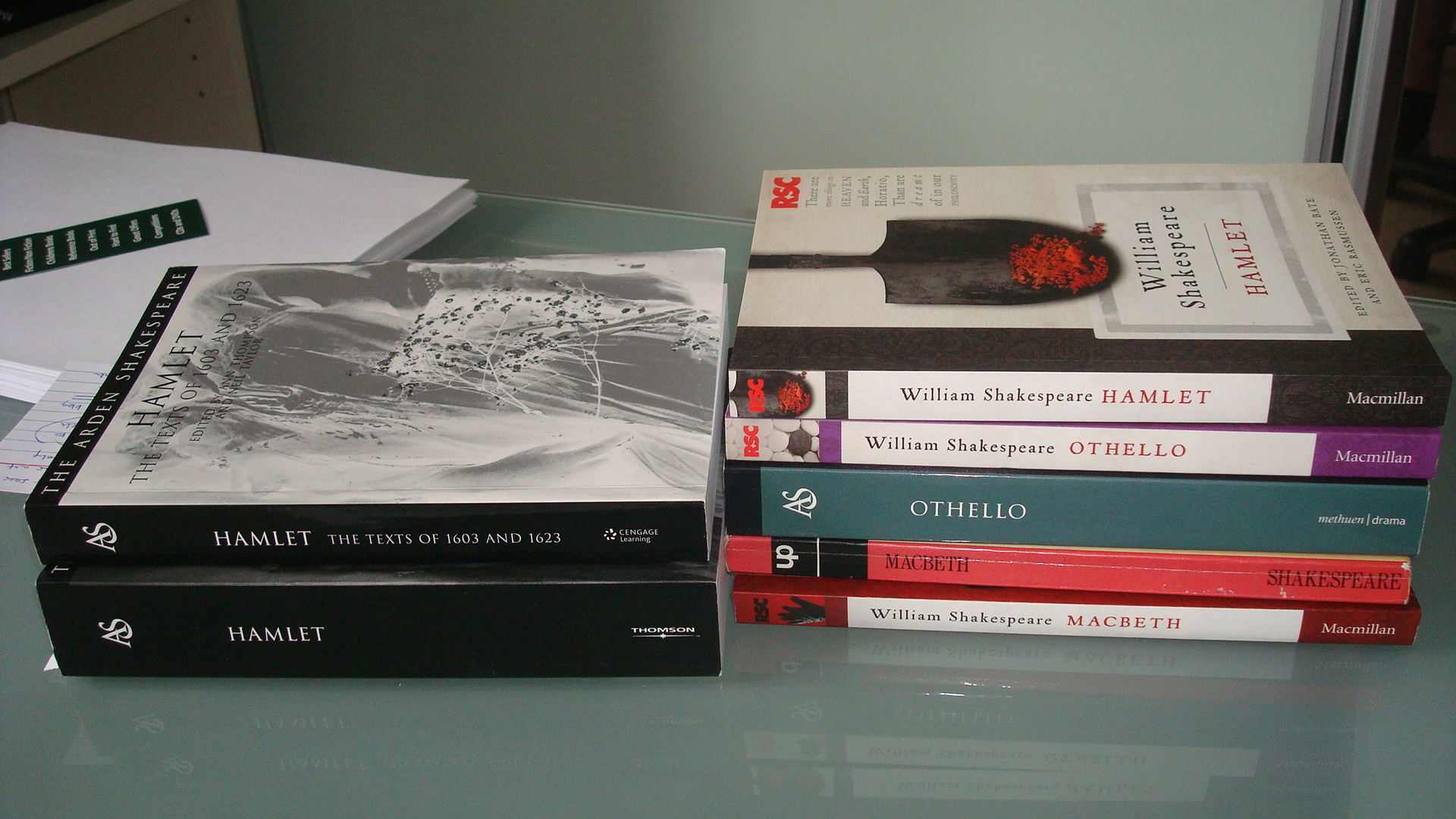
Recent Shakespeare reading

Working on my paper for Warwick in October. Hamlet, Macbeth and possibly something on Othello.

Posted in Shakespearean Territories, William Shakespeare | Tagged , , | Leave a comment

Open Access papers from Society and Space – Serres; Harman; Paglen; November, Camacho-Hübner & Latour; Doty, Adey & Bissell, Klauser, Blum & Secor, Woon, Brown & Rasmussen, Lisle…

Posted in Uncategorized | Leave a comment

European Integration and the Global Political Economy/Comparative European Politics prize

Prize for PhD students on European Integration and the Global Political Economy, with the journal Comparative European Politics – full details here.

Posted in Uncategorized | Leave a comment

‘How to Read Žižek’ by Adam Kotsko

In the Los Angeles Review of Books.

Posted in Slavoj Zizek | Leave a comment

London Group of Historical Geographers Seminar Series: Autumn 2012

Institute of Historical Research, University of London

Autumn 2012

 
TIME, MODERNITY & THE CITY

Guest Convenor: Mustafa Dikec

2 October 2012   James Nye (King¹s College, London)
 
The Tricky Business of Selling Time
 
16 October 2012           Peter Soppelsa (University of Oklahoma)
 
Stopping Time in Paris, 1830­1910
 
30 October 2012           Carlos Galvis (Royal Holloway, London)
 
Circles of Discontinuity: the Time of Railways and the Time of Cities, London & Paris 1860-1900
 
 13 November 2012        Charles Withers (University of Edinburgh)
 
The Prime Meridian, Metrology and the Internationalisation of Science, Space and Time

27 November 2012        Mustafa Dikeç (Royal Holloway, London)
 
Pumping Time: Temporal Infrastructures in Fin-de-siècle Paris
 
These seminars are held on Tuesdays at 5.15pm in the Torrington Room 104, South Block, Senate House, University of London (apart from 13 November when the venue is
Stewart House, STB8). For further details, or to have your name added to our e-mail list, please contact Felix Driver, Royal Holloway (f.driver@rhul.ac.uk) or Miles Ogborn, Queen Mary (m.j.ogborn@qmul.ac.uk). We are grateful to AHRC, Queen Mary, Royal Holloway, Kings, Birkbeck, UCL, LSE, University of Sussex, Open University and the IHR for supporting this seminar series.

Posted in Conferences | 2 Comments