Work for hire

I’ve just turned down an invitation to write for another one of those massive, multi-volume encyclopedias – this time a multi-disciplinary one. I’ve done a few pieces for such things, and I don’t really regret having done so. But I’ve done enough, and this time they wanted 5,000 words for a fee of $100. It would have been less offensive if they had not offered a fee really… Naturally for such a thing there is no chance of a complimentary copy – the cost to the libraries that buy it will be enormous.

$100 is about £64. I’d pay tax on that, but let’s forget that for a moment. The British minimum wage is £6.08 per hour. So if that was my bench-mark, I’d need to write the 5,000 words – including research, gathering up-to-date references, any reading, editing, and later dealing with revisions, queries, proofs, etc. – in 10.5 hours. That’s one and a half standard working days. Could I write this in that time? Unlikely, but even if I could it wouldn’t be very good, would be likely derivative and potentially ill-informed and under-referenced. I doubt I would enjoy doing it, and I’m not sure readers would benefit. For much academic publishing we generally make the argument that we are being paid a salary by our institution and that writing and reviewing is part of that role. Do I have that time spare within a standard working week? No, and if I did, then there are better things to do with it. It would be of just about zero-weight on the cv – not that this is a major consideration if other things apply – but I’m struggling to see what merit this has on any level. I’ve said ‘no’ – though rather more politely than in this post.

Posted in Publishing, Universities | 2 Comments

Thom Brooks on editing a journal

Forthcoming editorial of the Journal of Moral Philosophy (via The Brooks blog). As he says, much of this is relevant for other disciplines than his own. The beginning is largely about launching a journal, but the second half is about running one. Interesting to see this outlined by someone else.

My own experience, though similar in many respects, would differ on some important aspects. The majority of referees we approach decline (or fail to reply); and reports rarely point in the same direction. I don’t think authors necessarily understand the difficulty in obtaining reports, and why it can therefore take so long to get back to them with a decision. We label reports by letter, so the first three requests are to Referee A, B and C. If you get a paper back with a decision and reports from Referees E, G, and M, you can get a sense of why it took a while! I wrote more about this in an editorial for Society and Space a few years back.

Posted in Publishing, Society and Space | Leave a comment

Klaus Dodds on ‘very short introductions’. There is also one on ‘Borders’ forthcoming by Alexander C. Diener and Joshua Hagen
http://ukcatalogue.oup.com/product/9780199731503.do

Posted in Uncategorized | Leave a comment

Slavoj Žižek’s response to the campaign against Syriza

Go to the post and scroll down to see details of the launch event for Less than Nothing this Friday-Saturday

E's avatarGreek Left Review

The campaign against SYRIZA in the days before elections is getting nastier and nastier – since our enemies control the big media, they can permit themselves direct lies, knowing that our answer cannot reach the same wide public. They feel free to project onto us all their secret obscene dreams and wishes, up to the threat of a police terror.

But we should stay calm. Our critics hate us because, secretly, they know we have the courage to act as free people. When we are in the eyes of the public, those who observe us understand, for the flash of an instant, that we are offering them freedom, dignity and solidarity. For that instant, our critics are free, they feel one with us, but it is only a moment; fear returns and they hate us again because, in their spirit, they are slaves afraid of their own freedom.

There is…

View original post 558 more words

Posted in Conferences, Events, Politics, Slavoj Zizek | Leave a comment

Posted in Uncategorized | Leave a comment

Hardt and Negri declaration

This is not a mani­festo. Mani­fes­tos provide a glimpse of a world to come and also call into being the sub­ject, who although now only a specter must mater­i­al­ize to become the agent of change. Mani­fes­tos work like the ancient proph­ets, who by the power of their vis­ion cre­ate their own people. Today’s social move­ments have reversed the order, mak­ing mani­fes­tos and proph­ets obsol­ete. Agents of change have already des­cen­ded into the streets and occu­pied city squares, not only threat­en­ing and top­pling rulers but also con­jur­ing vis­ions of a new world. More import­ant, per­haps, the mul­ti­tudes, through their logics and prac­tices, their slo­gans and desires, have declared a new set of prin­ciples and truths. How can their declar­a­tion become the basis for con­sti­tut­ing a new and sus­tain­able soci­ety? How can those prin­ciples and truths guide us in rein­vent­ing how we relate to each other and our world? In their rebel­lion, the mul­ti­tudes must dis­cover the pas­sage from declar­a­tion to constitution. [continues]

Posted in Antonio Negri, Michael Hardt, Politics | Leave a comment

Les fabriques des “géographies” – Making academic geographies in Europe

Geographica Helvetica Symposium

Les fabriques des “géographies” – Making academic geographies in Europe

19 October 2012 ; Fribourg, Switzerland

The conference marks the re-launching of Geographica Helvetica (the Swiss Journal of Geography)

Conference Organisers: Benedikt Korf (Zürich), Ola Söderström & Francisco Klauser (both Neuchâtel)

Human geography in Europe is still shaped by so-called “national” – or “language-based” traditions, such as Francophone or “deutschsprachige” geography. Even within Anglo-American geography, we can detect nuances between British and US geographies. These various traditions have emerged from very specific national genealogies of the discipline, which has been shaped by specific philosophical thought traditions, traditions of practicing social sciences and academic writing. These genealogies shape present-day practices of young and established scholars in these different academic spaces. In our view, this is not a problem, but a source of richness. While there is a drive towards internationalization, which largely means Anglo-Americanization, this richness of thought traditions should be saved rather than buried. [more here]

Posted in Conferences, Geographica Helvetica | Leave a comment

William Walters, Governmentality

Just out with Routledge, a short book entitled Governmentality: Critical Encounters. Impressive back cover endorsements from Thomas Lemke, Barry Hindess, Wendy Brown, Marieke de Goede and Grahame Thompson.

It’s not quite a textbook, but I think it would work well for students. Much of it provides a good survey of the state of the field. I thought the connection to politics and international relations debates was good, as was that of postcolonial studies (making use of Stephen Legg’s work) and there were some useful references to follow up. I liked the final chapter linking governmentality to genealogy, suggesting that additional work in this register would be useful. More might have been done with the collaborative projects Foucault was involved with in the 1970s that explored a number of governmental strategies; or the work of his colleagues that developed these themes – some of which are glimpsed in The Foucault Effect. Much of the key material for an exploration of this is unfortunately not available in English – much is not even published in French. The book is a good way into work on this topic – to sit alongside Thomas Lemke’s work and that of Mitchell Dean.

Posted in Michel Foucault | 3 Comments

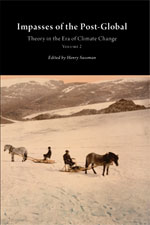
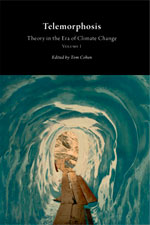
Critical Climate Change

Intriguing new series of books from Open Humanities Press. Details here.

Open Humanities Press is pleased to launch a new series in literary and cultural theory published in conjunction with the University of Michigan Library’s Scholarly Publishing Office. Each Critical Climate Change book will be freely available as an electronic book (open access) and as reasonably priced paperbacks.

The era of climate change involves the mutation of systems beyond 20th century anthropomorphic models and has stood, until recently, outside representation or address. Understood in a broad and critical sense, climate change concerns material agencies that impact on biomass and energy, erased borders and microbial invention, geological and nanographic time, and extinction events. The possibility of extinction has always been a latent figure in textual production and archives; but the current sense of depletion, decay, mutation and exhaustion calls for new modes of address, new styles of publishing and authoring, and new formats and speeds of distribution. As the pressures and re-alignments of this re-arrangement occur, so must the critical languages and conceptual templates, political premises and definitions of ‘life.’ There is a particular need to publish in timely fashion experimental monographs that redefine the boundaries of disciplinary fields, rhetorical invasions, the interface of conceptual and scientific languages, and geomorphic and geopolitical interventions. Critical Climate Change is oriented, in this general manner, toward the epistemo-political mutations that correspond to the temporalities of terrestrial mutation.

Posted in Books, Politics, Publishing | Leave a comment

Derek Gregory – Supplying war in Afghanistan: the frictions of distance

At the Open Democracy website.

Pakistan has said NATO’s supply convoys can cross the Afghan border so long as America’s drones do not. Though the expanded use of cyberwarfare, covert special forces and drones is designed to overcome the frictional problems of waging war from a distance, logistics still matter. The world is not flat – even for the US military.

Posted in Derek Gregory, Politics | Leave a comment