Siad's avatarsiadjnu

Essays and Analysis

Jason Adams, Williams College, Political Science: “Occupy Time”

Emily Brissette, University of California Berkeley, Sociology: “For the Fracture of Good Order: On “Violence” at Occupy Oakland”

Craig Calhoun, New York University, Sociology: “Evicting the Public: Why has occupying public space led to such heavy-handed repression”

Mike Davis, University of California Riverside, Creative Writing: “No More Bubble Gum”

Gaston Gordillo, University of British Columbia, Anthropology: “The Human Chain as a Non-Violent Weapon”

David Graeber, Goldsmiths University of London, Anthropology: “Occupy Wall Streets Anarchist Roots”

Claude Fischer, University of California Berkeley, Sociology: “Occupy! Now What?”

Michael Hardt (Duke University, Literature) and Antonio Negri (European Graduate School): “The Fight for ‘Real Democracy’ at the Heart of Occupy Wall Street”

David Harvey, The City University of New York, Anthropology: “The Party of Wall Street Meets its Nemesis”

Chris Herring (University of California Berkeley, Sociology) and Zoltan Gluck (City University of…

View original post 430 more words

Posted in Uncategorized | Leave a comment

Border Walls – Reece Jones

Forthcoming in July with Zed books. At the Zed books blog, Reece discusses 10 years of the Israeli wall in the West Bank.

Here’s the blurb on the book:

Two decades after the fall of the Berlin Wall, why are leading democracies like the United States, India and Israel building massive walls and fences on their borders? Despite predictions of a borderless world through globalization, these three countries alone have built an astonishing combined total of 5,700 kilometers of security barriers. In this groundbreaking work, Reece Jones analyzes how these controversial border security projects were justified in their respective countries, what consequences these physical barriers have on the lives of those living in these newly securitized spaces, and what long-term effects the hardening of political borders will have in these societies and globally.
Border Walls is a bold, important intervention that demonstrates that the exclusion and violence necessary to secure the borders of the modern state often undermine the very ideals of freedom and democracy they are meant to protect.

Posted in Boundaries, Politics, Territory | 2 Comments

John Gray on Žižek in the New York Review of Books

On Less than Nothing and Living in the End Times – here.

Posted in Slavoj Zizek | Tagged | 1 Comment

Balibar and Mezzadra at the Tate Modern – topology and borders

Videos of Etienne Balibar and Sandro Mezzadra on topology and borders. Via Joshua Kurz’s Being-in-Exodus blog.

Posted in Boundaries, Conferences, Etienne Balibar | Tagged , , , , | Leave a comment

Bruno Latour on his new project

Bruno Latour on his new project.

PE's avatarANTHEM

For his “An Inquiry Into Modes of Existence” project:

For a philosophy that is empirical and not simply empiricist, investigation offers the only way to ferret out its concepts and then put them to the test before proposing a version that can be submitted to critique by its peers. And yet, even though investigation as a genre benefits from a distinguished and intimidating prestige in philosophy, it is fairly unusual for an author to propose to carry out an investigation with the participation of his readers. This is nevertheless what I propose to do in publishing a book titled An Inquiry into Modes of Existence: An Anthropology of the Moderns, alongside a digital site that allows its visitors, who will have become co-investigators, to inspect its arguments and go on to suggest other fields to study, other proofs, other accounts. By means of this arrangement I invite my co-investigators…

View original post 69 more words

Posted in Bruno Latour | Leave a comment

Badiou – Mathematics of the Transcendental

Continuum have a page up for Badiou’s forthcoming Mathematics of the Transcendental: Onto-logy and being-there.

In Mathematics of the Transcendental, Alain Badiou painstakingly works through the pertinent aspects of Category Theory, demonstrating their internal logic and veracity, their derivation and distinction from Set Theory, and the ‘thinking of being’. In doing so he sets out the basic onto-logical requirements of his greater and transcendental logics as articulated in his magnum opus, Logics of Worlds. This important book combines both his elaboration of the disjunctive synthesis between ontology and onto-logy (the discourses of being as such and being-appearing) from the perspective of Category Theory and the categorial basis of his philosophical conception of ‘being there’.
Hitherto unpublished in either French or English, Mathematics of the Transcendental provides Badiou’s readers with a much-needed complete elaboration of his understanding and use of Category Theory. The book is an essential aid to understanding the mathematical and logical basis of his theory of appearing as elaborated in Logics of Worlds and other works and is essential reading for his many followers.
Posted in Alain Badiou | Leave a comment

The Birth of Territory – final revisions

Over the past several weeks I’ve been working hard on the final stages of revision of The Birth of Territory manuscript. Some of this has been responding to referee reports; some to my own thoughts on returning to the manuscript after almost nine months of distance (the time it took to get all three reader reports); references to a few pieces of good secondary literature to appear in the meantime; and a few other minor things I spotted along the way.

I finally tracked down some of the last references, though a few books I had on my ‘to read’ list eluded me. At this stage if the books are not in a northern English university library, the British Library, the Warburg Institute or any other London libraries and an inter-library loan can’t get them then I’m going to have to admit defeat. This is only a few pieces of secondary literature I’d have liked to have looked at. But I think I can say I managed to avoid any ‘X cited by Y’ type references where I have not checked X myself.
There are a few strange elements of this stage of a book. This is a book that has material I first drafted in 2000 and 2001, and so much of this book I’ve lived with for over a decade. There is a strange sense of finality and a difficulty in letting go. But on the other hand, new sentences or formulations I add now will appear – to the reader – to be the same as material written years ago. And while I’ve thought about, and in many cases spoken about, those earlier elements, the new bits are untested and appear raw. The trick will be – and long has been – to try to smooth all this over and ensure no-one else can see the joins. I was also struck, especially in the notes, at just how much work was embedded in this book. I had to keep the length to 200,000 words inclusive which took a bit of editing – at its longest this book was almost 250,000 words.

It’s also been a lot of work with images. Getting good quality images to have scanned or photographed is one element. For example, Durham has three first editions of Hobbes’s Leviathan, from which I wanted to include the iconic frontispiece. It’s surprising how poor-quality most reproductions of this are, especially for the bottom half. All of these books had to come from the stores of the special collection. The first two had damaged images, and were no use at all. They couldn’t bring me the third one as it was being lent out for an exhibition. I explained the reason I needed it, and they enquired a bit further, fortunately discovering it was actually awaiting repair before it went to the exhibition. They were able to locate it, brought it to me and the frontispiece was near perfect. They kindly agreed to have the image photographed before it went back to repair.

Most of the images in the book are of things that are out of copyright, but the photographs of them often are not. So Hans Holbein’s Ambassadors, for instance, is claimed by the National Gallery, especially if you want a high-quality reproduction of it. And the costs of getting permission to use that can be quite expensive. The cost can sometimes be waived for academic purposes, but electronic editions bring it back. I had to drop a couple I wanted but couldn’t get permission for. This is a complicated business and I have to hope that the dossier of information I put together will be sufficient.

I also had to clear permission to reuse material I had previously published. Very little of this book falls into this category – I estimate maybe 10% – but it required contact with four journals. Fortunately this was reasonably straight-forward, but it’s more a case of documenting things for the press so they know there will be no later problems.
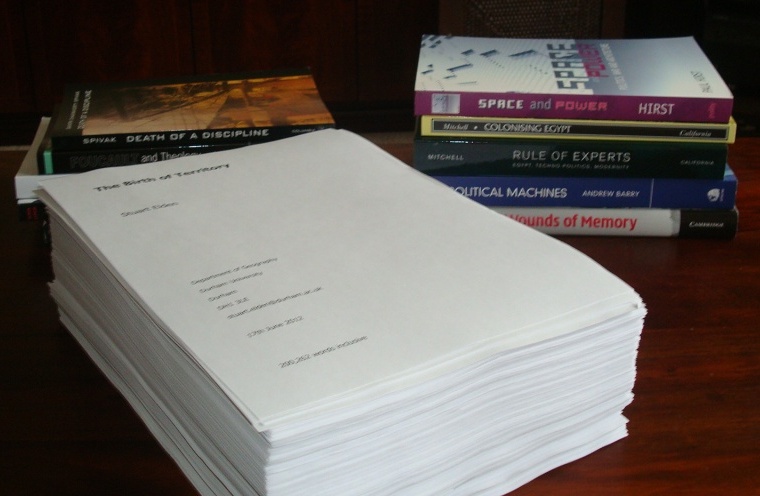
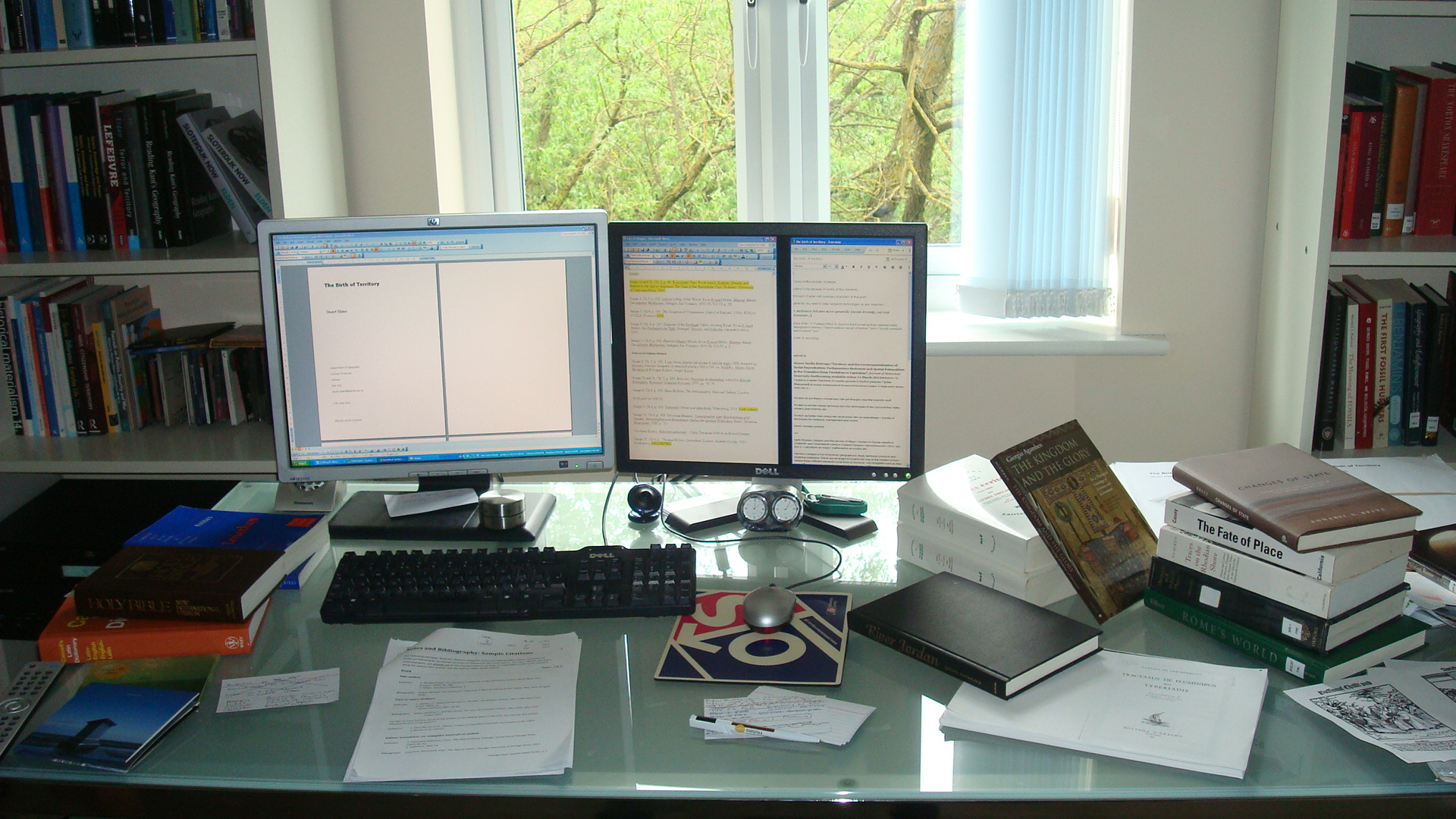
I’m now at the stage where I have printed the entire manuscript for one final read through on paper. The top photo is of that manuscript. The bottom one the state of my desk as I completed the last few changes today.

Posted in My Publications, Publishing, The Birth of Territory | Leave a comment

Sloterdijk at the Tate

Went to the Sloterdijk talk at the Tate yesterday. Nigel Thrift unfortunately couldn’t be there, so his place was taken by his Warwick colleague Ralf Rogowski. Rogowski gave an introduction and then Sloterdijk gave a talk. It was billed as more of a conversation than it actually was – Sloterdijk gave a very good introduction to and overview of his Spheres project, and then moved to reading a lecture that he said had been translated for him. The lecture was on ‘Spatialised Immunity’ and related to a number of themes in Spheres. I thought he was much better and more engaging when off script, and spoke for a long time. Rogowski then asked a few questions, and took a few from the audience. As he was when I’ve seen him speak before Sloterdijk didn’t always answer the questions, but he was usually interesting in replying to them.  The event was filmed and we were told it would be put up on youtube soon. I’ll link to it when it is.

The room was full – completely sold out according to the organizers. It was a large lecture room – maybe seating 250 people – and given tickets were £15 this would seem to indicate there is a lot of interest in his work. He spoke a little bit about now being part of British debates at the beginning of his remarks.

Posted in Conferences, Peter Sloterdijk | 2 Comments

Michael Mann – Sources of Social Power volumes 3 and 4

Volume 3: Global Empires and Revolution, 1890–1945 and 4: Globalizations, 1945–2011  of Michael Mann’s magisterial The Sources of Social Power are listed for late this year. The last volume appeared in 1993, so it’s been a long wait – not that Mann has been exactly quiet in the meantime, with huge books on Fascists, The Dark Side of Democracy, Incoherent Empire etc.

Volumes 1: A History of Power from the Beginning to AD 1760 and 2: The Rise of Classes and Nation-States, 1760–1914 are also being reissued in a second edition.

Thanks to Nick Srnicek for the alert.

Posted in Michael Mann | Leave a comment

Posted in Uncategorized | Leave a comment