
New College for the Humanities

A.C. Grayling’s proposed New College for the Humanities has a website here. For those who haven’t yet heard the news, it will charge £18,000 per year, have a list of 14 ‘star’ academics who will be involved in teaching to some extent, but a larger number of more junior people doing the bulk of the actual education. From the founding statement:-

The humanities provide personal enrichment, intellectual training, breadth of vision, and the well-informed, sharply questioning cast of mind needed for success in this complex and competitive world.

Funny how ‘enrichment’ is the first thing it will provide; and who told them that a picture of Grayling was the best thing to have on the website? This is a very worrying development, and there is opposition already being mobilised.

Nina Power is already on the case providing a critique and lots of links to discussions and counter-movements. See her Infinite Thought blog. Mary Beard also discusses why it will be different from Oxbridge here. And there is a discussion at Brian Leiter’s blog here.

Update 12.45: Crooked Timber asks a good question here.
Posted in Politics, Universities | Leave a comment

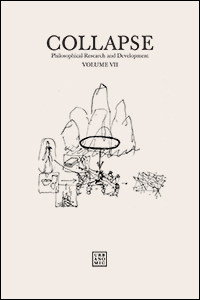
Collapse VII: Culinary Materialism

Collapse VII: Culinary Materialism is now available for advance ordering,
publication due July 1st. Details here. You can also download the intro free.

Posted in Uncategorized | Leave a comment

The Foucault Effect conference

The Foucault Effect 1991-2011 conference held over the last couple of days was very good. The room was packed for the opening session on Friday evening, and then a good audience throughout Saturday.

The first session included Daniel Defert on the 1970-71 Leçons sur la volonté de savoir(see my earlier thoughts here); Colin Gordon offering a retrospective and prospective look at governmentality studies; and Maria Carolina Olarte and Peter Fitzpatrick on Foucault and the death penalty. All good though Defert’s insights into a course few would have yet read were especially well received. My discussant comments – quite brief given the time – seemed to go down well and there was a good q&a afterwards. After one question I briefly outlined the ‘history of The History of Sexuality‘ project I hope to turn into a book, and I had a good follow-up conversation with Defert about this later.

There were four sessions on Saturday, with two papers in each. Some of the pairings could have been different but it did mean conversations worked between sessions rather than just within them. Bernard Harcourt and Jonathan Simon gave excellent presentations on mass incarceration in the US, which were both deeply disturbing. Fabienne Brion gave a really insightful discussion of the 1981 Louvain ‘Mal faire, dire vrai’ lectures that she and Harcourt have edited (they will be out in French in the autumn and English in the spring. The French will come with a DVD of Foucault delivering the lectures). Graham Burchell and Paul Patton both talked about the 1979 Birth of Biopolitics lectures; Burchell drawing out what Foucault said about Italy and the resources in that work to take the analysis further; Patton offered an intriguing and surprising juxtaposition of Foucault with John Rawls. Ben Golder gave a very careful discussion of Foucault and rights; Peter Miller discussed the calculating self; and Giovanna Procacci talked about security.

Thanks to Patrick Hanafin, Colin Gordon and Peter Fitzpatrick for organising this, and for asking me to be involved. The proceedings were taped and should be available soon here. There will hopefully also be a book.

Update 12th June 2011: the audio can now be found here

Posted in Conferences, Michel Foucault | 3 Comments

William Connolly workshop audio files

The audio files of the conference on A World of Becoming held last week are now available here, including Connolly’s own closing lecture. My own talk is here, along with the powerpoint slides of the full quotes from Connolly’s book.

Posted in Conferences, The Space of the World, William E Connolly | Leave a comment

Lefebvre on the State

When we were putting together State, Space, World, Neil Brenner and I discussed many texts for inclusion. We couldn’t include everything, due to space considerations, and hopefully some of the texts that didn’t make that volume will be in a future one. But one text we really wanted to include, and actually had in the version submitted to University of Minnesota Press, had to be removed for copyright reasons.

It’s a one page outline of a presentation Lefebvre was going to give in 1979.

The translation made by Gerald Moore and reworked by Neil and me, along with a brief intro and notes, can be found here. A document of minor, but hopefully some, interest.

Posted in Henri Lefebvre, Neil Brenner | Leave a comment

Australian ERA journal ranking scrapped

When I was out in Australia the journal rankings of their ERA system was regularly discussed. It had some strange category mistakes and extremely arbitrary elements, as well as being deeply problematic in general principle. But now the letter ranking has been scrapped. News here, here and here.

Posted in Politics, Universities | Leave a comment

Colin Gordon on Foucault’s 70-71 lectures

Colin Gordon, editor of Foucault’s Power/Knowledge and one of the editors of The Foucault Effect sent me these comments for posting:

Stuart, Thanks for mentioning the event and agreeing to take part, and I agree with your comments on the new Foucault volume. It’s become clear that every new Foucault publication – and there are a number still to come – will surprise us, have stuff in it we didn’t know about, and change our picture of his entire project. I think the 70-1 lectures are going to take a while to digest, for me at least. I have heard a couple of senior Oxford philosophers fulminating decades later about the terrible things they heard Foucault say at McGill – now we can find ou why. This was 70-71, the time of the GP and GIP – there is a political context present in these surprising discussions of class struggle and the origins of law in ancient Greece … I think we willl have a rich discussion at Birkbeck graced by the presence of major writers on the issues of penal justice today. We’ll have the editors of the newest lecture publications to explain what these, as well as the now well-known governmentality materials, say to the present of 2011… a few days after Jonathan Simon’s blog has reported what a US judge calls ‘perhaps the most radical injunction issued by a court in our Nation’s history’.

Posted in Conferences, Michel Foucault | 1 Comment

Roundup

Bryan Magee’s TV interviews on philosophy are now available on You Tube here (via Leiter Reports). These interviews were collected as The Great Philosophers: An Introduction to Western Philosophy which was one of the first books on philosophy I read, but good to have the videos easily available – Nussbaum, Ayer, Dreyfus, Searle, Singer, et. al.

Speaking of Singer, and books of philosophy I read a long time ago… Singer describes Derek Parfit’s new book On What Matters as “the most significant work in ethics since Sidgwick’s masterpiece was published in 1873 … a work of epic proportions and ambitions”. Two volumes and 1,440 pages! I read Parfit’s On Reasons and Persons back in the 1990s but remember almost nothing. Thanks to Clive at Pop Theory for the alert.

Over at the Society and Space blog, Alex Jeffrey of Newcastle University writes about the recent arrest of Ratko Mladić in a piece on “Haematological Narratives of Violence”. Alex had a piece in Society and Space in 2009 entitled “Justice incomplete: Radovan Karađžic, the ICTY and the spaces of international law“, which we have made open access to link to this piece.

Posted in Derek Parfit, Politics, Society and Space | Leave a comment

Justin Smith – Divine Machines: Leibniz and the Sciences of Life

I’ve been looking forward to Justin Smith’s Divine Machines book on Leibniz for a while. I previously mentioned it here in relation to Glenn Hartz’s book Leibniz’s Final System: Monads, Matter, Animals; and also provided a link when John Protevi interviewed Smith. (See also Smith’s blog here.)

I’ve now read the book, and it doesn’t disappoint. Seven chapters on different aspects of Leibniz’s engagement with natural philosophy – medicine, animals, organic bodies (two chapters), divine preformation, games of nature, and biological species. Five appendices which translate short texts of Leibniz. Along the way there are discussions of Leibniz’s interest in alchemy, orang utans, race, machines, deformed goats, vivisection, warrior slaves, and bodily fluids… “One would not expect to learn much about a philosopher’s broader concerns from his preoccupation with vomit, yet here, as elsewhere, Leibniz surprises us” (p. 34).

It’s a valuable correction to views of Leibniz as a rationalist, stressing his empiricism (i.e. p. 17); and as an idealist, demonstrating his realism (i.e. pp. 101-2). There is a good point made about his ‘philosophy of biology’ – Smith notes that it is both everywhere and nowhere in the book, because Leibniz would not have distinguished  between his studies of “for example, anatomy and embryology on the one hand, and on the other his deeper philosophical interests in the metaphysics of corporeal substance, the ontology of species, and such” (p. 20). I was most interested in Chapter Six, which has some good discussion of fossils and the Protogaea more generally.

Smith has some good references including Pauline Phemister, Leibniz and the Natural World, which looks particularly good, though shame about the ridiculous price even as paperback and e-book (see Smith’s review here) and Daniel Garber’s Leibniz: Body, Substance, Monad (due out in paperback shortly). Smith, Phemister and Garber would make a good review essay.

Posted in Fossils, Gottfried Leibniz | 4 Comments

Territorial Masquerades

Interesting newish blog called Territorial Masquerades by an anonymous political geographer . Mainly notes from reading so far. There are discussions of Lefebvre’s State, Space, World and the Space, Knowledge and Power: Foucault and Geography collection I co-edited, along with lots of other interesting material.

Posted in Henri Lefebvre, Michel Foucault, Territory | 1 Comment