Leaving Seattle with a better draft

Time to leave Seattle. It’s been a good, but busy, six weeks. I had great side trips to Vancouver (twice), Victoria, Eugene, and Columbus. University of Washington has a great geography department and it’s been good to get to know people here – as well as some well-known faculty they have some particularly impressive graduate students.

I came with a draft of the book’s chapters; I leave with a better draft of each chapter. I’ve just put all the chapters into a single word file, along with the Rousseau ‘frame’ I’ve been using to begin and end recent lectures. That’s a bit less than I think will be in the real introduction, which I expect will be a version of the ‘Land, Terrain, Territory’ piece, and I have a stack of notes for the coda. So there is still quite a lot I need to do. But it would now just about work as a book from start to finish, which is an important stage. I’ve trimmed about 10,000 words out in this draft, but single spaced at 12 point it’s still 464 pages.

While I could keep reading things for this book for ever, and still have a bunch of things I’d like to look at, I’m now down to only six references that are incomplete in what I have: one each to Boethius, Hostiensis, Baldus and Bartolus and two to Innocent IV.

Back to London tomorrow, and then driving to York, if weather permits…

Posted in The Birth of Territory, Travel, Universities | Leave a comment

UCLA conference streaming

Today’s conference at UCLA (details here) is being streamed live on the Ecology without Nature site. Starts in just over an hour – 10.30 local time.

Posted in Conferences | Leave a comment

The Birth of Territory – Chapter Updates

These are the links to the chapter updates I’ve been posting as I’ve worked through this redraft. Reading the posts through would give a pretty good idea of what’s in the book, as well as some of the issues I faced in writing and particularly in revising the chapters.

Chapter One

Chapter Two

Chapter Three

Chapter Four  

Chapter Five

Chapter Six

Chapter Seven

Chapter Eight

Chapter Nine

Posted in The Birth of Territory | 1 Comment

Chapter Nine

Chapter Nine is now done. This is the last chapter of the book, which means I’ve now worked through all the chapters in the revision I’ve done while in Seattle. I leave tomorrow. I’ve posted quite a bit about this chapter before (i.e. here, here and here), since I wrote it between May and October this year, when I was already doing this blog.

Basically the chapter is on the seventeenth century. It begins with a section I call ‘The Consolidation of the Reformation’ which looks at Hooker, Althusius, Zasius, Stephani, Knichen, Bacon, and ‘Walter Ralegh’ (actually the focus is a text probably not by him). There is then a section on the relation between the scientific revolution and politics – Descartes, a brief backtrack to Copernicus, Galileo, and Cusa, a little on Hobbes, some on Spinoza, Boulainviller, Newton and Leibniz. There is then a fuller discussion of Hobbes, Filmer and Locke, plus a bit on Neville and Harrington. I’ve ended up dropping the discussion of George Lawson down to a single footnote, and removed most of the discussion of Hobbes’s reading of Cardinal Bellarmine. Throughout I try to historically and geographically situate these writers and the debates.  The final section is principally on struggles within the Empire, looking at Reinking, von Chemnitz, the Westphalia treaties, Pufendorf, and Leibniz again.

Most of the relatively minor work on this revision was cutting some of the lengthy quotes from these writers down to try to tighten up the argument. The notes were in good shape: I was keen not to leave things in this chapter undone before I left London.

Posted in Andreas Knichen, Bogislaw Philipp von Chemnitz, George Lawson, Gottfried Leibniz, Henri de Boulainviller, Isaac Newton, James Harrington, Johannes Althusius, John Locke, Matthias Stephani, Nicholas of Cusa, René Descartes, Robert Filmer, Samuel Pufendorf, The Birth of Territory, Theodor Reinking, Thomas Hobbes, Udalricus Zasius, Walter Ralegh | 1 Comment

Leibniz, fossils, unicorns and the mammoth

While working on Chapter Nine, I wrote a review of Leibniz’s Protogaea for Society and Space. It’s a fascinating book, in a very good bi-lingual edition, with some striking illustrations. Particularly interesting for the discussion of fossils, which is something I’m going to be looking at for my next book. It’s very interesting to see how Leibniz used empirical evidence as the basis for his theories about the earth. There are some errors, of course, including the attempt at reconstructing the skeleton of a unicorn, but it’s a striking piece of work for the late 17th century. Leibniz talks of the ‘new science of natural geography’, and it’s not over inflated – he really does have a lot to say to discussions in geography and history, alongside his better known work on mathematics and metaphysics. There are all sorts of interesting linkages to his work on the mines in the Harz mountains and his massive history of the Brunswick family for the Dukes of Hanover.

One of the translators, Claudine Cohen, had an excellent book of her own translated and published by Chicago a few years ago. Entitled The Fate of the Mammoth, chapter three is on “Leibniz’s Unicorn”. She notes that the book is not really about the mammoth, but rather about a whole range of issues in the history of science and objects, for which the mammoth is the way in. It’s a great book, again very nicely produced. I’m sure I’ll return to this next year too.

Posted in Fossils, Gottfried Leibniz, Society and Space, The Space of the World | 2 Comments

Bi-lingual German philosophy texts

Thanks to Enowning for alerting me to this site – bilingual pdfs of some major works of German thought, including Kant, Hegel, Nietzsche, Freud, and Heidegger. An enormous amount of work here. If you want to check if it is Ursprung, Herkunft or Entstehung; Geschichte or Historie; Dasein or Da-sein this would be a helpful place to look…

Posted in Friedrich Nietzsche, Georg Wilhelm Friedrich Hegel, Immanuel Kant, Martin Heidegger | Leave a comment

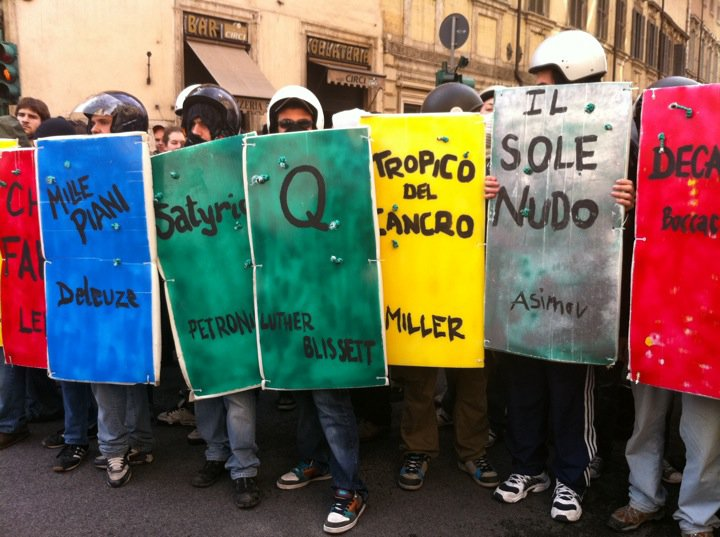
Literary protests – image from Wu Ming

Wu Ming kindly sent me a link to a better picture of the literary themed protests.

Posted in Politics, Universities, Wu Ming | 1 Comment

review of State, Space, World

There is a brief review of the Lefebvre collection State, Space, World in the new issue of Contemporary Sociology. Although the book has been out for eighteen months, this is the first review to be published to my knowledge (leaving aside a few things on websites).

Lefebvre combined an urbane realism with sociological awareness, along with a dedication to the sanest aspects of the Marxist tradition, that still makes him uniquely valuable… Originating mostly from the 70s, this essay collection covers virtually every aspect of spatiality and state-formation that one would need to know about as a sociologist, plus essays on Kostas Axelos and revolutions. It is not a simple introduction to an important thinker’s ideas, but rather a useful corollary to his earlier works in English—most of which are themselves in need of rediscovery by a new generation of urban and political theorists.


Posted in Books, Henri Lefebvre, Neil Brenner | Leave a comment

Student Protests – K-Punk on the media; Wu Ming on the literature

K-Punk offers a sharp analysis of last week’s events here, along with some good discussion of the mainstream media’s take on it all. I particularly enjoyed this line:

It looks as if the situation might be starting to dawn on Clegg, who increasingly has the cheated and desperate look of a man who has sold his soul to the devil at the very moment the devil went out of business.

Wu Ming offer a reading of the literature of the struggle in Italy here.

It could be interesting to look closely at the classics the students chose to put on their shields. Let’s look at the frontline.
Boccaccio’s Decameron, which is about people sharing stories while waiting for the plague to end.
Asimov’s The Naked Sun, which is the description of a world where humans no longer touch each other.
Melville’s Moby Dick, which is an epic tale of obsession.
Cervantes’ Don Quixote, ie the story of a proud, noble man led astray by an obsolete ideology (the chivalrous one).
Petronius’ Satyricon, that is, the description of a greedy, decadent power.
Henry Miller’s Tropic of Cancer, that is, a piece of «auto-fiction», a scandalous mix of autobiography and fiction.
Lenin’s What Is To Be Is To Be Done?, which deals with the problem of organization.
Deleuze & Guattari’s
A Thousand Plateaux, that is, the theme of nomadism, the nomadic war machine… (continues)

In an earlier post they gave us an image of the shields – they don’t quite match the list above – but it includes Plato’s Republic, Machiavelli’s The Prince and their own Q (under the earlier ‘Luther Blissett’ identity).


Posted in Politics, Uncategorized, Universities, Wu Ming | 2 Comments

Roundup – WW2 maps, Right-Badiouians, and the End of the World

At his Open Geography blog, Jeremy Crampton mentions an interesting GSU magazine story on his research on the history and politics of maps here 

Graham Harman engages with some criticisms of object-orientated philosophy here, and ends with an interesting suggestion about the relation of politics and philosophy:

I’ll never be fully convinced about Badiou until we see the emergence of Right Badiouians just as we’ve seen Left Heideggerians and Left Nietzscheans. (And I’m afraid my “wager” is that it’s not going to happen. Too many people are drawn to Badiou because they find his explicit political content appealing. Which is fine, but it’s not a strictly philosophical commitment. It’s Badiou as use-value.)

Until the other side of the political aisle finds some use for you, I’m not yet convinced that what you’ve done is entirely philosophical. Philosophy is not the handmaid of Leftism (or Conservatism) any more than of theology– or of natural science. You know you’ve reached a philosophical insight when you stumble across an idea that flatters no discipline and no Party.

And Alessandro Scafi is giving at talk at at Durham on ‘Apocalypses in Medieval and Renaissance Cartography’ – details here

Depictions of apocalypse – understood as revelation and/or the end of the world, in both religious and secular discourses – serve a variety of functions, ranging from the political to the scientific, and the theological to the anthropological. They can reinforce or subvert power structures, interrogate what it is to be human, and figure the future in order to reflect on the present.

This interdisciplinary seminar series brings together experts from a number of disciplines to reflect on two intertwined themes. The first explores the functions served by end-of-world narratives and pictures, that is, it focuses on why apocalyptic stories are told rather than on what particular stories are told. The second analyses the ways in which the apocalyptic is characterized by a relationship with particular sorts of form, language and image, for example, metaphors and fictions, pictures, performances, and poems.

Intellectual and art historians, when dealing with the medieval iconography of the Last Things, do not seem to have paid much attention to world maps. The end of the world is depicted or alluded to on medieval maps in different ways. The visual imagery offered by cartographic material sheds light on the complex conception of time and space that developed in medieval Christianity.

Posted in Alain Badiou, Graham Harman, Jeremy Crampton, Medieval Studies, Politics | Leave a comment