
I-Perception

The publisher of Society and Space, Pion, is a small independent operation – something that is increasingly rare. I was speaking to them about the article based publishing model I discussed a few posts back, and they told me they are doing just this for a new journal called i-Perception. Perception is a journal Pion have been publishing for many years, and i-Perception is an open-access twin journal – same editorial team, but different publishing model. There is an editorial explaining things here.
Posted in Publishing | Leave a comment

Really Blind Review

The comments following the post on referee etiquette on the Leiter Report blog are worth reading.

One theme in particular is worth reflecting on. Would the process of double blind review – referees don’t know the author; authors don’t know their referees – be improved by editors not knowing whose papers had been submitted? Either by manuscript handling software, or by people acting as journal managers or administrators, it would be possible to make that stage of the process anonymous.

The positive reason that it would take away any bias editors might have in the process – presumably things like picking perceived soft or hard referees, how they handle conflicting reports, what decision they make, what they ask of the authors, etc.

But there are downsides as well.

– In selecting referees we avoid author’s colleagues, research collaborators, known friends, etc. This is much harder if the author is not known and these names are entered into a machine. I wonder how many times, working blind, we would pick the author of a paper to review their own work? A person doing the role of administrator could catch some – such as colleagues – but by no means all of the referees we might chose not to use if we knew author identity. There is an lot of editor knowledge that would be lost this way.

– Authors would then not be able to have any contact directly with the editor. Initial queries about potential papers, suitability, encouraging people at conferences to send their work to the journal, etc. – all would need to be prohibited.

– Just as referees can sometimes guess author identies, so too would editors. This can happen simply by knowing the field, attending conferences, etc., but the process of finding referees would exacerbate it. I might remember hearing a paper at a conference and think that person would be a good referee. A bit of online searching later I might put a name to that memory. But wouldn’t I likely stumble upon the author? If authors genuinely made their papers anonymous – a large number still don’t – what chance I would realise their identity simply because their own work was not cited? All these are true of referees too, but I think the average editor has a much better sense of these things than the average referee.

– With people early career I tend to show what might be called a generosity of process, not outcome. In other words, papers need to meet the same standard to get accepted, regardless of career stage, but I might be more forgiving of some things up until decision with someone who is learning the system. So I might suggest that authors do a few things to the paper before review, or suggest that they rework it more throughly before second-round review after a revise and resubmit decision. That would be very difficult without knowing the author identity. Similarly with issues over language competency.

There may be other problems too. But the idea seems to rest on the assumption that editors carry biases. I’m sure we do, but at Society and Space we work quite hard to try to minimise their impact. There are four co-editors and an editor – we work collectively and so I’d hope that would highlight and/or stop any unfairness or unreasonable generosity. We each have a policy of keeping out of decisions on colleagues, close friends or students (current or ex-) and leaving it to others in the team.

I also worry that it would take away from the role of editor. With the volume of submissions it can be hard to give each paper a personalised touch as it goes through review, but I think we try. Take away the author identity and it becomes just another piece of paper. Editors should edit, not just manage, a journal and I think this idea would reduce that ideal still further.

Posted in Publishing, Society and Space | 1 Comment

Nitzan and Bichler’s Capital as Power free download

Capital as Power: A Study of Order and Creorder by Jonathan Nitzan and Shimshon Bichler

In our book contract with Routledge, we gave up our royalties in return for the publisher pricing the paperback at less than $40 and for allowing us to post a free PDF copy 18 months after the original publication date (May 22, 2009). In line with this agreement, the complete book is now freely available in PDF format (subject to the Creative Commons License).

FREE DOWNLOAD: here

Looks good, and very interesting publishing model too.

Posted in Politics, Publishing | Leave a comment

Chapter Eight

Chapter Eight is now done. It needed work in two main areas – expanding and developing the treatment of Luther; and dramatically cutting down the discussion of King Lear. The Lear material might make a journal article in its expanded form.

The chapter begins with the 1494 Treaty of Tordesillas, and runs through some broader contexts for fifteenth to sixteenth century European theory – discoveries of the new world, Ptolemy’s Geography, the use of the astrolabe, practical uses of geometry (Leonard Digges, John Dee), Renaissance cartography, and so on.

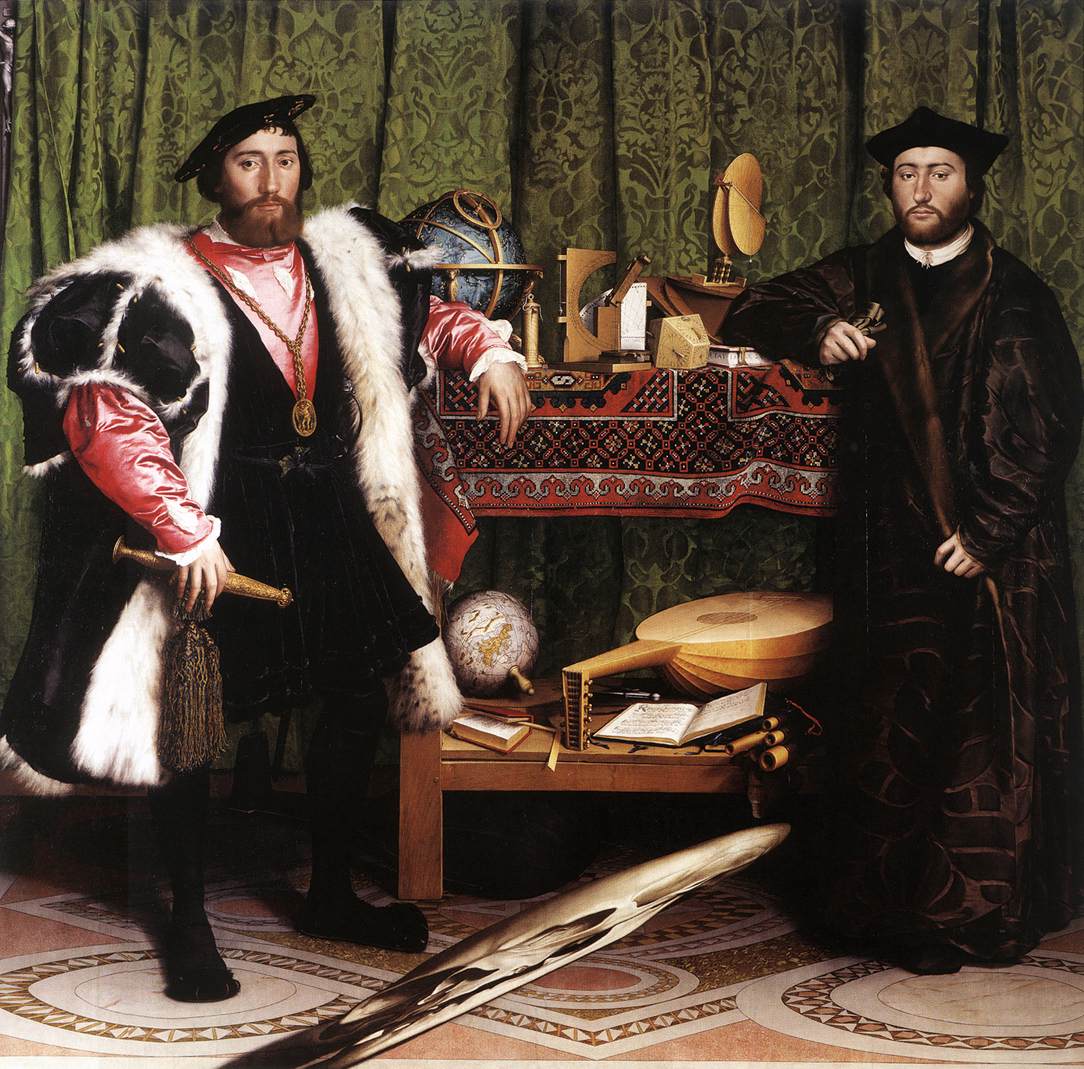
The first major thinker I discuss here is Niccolò Machiavelli, through The Prince, the Discourses and various other writings. I tackle Foucault’s reading of Machiavelli head-on, and indeed more mainstream readings, through a reading of the Italian texts, and try to show how his object of rule was rarely geographical. The next section is on the politics of religious reform, discussing Erasmus, More, Luther, Melanchthon, Calvin and a few others. There’s a brief reading of Hans Holbein’s Ambassadors in here too – I’m most interested in the objects between the two figures, rather than the ambassadors themselves or the skull at the bottom. (Clicking on the the image will take you to a larger version).

I then try to work through the complications of Jean Bodin’s Six Books on the Republic in their French and Latin versions, as well as a near contemporaneous English translation which is revealing in terms of English vocabulary, rather than as a guide to Bodin. I then turn to Giovanni Botero’s famous work on ‘reason of state’, and try to situate it in relation to his lesser-known works on cities and the world. The latter is a synthesis of what was known of the world at the time. I found Romain Descendre’s recent book L’état du monde: Giovanni Botero entre raison d’état et géopolitique, helpful here. The chapter ends with the reading of Shakespeare’s King Lear, with a focus on the politics of land that runs through the play. 

This chapter didn’t need that much work, but then most of it was written earlier this year while I was in London. The main texts read tend to exist in modern editions – with minor exceptions of those by Guillaume de la Perrière, Thomas Elyot, some of François Hotman, Justus Lipsius, and Charles de Grassaille.  I don’t remember many problems of actually finding the texts; though there were lots of problems in the texts. The Lear section was expanded from some brief comments I made in the my inaugural lecture and the Companion to Human Geography piece. The bulk of that section was written in New York in April, while staying at Neil Brenner’s apartment, and making use of the wonderful collection at Columbia University library, and then completed while stuck in Vienna, Virginia after the AAG because of the Iceland volcano.

Posted in Giovanni Botero, Jean Bodin, Martin Luther, Michel Foucault, Neil Brenner, Niccolò Machiavelli, Philipp Melanchthon, The Birth of Territory | 1 Comment

Sidaway on Terror and Territory

James Sidaway’s very generous review of my Terror and Territory in the Annals of the Association of American Geographers is now available here.

This is a compact and sharp book. It is also one that, as a geographer, I am able (and can feel rather proud) to recommend, not only to my students but to peers in other disciplines. It is a good example of the potential for geographical analysis of the political cultures and international relations of the present, showing how these intertwine…

A broader argument about the interactions of sovereignty, terror and violence, and territory can be glimpsed here and in other studies by this author (see especially Elden [forthcoming], a truly agenda-setting study). I expect that his next book… could well prove a landmark survey. In the meantime, Terror and Territory paves the way and will reach wider audiences.

There are some criticisms, of course, particularly in terms of the maps, and the lack of a historical geographical specification of some of the sites covered. The review also highlights the partiality of the coverage, which is fair, although I’d still claim I range far more widely historically and geographically than many accounts.

In short, there are many other terrors, other contested territories, and other ways to comprehend them… Stuart Elden has written a brilliant but also a very particular engagement with the problematics of terror and territory. As such he leaves plenty of room for others.

Posted in My Publications, Territory, Terror and Territory, The Birth of Territory | Leave a comment

Understanding the Changing Planet

Understanding the Changing Planet: Strategic Directions for the Geographical Sciences is a report for the National Research Council by a team of geographers, led by Alexander Murphy of University of Oregon. Alec kindly gave me a copy when I visited earlier this month. There is a lot in the report, and it discusses a broad set of issues which include food security, bio-diversity, climate change, geopolitics, migration, health, economics and so on. It does so by raising questions – both in terms of the chapter titles and also within each chapter.

How Are We Changing the Physical Environment of Earth’s Surface?

How Can We Best Preserve Biological Diversity and Protect Endangered Ecosystems?

How Are Climate and Other Environmental Changes Affecting the Vulnerabilities of Coupled Human–Environment Systems?

How and Where Will 10 Billion People Live on Earth?

How Will We Sustainably Feed Everyone in the Coming Decade and Beyond?

How Does Where People Live Affect Their Health?

How Is the Movement of People, Goods, and Ideas Transforming the World?

How Is Economic Globalization Affecting Inequality?

How Are Geopolitical Shifts Influencing Peace and Stability?

How Might We Better Observe, Analyze, and Visualize a Changing World?

What Are the Societal Implications of Citizen Mapping and Mapping Citizens?

It’s well-worth reading, and illustrated with a range of diagrams, tables and maps. There is a bit of tendency to pull back on some of the controversial aspects, but it’s worth remembering what constraints the authors were working under. I understand from Alec that there will be a set of critical responses coming out in one of the main geography journals. I can see it being helpful in teaching, and in terms of setting some research agendas – not so much for academics, perhaps, but in terms of those who fund them. It also has an aim of feeding into policy discussions and informing citizens in their encounters with geographical questions. If it helps to develop debates within the discipline about what its purpose is, and to help push a message of what geographers do outside of the discipline, then it is to be applauded. I’d certainly see it as a start, rather than any kind of last word. 

Both the paper and pdf versions of the report are available to purchase, but are quite expensive, but you can read quite a few bits online. It’s a shame that the whole pdf isn’t open-access, given its aim of increasing awareness of the geographical dimensions of these crucial questions.

Posted in Politics, Publishing | Leave a comment

UK student occupations and protests

Alex Vasudevan does a good job of rounding up news on UK student occupations at his blog Experimental Geographies here. Being outside of the UK at the moment means I’ve been following what’s been happening on news sites and, increasingly blogs. Alex mentions Infinite Thought and Lenin’s Tomb; I’d also add the University for Strategic Optimism. K-Punk has been quiet recently, but is worth a look – his Capitalism Realism remains a must-read.

Posted in Events, Politics | 1 Comment

Referee etiquette

The Leiter Blog posts some suggested guidelines from Thom Brooks on referee behaviour, along with a request for comments.

I was hoping that you could help publicize some comments for feedback from your readers concerning referee guidelines. I am part of an APA committee looking into journal practices and sit on a subcommittee on guidelines for referees. We have three different areas where I would be keen to solicit comments from your readers: 

A.    Appropriate response times to an invitation and for an evaluation

My view is that potential referees should have at least two weeks to respond to invitations for reviews. This is because they should have an extra few days to assess whether they have the time to commit to providing a review. Once a referee accepts, I believe the maximum evaluation time should be 6-8 weeks and ideally one month. Colleagues should have time to review given their many existing commitments, but no more than two months. Otherwise, it is best to find someone else.

B.    Guidelines for comments with regard to civility and the promotion of quality research.

Referees should be expected to treat authors with courtesy and even where authors have been uncharitable towards their targets. Reports should convince editors to follow their recommendations and uncivil reports may have the opposite effect.

C.    Conflicts of interest

While it is necessary that reviewers inform editors where they may know the author’s identity, I am not sure this need always be a problem or that another reviewer is needed in every instance.

The second and third seem straight-forward: although especially with the second there are still plenty of uncivil reports. As an editor I don’t ordinarily edit reports, but I might remove an unnecessarily nasty sentence or two. On the other hand, I do find it difficult when the report for authors is softened, perhaps suggesting substantial revisions, while the confidential comments to editors are much harder. The editor can then be in the difficult position of knowing the paper should be rejected but without the justifications to do so. So I’d encourage civility but directness. (For this reason I discourage comments just to editors, unless they are to inform instances in the third category, or other more technical issues.)

The first is perhaps uncontroversial too: who could argue with giving people enough time to decide if they can commit to do something, and then giving them a sufficient period of time to do it? The time given is balanced by editor needs to keep things moving, and authors want to hear about their papers in reasonable amounts of time. But, in my experience as editor, this is what can introduce delays into the review system. Referees often take a long time to agree to do a report, and many do not reply at all, and then many miss deadlines, even if these were extended to accomodate their needs. Once a referee has failed to reply, or to deliver what was agreed, another referee is asked, and the process begins again. I’d happily give all referees two weeks to decide, and up to eight weeks to referee the paper, if we always heard within two weeks and then always received the report within eight. Ten weeks maximum time in review if all the first group of referees agree; twelve if you need to ask a second group to replace those who decline. But I’m cautious about expanding the time if there is no guarantee of delivery. So this is the question about the ‘no more than two months’ maximum. Yes, if you know at the outset that it will appear in two months, no if that’s when you are forced to give up on this particular referee and start again with another referee. In other words, this proposal only improves things if all referees reply within that time, and do what they agree to within that time.

Posted in Publishing, Society and Space | Leave a comment

Chapter Seven

The work on Chapter Seven in this redraft was minor. This is largely because of the amount of work I’d already put into this chapter; a chapter which caused me more textual difficulties than any other.

The chapter discusses Roman law, beginning with the codification of classical law by the sixth century Byzantine Emperor Justinian in the Codex, Digest and Institutes. This work had little impact in the Latin West until a manuscript was discovered in 1077. The chapter looks at the work of the initial ‘glossators’, who tried to clarify the text, including Irnerius, but the real focus is on the later ‘post-glossators’ Bartolus of Sassoferrato and Baldus de Ubaldis, and their writings which put the law to work. Very little of their work is available in English, and there are no modern editions in any language except for a few short pieces. In Bartolus there are recurrent concerns with the relation between place and power, in terms of the extent of law and the relation between different legal codes. Bartolus explicitly links jurisdiction to territorium. I also say a bit about some of Bartolus’s other interests, including his fascinating tract on rivers and legal issues around their geography. It’s a small text of legal geometry. Baldus is interested in jurisdiction and territory too (they go together like ‘mist in a swamp’, he says), though he also brings the notion of the populace to centre stage.

A subsequent section of the chapter looks at the idea that the ‘rex imperator in regno suo’; that the king is a emperor within his own kingdom. Various legal codes and papal proclamations are discussed. The chapter ends by some discussion of the legacy of thinkers like Bartolus and Baldus in writers on canon law such as Nicholas of Cusa, and in secular legal theorists such as Vitoria, Grotius and Selden. These last three writers were all dealing with issues that arose through colonisation, which forms the background context to lots of the writers discussed in chapters eight and nine.

I think this chapter is perhaps the key to the whole book. I did some initial work on these thinkers in Singapore in late 2008, and then much more extensively in London in 2009 and 2010. I can’t begin to think how I’d have done this work if I’d not had access to the British Library rare books room on a regular (often daily) basis. Three minor referencing issues remain, but I hope these can be resolved with one more trip there.

Posted in Baldus de Ubaldis, Bartolus of Sassoferrato, Francisco de Vitoria, Hugo Grotius, Irnerius, Medieval Studies, The Birth of Territory | 1 Comment

Issues in Progress

Elsevier are launching a new system of publication they are calling ‘article-based publishing’. Details here.

I’m sure most people have seen ‘online-first’, forthcoming papers, or similar systems. Society and Space has a page of just such papers here.

But the Elsevier system is somewhat different. They are not simply making an earlier version of the paper available, with temporary page numbers starting at 1. They are building the issue up as they go – assigning volume and issue number, and run-on pagination. The advantage of this is that they can get things up online early, as before, but with reference details that remain static for citation purposes.

But there are disadvantages. The key one is for the journal editor – any discretion over lineup of issues seems to be removed. The papers are ordered as they come off the production line, and so working out an effective running order for an issue is much more difficult, if not impossible. For a theme issue, the last thing finalised is often the introduction or guest editorial. But that’s the first thing that appears in the issue. Working on that sometimes suggests a different running order than originally planned. And even non-themed issues are often ordered in particular ways that are not simply first in, first out. Commentaries or editorials, sometimes on a very timely topic, come out quicker and appear first in an issue. Papers don’t always come out as the number of pages first expected, which might mean that the overall pagination of the issue is exceeded or light, and other things need to be juggled; some papers take longer through proof stage and have to slip down an issue, meaning something else needs to be moved up, but that may not work best as the last item, etc. Review essays and reviews are often used to make issues work to length, but this system would seem to make them more likely to be used in that way, rather than allowing flexibility.

It is clear that most people no longer read a journal as a print copy in a library or by subscription, but access papers online. They increasingly do this not through the journal contents page but through links, google scholar, etc. For this reason each piece in the journal needs to work as a standalone item, even if some pieces gain extra value and context when seen alongside others. Things like feeds, contents alerting, forthcoming sections, etc. all help with the visibility of individual pieces. But equally it still seems worthwhile to work on the overall shape of a single issue, and that requires much more flexibility than this new system would seem to allow. I spend a lot of time with a planning spreadsheet for future issues, and am continually moving things around and working with the publishers to try to make things work as well as possible.

In other words, don’t expect Society and Space to move to this model. But do keep checking the forthcoming page, or better yet subscribe to rss or email updates.

Posted in Publishing, Society and Space | 2 Comments