Claire Rydell Arcenas, America’s Philosopher: John Locke in American Intellectual Life – University of Chicago Press, 2022

Claire Rydell Arcenas, America’s Philosopher: John Locke in American Intellectual Life – University of Chicago Press, 2022
The influence of polymath philosopher John Locke (1632–1704) can still be found in a dizzying range of fields, as his writings touch on issues of identity, republicanism, and the nature of knowledge itself. Claire Rydell Arcenas’s new book tells the story of Americans’ longstanding yet ever-mutable obsession with this English thinker’s ideas, a saga whose most recent manifestations have found the so-called Father of Liberalism held up as a right-wing icon.

The first book to detail Locke’s trans-Atlantic influence from the eighteenth century until today, America’s Philosopher shows how and why interpretations of his ideas have captivated Americans in ways few other philosophers—from any nation—ever have. As Arcenas makes clear, each generation has essentially remade Locke in its own image, taking inspiration and transmuting his ideas to suit the needs of the particular historical moment. Drawing from a host of vernacular sources to illuminate Locke’s often contradictory impact on American daily and intellectual life from before the Revolutionary War to the present, Arcenas delivers a pathbreaking work in the history of ideas.
Posted in John Locke | 1 Comment

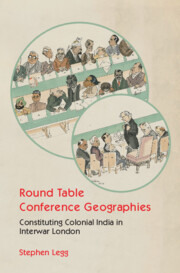
Stephen Legg, Roundtable Conference Geographies: Constituting Colonial India in Interwar London – Cambridge University Press, March 2023

Stephen Legg, Roundtable Conference Geographies: Constituting Colonial India in Interwar London – Cambridge University Press, March 2023

Just an expensive hardback at present, unfortunately.

Round Table Conference Geographies explores a major international conference in 1930s London which determined India’s constitutional future in the British Empire. Pre-dating the decolonising conferences of the 1950s–60s, the Round Table Conference laid the blueprint for India’s future federal constitution. Despite this the conference is unanimously read as a failure, for not having comprehensively reconciled the competing demands of liberal and Indian National Congress politicians, of Hindus and Muslims, and of British versus Princely India. This book argues that the conference’s three sessions were vital sites of Indian and imperial politics that demand serious attention. It explores the spatial politics of the conference in terms of its imaginary geographies, infrastructures, host city, and how the conference was contested and represented. The book concludes by asking who gained through representing the conference as a failure and explores it, instead, as a teeming political, social and material space.

Posted in Uncategorized | Leave a comment

Michel Foucault, Le Discours philosophique, edited by Daniele Lorenzini and Orazio Irrera – EHESS/Gallimard/Seuil, May 2023

Michel Foucault, Le Discours philosophique, edited by Daniele Lorenzini and Orazio Irrera – Gallimard/Seuil/EHESS, May 2023

This is a previously unpublished manuscript, probably from 1966, written after The Order of Things and before or alongside early work on what became The Archaeology of Knowledge.

Starting to appear in online bookstores, with title page and table of contents shared online:

Posted in Michel Foucault | 1 Comment

Books received – Leroi-Gourhan, Blanchot, Vogl, Ungar, Heidegger, Bobic and Haghighi

Some second-hand books connected in part to the ongoing research on Indo-European though in France, the latest volume of the Heidegger Gesamtausgabe and copies of Joseph Vogl, Capital and Ressentiment: A Short History of the Present and Nikolina Bobic and Farzaneh Haghighi (eds.), The Routledge Handbook of Architecture, Urban Space and Politics, Volume I: Violence, Spectacle and Data – kindly sent by the publisher and editors.

Posted in Martin Heidegger, Uncategorized | Leave a comment

Archive: Sennett and Foucault on Sexuality and Solitude (audio recording and other links)

Audio recording of Michel Foucault and Richard Sennett discussing Sexuality and Solitude. The date there is given as 1979, but I think this was actually in November 1980.
The edited transcript was published in 1981 in the London Review of Books It is translated into French in Dits et écrits and reprinted in Essential Works volume I, though without Sennett’s remarks.
I’ve added this to my list of audio and video recordings of Foucault (that list is hard to keep uptodate as things are removed or links change).

Clare O'Farrell's avatarFoucault News

Richard Sennett and Michel Foucault, Sennett and Foucault on Sexuality and Solitude (1979)
New Books Network, 2 Feb 2023.

[See site for recording]

In 1979, sociologist and NYIH founder Richard Sennett, and philosopher Michel Foucault, discussed the connections between the history of sexuality and self consciousness. In this episode from the Vault, the two discuss their research and, by extension, the underpinnings of the idea of solitude.

View original post

Posted in Uncategorized | 2 Comments

Pierre Hadot, Don’t Forget to Live: Goethe and the Tradition of Spiritual Exercise – University of Chicago Press, April 2023

Pierre Hadot, Don’t Forget to Live: Goethe and the Tradition of Spiritual Exercise – University of Chicago Press, trans. Michael Chase, April 2023

The esteemed French philosopher Pierre Hadot’s final work, now available in English.
With a foreword by Arnold I. Davidson and Daniele Lorenzini.
 
In his final book, renowned philosopher Pierre Hadot explores Goethe’s relationship with ancient spiritual exercises—transformative acts of intellect, imagination, or will. Goethe sought both an intense experience of the present moment as well as a kind of cosmic consciousness, both of which are rooted in ancient philosophical practices. These practices shaped Goethe’s audacious contrast to the traditional maxim memento mori (Don’t forget that you will die) with the aim of transforming our ordinary consciousness. Ultimately, Hadot reveals how Goethe cultivated a deep love for life that brings to the forefront a new maxim: Don’t forget to live.

Posted in Pierre Hadot, Uncategorized | Leave a comment

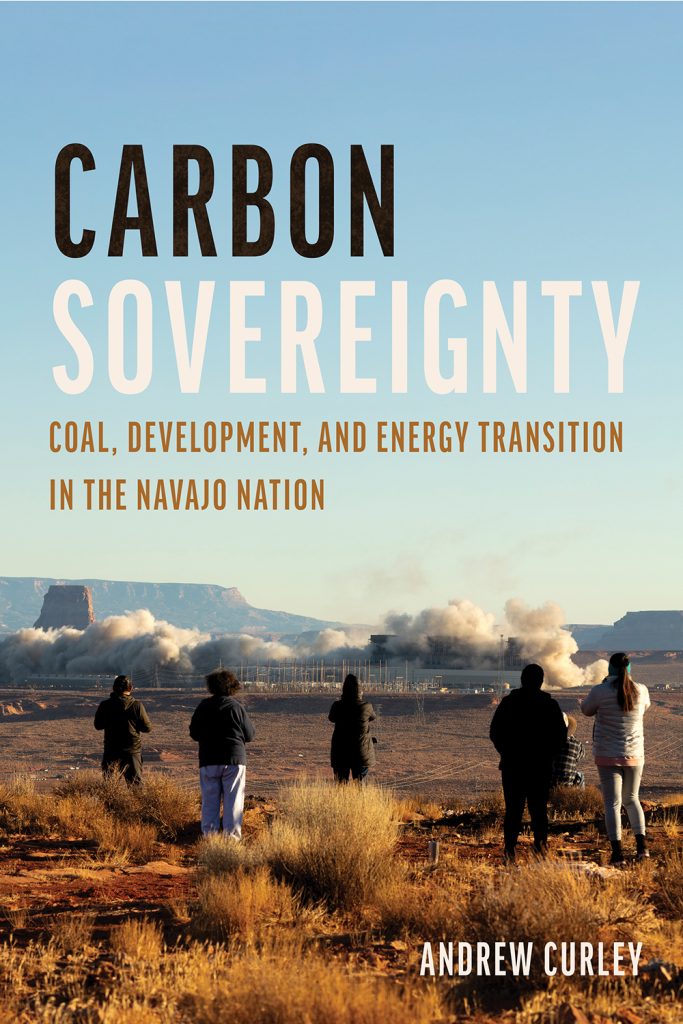
Andrew Curley, Carbon Sovereignty: Coal, Development, and Energy Transition in the Navajo – University of Arizona Press, April 2023

Andrew Curley, Carbon Sovereignty: Coal, Development, and Energy Transition in the Navajo – University of Arizona Press, April 2023

For almost fifty years, coal dominated the Navajo economy. But in 2019 one of the Navajo Nation’s largest coal plants closed.

This comprehensive new work offers a deep dive into the complex inner workings of energy shift in the Navajo Nation. Geographer Andrew Curley, a member of the Navajo Nation, examines the history of coal development within the Navajo Nation, including why some Diné supported coal and the consequences of doing so. He explains the Navajo Nation’s strategic choices to use the coal industry to support its sovereignty as a path forward in the face of ongoing colonialism. Carbon Sovereignty demonstrates the mechanism of capitalism through colonialism and the construction of resource sovereignty, in both the Navajo Nation’s embrace and its rejection of a coal economy.

For the people of the Navajo Nation, energy sovereignty is dire and personal. Thanks to on-the-ground interviews with Diné coal workers, environmental activists, and politicians, Curley documents the real consequences of change as they happened. While some Navajo actors have doubled down for coal, others have moved toward transition. Curley argues that political struggles ultimately shape how we should understand coal, capitalism, and climate change. The rise and fall of coal magnify the nuance and complexity of change. Historical and contemporary issues intermingle in everyday life with lasting consequences.

Posted in Uncategorized | Leave a comment

Alain Corbin, A History of the Wind, trans. William Peniston – Polity, November 2022

Alain Corbin, A History of the Wind, trans. William Peniston – Polity, November 2022

Everyone knows the wind’s touch, its presence, its force. Sometimes it roars and howls, at other times we hear its wistful sighs and feel its soothing caresses. Since antiquity, humans have borne witness to the wind and relied on it to navigate the seas. And yet, despite its presence at the heart of human experience, the wind has evaded scrutiny in our chronicles of the past.

In this brilliantly original volume, Alain Corbin sets out to illuminate the wind’s storied history. He shows how, before the nineteenth century, the noisy emptiness of wind was experienced and described only according to the sensations it provoked. Imagery of the wind featured prominently in literature, from the ancient Greek epics through the Renaissance and romanticism to the modern era, but little was known about where the wind came from and where it went. It was only in the late eighteenth century, with the discovery of the composition of air, that scientists began to understand the nature of wind and its trajectories. From that point on, our understanding of the wind was shaped by meteorology, which mapped the flows of winds and currents around the globe. But while science has enabled us to understand the wind and, in some respects, to harness it, the wind has lost nothing of its mysterious force. It still has the power to destroy, and in the wind’s ethereal presence we can still feel its connection with creation and death.

Posted in Uncategorized | Leave a comment

Sida, prisons, décolonisation : la vie militante de Daniel Defert (2023)

Sida, prisons, décolonisation : la vie militante de Daniel Defert, France Culture (radio), fév 2023.

Clare O'Farrell's avatarFoucault News

Sida, prisons, décolonisation : la vie militante de Daniel Defert, France Culture (radio), fév 2023. © Claude Truong-Ngoc / Wikimedia Commons – cc-by-sa-3.0, Aucun(e)

À propos de la série

Une série d’entretiens proposée par Virginie Bloch-Lainé. Réalisation : Laetitia Coia. Prise de son : Yves le Hors. 5 épisodes.

Tout au long de son existence, dont 20 années aux côtés du philosophe Michel Foucault, Daniel Defert a lutté pour et avec les autres. Ouvriers, prisonniers, colonisés, malades du sida… Une vie en cinq entretiens avec le sociologue fondateur de l’association Aides.

En 1984, Daniel Defert crée Aides, la première association française de lutte contre le sida qu’il dirige jusqu’en 1991. Le virus à l’époque tue rapidement ; c’est une hécatombe. Michel Foucault, compagnon de Daniel Defert pendant vingt ans, vient d’en mourir, mais le silence est gardé sur la cause de sa mort : “J’avais à résoudre un problème…

View original post 206 more words

Posted in Uncategorized | Leave a comment

Interviews with Mary Douglas and Roland Barthes in ‘Notes on Structuralism’ section of Theory, Culture and Society (open access)

Mary Douglas on Purity and Danger: An Interview – Mike Featherstone, Bryan S. Turner

A previously unpublished 1979 interview:

This interview with Mary Douglas took place at Lancaster University in the Religious Studies Department. The main focus of the interview was her recently published book, Purity and Danger, which had already become a classic of British anthropology. The questions and answers ranged mainly over the differences between the physical body, representations of the body, the body as a classificatory system, and social constructivism. Douglas’s early academic years and the influences on her work, such as the role of Roman Catholicism in her childhood and youth, were discussed. The interview concluded with speculation about the connections between anthropology and colonialism, and how she responded to those developments.

On Narrative: An Interview with Roland Barthes – Paolo Fabbri, introduction by Monica Sassatelli, and Sunil Manghani, translated by Jon Templeman

A new translation of an interview first published in Italian in 2019

This article presents a dialogue between Roland Barthes and Paolo Fabbri, which took place on 18 December 1965 in Florence, Italy. Barthes offers an engaging account of his structuralist approach to narrative, as was later published in essay form, ‘Introduction to the Structural Analysis of Narrative’, included in a special issue of Communications (Issue 8, 1966). In a cordial exchange with Fabbri, Barthes provides a more candid presentation of method than found in print, along with critical reflection of the underlying importance of the structuralist approach, as perceived at the time. The interview took place as part of a small conference on narrativity. Participants included Algirdas Julien Greimas, Claude Bremond, Umberto Eco, Jules Gritti, Violette Morin, Christian Metz, and Tzvetan Todorov. Subsequently, a number of these participants contributed articles to the same issue of Communications, on the structural analysis of narrative.

See also Sunil Manghani, ‘Notes on Structuralism: Introduction‘, and Jonathan Culler, ‘Analyzing Narrative: Roland Barthes’ Forgotten Interview‘ from the same section of the journal. Culler’s article requires subscription, but the others are open access.

Posted in Roland Barthes | Leave a comment