My favourite music of 2020

Alphabetical list of the music I enjoyed the most this year…
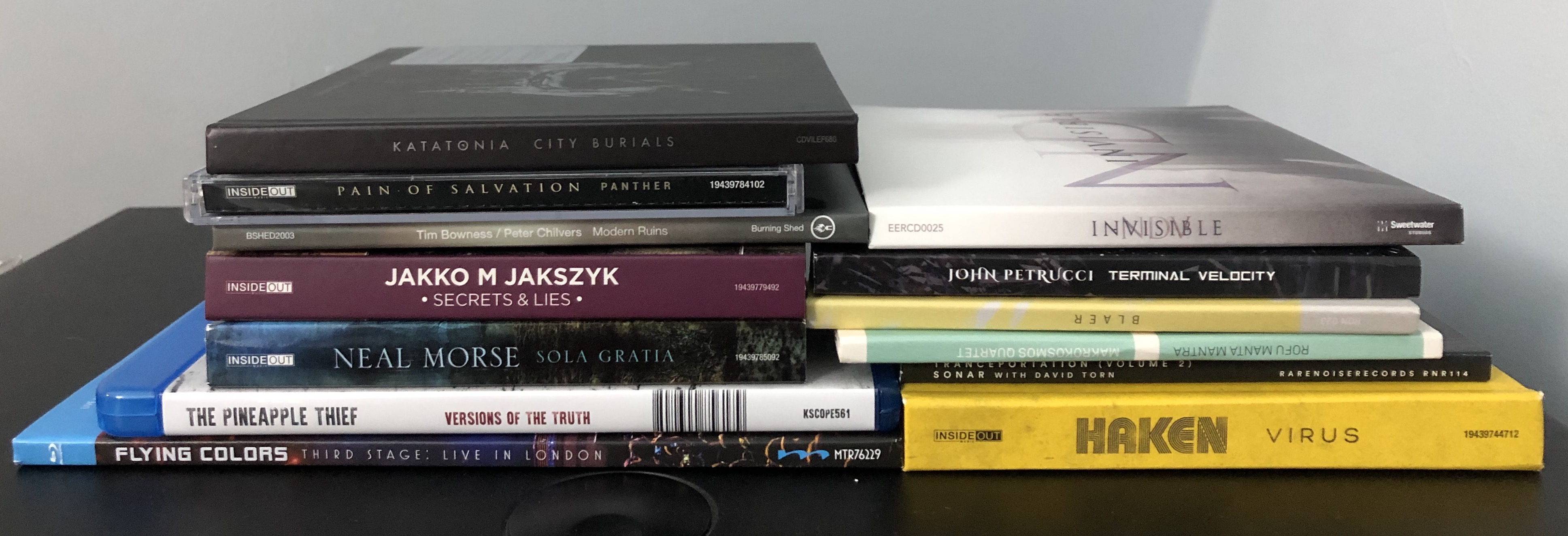
  • Big Big Train, Empire
  • Blaer, Yellow
  • Brass Against, III
  • Tim Bowness, Peter Chilvers, Modern Ruins
  • Flying Colours, Third Stage: Live in London
  • Frost*, 13 Winters (box)
  • Peter Gabriel, Rated PG
  • Gary Husband and Markus Reuter, Music of our Times 
  • Haken, Virus
  • Jakko Jaksyk, Secrets and Lies
  • Katatonia, City Burials
  • King Crimson, Complete 1969 Recordings (box)
  • Makrokosmos Quartet, Rofu, Manta Mantra (2 works for 2 pianos and 2 percussionists by Nik Bärtsch)
  • Patrick Moraz-Bill Bruford, Temples of Joy (box reissue)
  • Neal Morse, Sola Gratia 
  • Nick D’Virgilio, Invisible
  • Pain of Salvation, Panther
  • Porcupine Tree, In Absentia (box reissue) 
  • Markus Reuter (featuring Fabio Trentini and Asaf Sirkis), Truce
  • Nine Inch Nails, Ghosts V: Together and VI: Locusts
  • John Petrucci, Terminal Velocity
  • The Pineapple Thief, Versions of the Truth
  • Sonar with David Torn, Tranceportation Vol 2
  • Sons of Apollo, MMXX
  • Toyah and The Humans (box)

I really missed live music, with the only gig I attended The Aristocrats early in the year. Lots of things cancelled or postponed. But I did enjoy being able to stream some live concerts, especially from Nik Bärtsch’s Ronin and Mobile.

For previous years, see the lists from 2019201820172016201520142013 and 2012.

Posted in Music, Uncategorized | 5 Comments

Most popular posts and pages on Progressive Geographies in 2020

Geographers, sociologists, philosophers, etc. on covid-19

Where to start with reading Henri Lefebvre?

Stuart Hall’s documentary on Marx and Marxism

Georges Bataille – Oeuvres complètes and other French collections; English translations

My favourite academic books of 2019 [other years here]

Foucault audio and video recordings (other Foucault resources here)

Where to start with reading Peter Sloterdijk?

The Deleuze Seminars, Website Launch

Etienne Balibar – Being Communist, Becoming Other (audio)

Intolerable: Writings from Michel Foucault and the Prisons Information Group (1970–1980), edited by Kevin Thompson and Perry Zurn, University of Minnesota Press, December 2020

Foucault – uncollected notes, lectures and interviews

The Early Foucault – research updates

Quite a lot of these are pages, rather than posts, and some are quite old. Not many posts this year seemed to get much attention, which is probably due to social media as much as anything else. I’ve been using Twitter more, and Facebook much less. But there are some things which don’t really work on those, so I imagine I’ll keep going with this site for a while longer. Thanks for reading this year.

Posted in Uncategorized | Leave a comment

Discussion of The Early Foucault (@politybooks, 2021) on the Hermitix podcast

On the Hermitix podcast (stream or download) I discuss The Early Foucault, forthcoming with Polity in 2021. Also on Youtube.

Stuart Elden is Professor of Political Theory and Geography at University of Warwick. He is the author of multiple books on the work of Michel Foucault, alongside other texts on Georges Canguilhem, Kant and Heidegger. In this episode we discuss his soon to be published book The Early Foucault

The Early Foucault can be purchased here: https://politybooks.com/bookdetail/?isbn=9781509525959

Posted in Michel Foucault, The Early Foucault | 2 Comments

Journal of the History of Ideas blog – The Year in Review: Best of 2020

Journal of the History of Ideas blog – The Year in Review: Best of 2020

They are kind enough to include my two-part interview on Foucault with Jonas Knatz and Anne Schult

Historicizing Foucault: Stuart Elden on Tracing Foucault’s Ideas from Discipline and Punish to the History of Sexuality

“Foucault Was Always Much More Circumspect”: Stuart Elden on Foucault’s Politics and the Rediscovery of His Early Years

Posted in Foucault's Last Decade, Foucault: The Birth of Power, Michel Foucault, The Archaeology of Foucault, The Early Foucault, Uncategorized | Leave a comment

Foucault’s Christmas

In a fascinating interview about Foucault, ‘The Materiality of a Working Life‘ (open access; original French), Daniel Defert talks about his daily routines, and how these were similar year round:

No no, weekends didn’t exist! We would go to see art exhibitions on the Saturday afternoon, certainly, but the very notion of the weekend didn’t exist… Especially a public holiday, a Christmas day without writing, that was impossible! Foucault rarely put dates on his writings, but he would have been quite capable of putting “December 25th” on something, that being a day when, as he said, “nothing has happened for several thousand years.”

I pick up on this story in The Early Foucault, but it’s not a model I try to follow. Although the winter sun and cycling won’t happen this year, I will be taking a few days off. Happy Christmas and I’ll be back before the New Year with some lists of books and music I liked.

Posted in Michel Foucault, The Early Foucault | 2 Comments

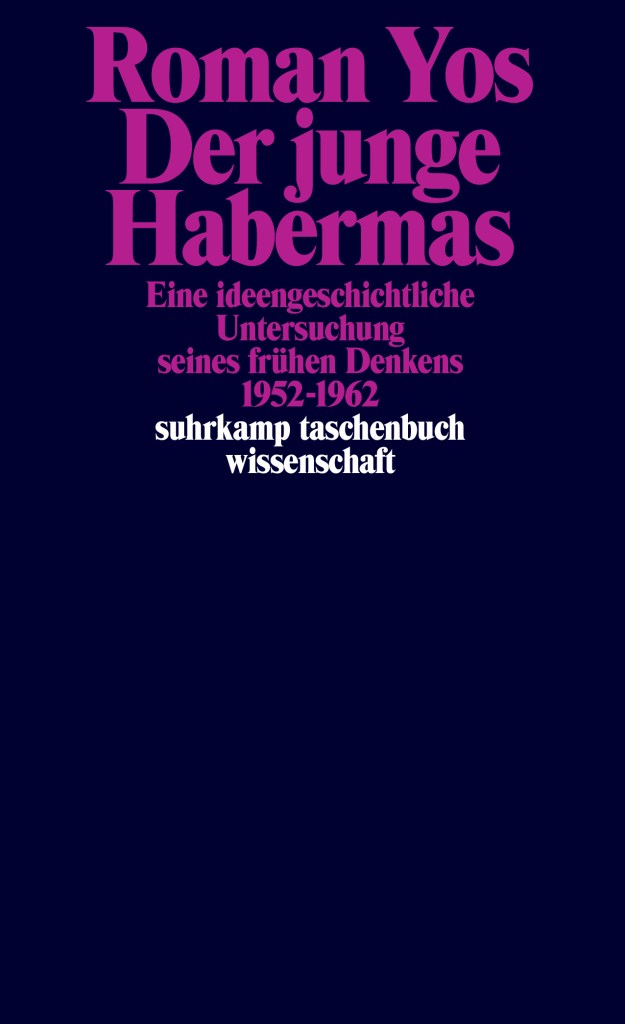
Young Habermas: An Interview with Roman Yos – Jonas Knatz at Journal of the History of Ideas blog

Young Habermas: An Interview with Roman Yos – Jonas Knatz at Journal of the History of Ideas blog

Roman Yos is a researcher at the Institute of Philosophy at the University of Potsdam. His research focuses on the history of German Philosophy in the early and mid-20th century. In 2017, he co-edited Mensch und Gesellschaft zwischen Natur und Geschichte, a volume that investigates the relationship between Philosophical Anthropology and Critical Theory. Contributing editor Jonas Knatz spoke with him about his new book Der junge Habermas (Suhrkamp, 2019), an intellectual biography of German philosopher and sociologist Jürgen Habermas.

Posted in Jürgen Habermas | Leave a comment

Books received (2) – Hyppolite, Mauss, Wollstonecraft, Jameson, Benveniste, Forestal & Philips, Besteman

The papers from Hyppolite’s final seminar (including pieces by Derrida and Althusser), Marcel Mauss, Sociologie et anthropologie, Mary Wollstonecraft, A Vindication of the Rights of Woman, some works by Emile Benveniste, Fredric Jameson’s The Prison-House of Language, Jennifer Forestal and Menaka Philips (eds.), The Wives of Western Philosophy: Gender Politics in Intellectual Labor, Catherine Besteman, Militarized Global Apartheid.

Most of these are connected to ongoing research projects, though I’ll be teaching Wollstonecraft for the first time in 2021, and wanted this edition. The Routledge collection was pre-ordered in recompense for review work, and Duke University Press sent Catherine Besteman’s book.

Posted in Emile Benveniste, Fredric Jameson, Jacques Derrida, Louis Althusser, teaching, Uncategorized | Leave a comment

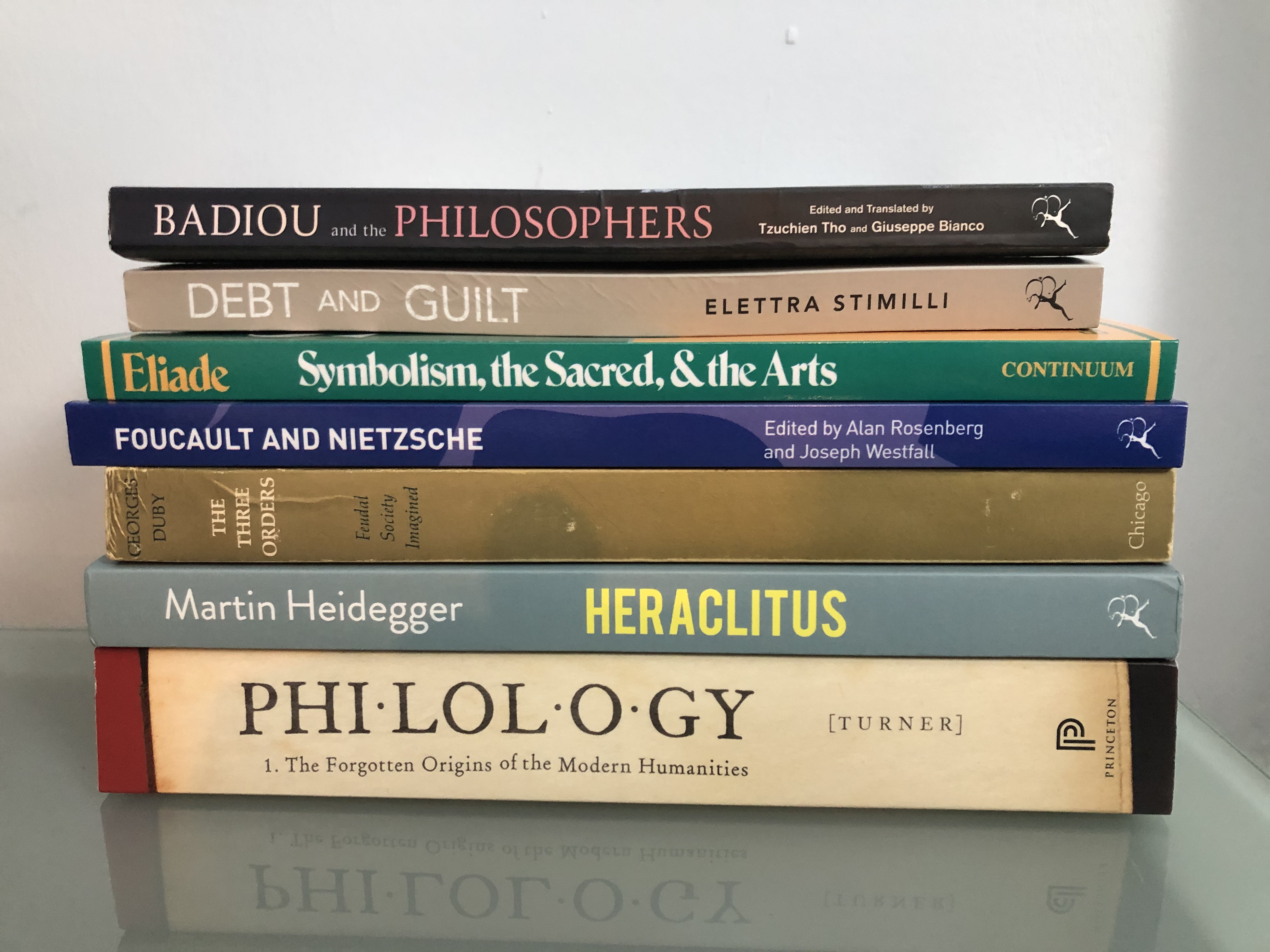
Books received (1) – Badiou, Stimilli, Eliade, Rosenberg & Westfall, Duby, Heidegger, Turner

Some books in recompense for review work for Bloomsbury, James Turner, Philology: The Forgotten Origins of the Modern Humanities and a second-hand copy of Georges Duby, The Three Orders.

Posted in Alain Badiou, Martin Heidegger | Leave a comment

Adrian J Ivakhiv’s Books of the decade in ecocultural theory

Adrian J Ivakhiv’s Books of the decade in ecocultural theory

Ten years ago, I posted an article on this blog with the exact same title as this one. It was enjoyable, at the time, to create a list of ten books I found both most personally influential and most significant in the intersectional study of ecology and culture. The list resonated fairly widely, attracting one of the highest number of visits on the blog to that point. (The blog looked different back then; you can see that in a screen shot here.)

Reviewing that list today, I can reaffirm the significance of each of its “top ten,” even if my ordering might be different in retrospect. Arturo Escobar’s Territories of Difference (second on that list) strikes me as the most forward-looking in terms of how it anticipated the most important stream of ecocultural thinking over the past ten years (the decolonial, though that term covers a great deal of complexity, which I will touch on below). Karen Barad’s Meeting the Universe Halfway (#4) is, of the ten, the book that has appeared on the greatest number of reading lists and graduate theses since then, in the areas that I read and advise in. And while the book I listed in first place, William Connolly’s Neuropolitics, has perhaps not aged as well as some of Connolly’s other books (so much has been written about “neuropolitics” since then), its intervention at the time of its writing was substantial and the author’s ongoing productivity merits great respect.

It’s not as easy to write a similar list today, in part because of the dynamics of the “present moment”: this year, in particular, with its global pandemic, its racial-justice convulsions, and its political insanity (here in the United States) has left me with a certain abyssal feeling of the loss of bearings. Can anyone today feel confident that they know what’s going on and what the future holds? (Other than that things will get much worse before they get any better.) [continues here]

Posted in Uncategorized | 1 Comment

Alexander Orakhelashvili, International Law and International Politics: Foundations of Interdisciplinary Analysis – Edward Elgar, December 2020

Alexander Orakhelashvili, International Law and International Politics: Foundations of Interdisciplinary Analysis – Edward Elgar, December 2020

This illuminating monograph examines analytical and practical aspects of the relationship between international law and international politics, providing a comprehensive analysis of the foundations on which both the international legal system and international politics rest.

With an interdisciplinary perspective, Alexander Orakhelashvili compares and contrasts the methods of international legal reasoning with international relations as a discipline, focusing on timeless and central issues that connect the past, present and future. The book examines, through the use of both disciplines’ methodology, some more specific areas such as public authority, global space, and peace, with the overall outcome that political contempt towards the international legal system could have unexpected and costly adverse political consequences.

Examining a broad range of theories and literature, International Law and International Politics will be an invigorating read for academics, students and practitioners of international law, international relations, politics, and diplomacy.

Hardback and e-book only at present, but Intro and Chapter 1 are available to read open access.

Posted in Uncategorized | Leave a comment