
Foucault at Warwick, 17 January 2020, 5pm, with Alison Downham Moore, Lisa Downing, Stuart Elden, Daniele Lorenzini and Federico Testa – free and open to all. I’ll be speaking about the archival work I’ve done on the early Foucault.

Foucault at Warwick, 17 January 2020, 5pm, with Alison Downham Moore, Lisa Downing, Stuart Elden, Daniele Lorenzini and Federico Testa – free and open to all. I’ll be speaking about the archival work I’ve done on the early Foucault.
 The making of migration: A roundtable on Martina Tazzioli’s book The Making of Migration: The Biopolitics of Mobility at Europe’s Borders (Sage, 2019)
With Stuart Elden (PAIS, Warwick), Daniele Lorenzini (Philosophy, Warwick), Vicki Squire (PAIS, Warwick), Maurice Stierl (PAIS, Warwick) and Martina Tazzioli (Goldsmiths, University of London)
Wednesday, January 15 2020, 4:30pm to 5:45pm (room S0.17)
Warwick PAIS and Philosophy organise a roundtable to discuss Martina Tazzioli’s new book, The making of migration: The biopolitics of mobility at Europe’s borders (London: SAGE, 2019) on 15 January 2020, at 4:30pm in S0.17.
The book addresses the rapid phenomenon that has become one of the most contentious issues in contemporary life: How are migrants governed as individual subjects and as part of groups? What are the modes of control, identification and partitions that migrants are subjected to?
Bringing together an ethnographically grounded analysis of migration, and a critical theoretical engagement with the security and humanitarian modes of governing migrants, The making of migration pushes us to rethink notions that are central in current political theory such as multiplicity and subjectivity. This is an innovative and sophisticated study, deploying migration as an analytical angle for complicating and reconceptualising the emergence of collective subjects, mechanisms of individualisation, and political invisibility/visibility.
Further details on the book can be found here – https://uk.sagepub.com/en-gb/eur/the-making-of-migration/book263211
All welcome!
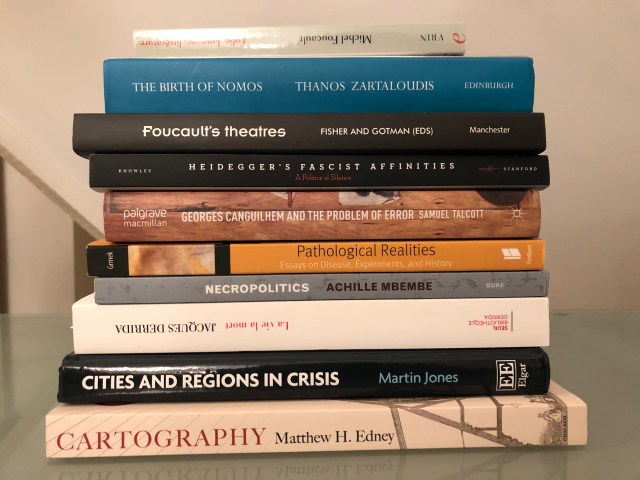
As ever, a list of the books I read as a break from normal academic reading, though the line gets blurred with some of the biographies. I enjoyed the biographies more than the novels, and even abandoned a novel – which I do very rarely. Some of the more recent bios appear on the list of academic books I liked this year.
For lists from previous years see here, and for some responses to questions asked about my novel reading see here.
New Perspectives – 03/2019 – Full Issue open access
Benjamin Tallis announces that the journal will be moving to Sage in 2020

Editorial
1. The Velvet Revolution Happened Yesterday
Alena Drieschová
Research Articles
2. Brexit and EU Legitimation: Unwitting Martyr for the Cause?
Paul Beaumont
3. How Quantum Ontology and Q Methodology Can Revitalise Agency in IR
Pinja Lehtonen
4. Forgotten Velvet: Understanding Eastern Slovakia’s 1989
Marty Manor Mullins
Fora
5. Russia and the World: 2019 IMEMO Forecast
Mark Galeotti, Cai Wilkinson, Alexander Graef, Paul Robinson, Glenn Diesen
6. Multiplicity and/as International Relations
Justin Rosenberg, Cameron Thies, Catarina Kinnvall, Alena Drieschová, Anatoly Reshetnikov, Benjamin Tallis
At the end of each year I’ve posted a list of academic books I liked (2013, 2014, 2015, 2016, 2017, 2018). The criteria was simply that they were published in that year (or late the previous year), and that I read and liked them. Some of these are books I reviewed or endorsed, and some are by friends and colleagues. It’s of course biased by my interests and prejudices. I’m sure I’ve missed loads of other great books, but I can at least say that these are all worth reading.
Other 2019 books that I’m planning to read, but either don’t yet have a copy or haven’t yet had time for, include…
And then there are some books I had some involvement with, mainly as author of a chapter, and so have excluded from the above list:
I should also say that some other very good things I’ve read this year have been in manuscript, and will hopefully be out in 2020.
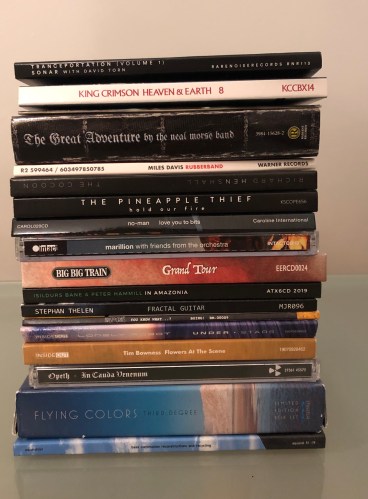 A list of the music released this year which I enjoyed the most…
Live, I enjoyed Steve Rothery, Haken, The Pineapple Thief, The Neal Morse Band, Tim Bowness, King Crimson, Big Big Train, Nik Bärtsch’s Ronin, Marillion, Steve Hackett and Flying Colours.
For previous years, see the lists from 2018, 2017, 2016, 2015, 2014, 2013 and 2012.
Foucault à l’épreuve de la psychiatrie et de la psychanalyse, Astérion (ENS de Lyon), 21/2019 – thanks to Foucault News for this link
Challenging Foucault with psychiatry and psychoanalysis
Sous la direction de Laurent Dartigues et Elisabetta BassoOpen access online – pdfs require subscription
Le dossier a pour but d’interroger, à partir de Michel Foucault, le lien entre la réflexion épistémologique sur la santé mentale et l’historicité des savoirs qui la cernent. La contribution d’Elisabetta Basso s’appuie sur les manuscrits foucaldiens des années 1950 afin d’analyser le chantier à partir duquel le jeune Foucault inaugure une réflexion qui l’amènera à une mise en question radicale du bien-fondé des sciences humaines. Ugo Balzaretti discute le rapport de la psychanalyse à la biopolitique, qu’il approfondit à la lumière de l’archéologie de la psychanalyse que Foucault développe dans Naissance de la clinique et Les mots et les choses, mais aussi de la généalogie du pouvoir esquissée dans La volonté de savoir. L’article de Laurent Dartigues a pour objet la manière dont Foucault lit et utilise la psychanalyse, dont la présence ne concerne pas les seuls écrits des années 1950 et 1960, mais reste constante tout au long de l’œuvre du philosophe, avec un statut incertain et fluctuant. Aurélie Pfauwadel s’intéresse à un point d’achoppement qui concerne une des généalogies foucaldiennes de la psychanalyse, celle qui, dans les années 1970, met le freudisme du côté de la normalisation. Clotilde Leguil se concentre sur la pensée de Lacan, dont elle fait remarquer la dimension politique dans la mesure où elle promeut une conception anti-identitariste du sujet. Enfin, le dossier présente la transcription d’un inédit de Foucault sur la psychanalyse, où le philosophe entend mesurer l’apport de la psychanalyse à la compréhension de la maladie mentale.
The aim of this special issue is to question, starting from Michel Foucault, the link between the epistemological reflection on mental health and the historicity of the knowledge that defines it. Elisabetta Basso’s contribution draws on Foucault’s manuscripts of the 1950s, in order to analyze how the young Foucault initiates a reflection that leads him to radically put into question social sciences. Ugo Balzaretti discusses the relationship between psychoanalysis and biopolitics, which he explores in the light of the archaeology of psychoanalysis developed by Foucault in Naissance de la clinique and Les mots et les choses, but also in the genealogy of power outlined in La volonté de savoir. Laurent Dartigues’s article deals with the way in which Foucault reads and uses psychoanalysis – whose presence in Foucault’s corpus does not only concern the writings of the 1950s and 1960s – but remains constant throughout the philosopher’s work, with an uncertain and fluctuating status. Aurélie Pfauwadel dwells on a stumbling block that concerns one of the genealogies of psychoanalysis outlined by Foucault, the one that, in the 1970s, put Freudism on the side of normalization. Clotilde Leguil focuses on Lacan’s thinking, by emphasizing its political dimension in that it promotes an anti-identitarist conception of the subject. Finally, the dossier presents the transcription of an unpublished manuscript by Foucault on psychoanalysis, in which the philosopher intends to assess the contribution of psychoanalysis to the understanding of mental illness.
Elisabetta BASSO and Laurent DARTIGUES
IntroductionElisabetta BASSO
De la philosophie à l’histoire, en passant par la psychologie : que nous apprennent les archives Foucault des années 1950 ?
From philosophy to history, through psychology: what do we learn from the Foucault archives of the 1950s?
Ugo BALZARETTI
Cogito et histoire du sujet : quelques remarques sur la biopolitique et la psychanalyse
Cogito and history of the subject: some remarks on biopolitics and psychoanalysis
Laurent DARTIGUES
La question de psychanalyse chez Michel Foucault
Psychoanalytical disorders in the Foucault’s thought
Aurélie PFAUWADEL
La psychanalyse et la société de normalisation : Lacan versus Foucault
Psychoanalysis and the society of normalization: Lacan versus Foucault
Clotilde LEGUIL
Le sujet lacanien, un « Je » sans identité
The Lacanian subject, an “I” without identity
Michel FOUCAULT and Elisabetta BASSO
Un manuscrit de Michel Foucault sur la psychanalyse
A manuscript by Michel Foucault on psychoanalysisVARIA
Thomas EBKE
La connaissance vitale de la vie : une parallaxe entre Canguilhem et Plessner [Full text]
Vital knowledge of life: A parallax view between Canguilhem and Plessner
 Hannah Arendt and Theodor W. Adorno’s correspondence on the legacy of Walter Benjamin – in the Los Angeles Review of Books, edited and translated by Susan H. Gillespie and Samantha Rose Hill
THE 1967 CORRESPONDENCE between Hannah Arendt and Theodor W. Adorno followed Walter Benjamin’s death by nearly 30 years. The acrimony that grew between Arendt and Adorno during the intervening decades is present in these letters. Who had the right, ethically and intellectually, to edit and publish Benjamin’s work?
Samantha Rose Hill’s bio on the LARB site says she is writing a biography of Arendt.
Update: there is a fascinating piece on Benjamin’s last work and the feud between Arendt and Adorno over its editing by Samantha Rose Hill here.
The London Review of Books has a new website and content is open access for one month:
For a full calendar month, there won’t be a paywall of any kind anywhere on the site. This means that not only all 24 of this year’s issues, but also our entire archive, dating back to 25 October 1979 and containing almost 17,500 articles, will be free to read, for everyone, without limits, until midday on Wednesday 15 January. Merry Christmas!Where to start? Why not on our new subject hub pages, where you’ll find selections of some of the best pieces we’ve published, as well as other curated collections of brilliant articles linked by particular themes.
 Jonathan Basile writes about at Derrida’s Seminars: Writing Before Writing Before the Letter in 3:AM Magazine.
Thanks to Peter Gratton at Philosophy in a Time of Error for the link.

