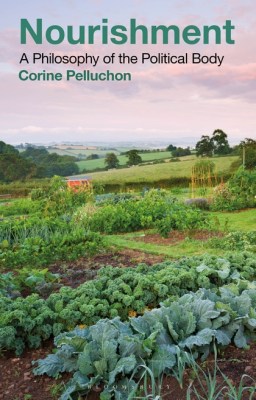
Corine Pelluchon, Nourishment: A Philosophy of the Political Body – Bloomsbury 2019

9781350073876Corine Pelluchon, Nourishment: A Philosophy of the Political Body, translated by Justin E. H. Smith,  Bloomsbury 2019

In this original and important book, Corine Pelluchon argues for nothing less than a new social contract that does justice to the biosphere, to all life, especially other animals, as well as human life, and to future generations. On the basis of a phenomenology of food and nourishment, she shows how freedom depends on the “love of life” and on sharing what nourishes with others. Pelluchon also takes up the practical challenge of reimagining democratic institutions to sustain this ethics of life. Anyone interested in questions of justice and environmental or food ethics should read this book.

Posted in Uncategorized | 2 Comments

Jo van Every – About the Short Guides Series on writing and publishing

Jo van Every, About the Short Guides Series – an introduction to her series of books about academic writing and publishing. The third volume is due out soon.

As I was finalising the third volume in this series of books, my editor suggested that I might want to write a series introduction. I published the first volume, The Scholarly Writing Process in November 2016. The 2nd volume, Finding Time for your Scholarly Writing was published in April/June 2018. The ebook of volume 3, Scholarly Publishing, will be publishing on 7 January 2019 with the paperback following later that month.

There are lots more links and some discussions about writing and publishing from this site archived here.

Posted in Publishing, Uncategorized, Writing | Leave a comment

Special Issue: Processes of Subjectivation: Biopolitics and the Politics of Literature (2018)

Special issue on Processes of Subjectivation: Biopolitics and the Politics of Literature – open access

Clare O'Farrell's avatarFoucault News

Special Issue: Processes of Subjectivation: Biopolitics and the Politics of Literature, Comparative Literature and Culture 20.4 (2018)_ Issue 20.4 (December 2018)
Ed. Azucena G. Blanco


The Eventualization of Political Thinking: From the Arab Revolutions to the Trump Era
Oscar Barroso

The Composition of History: a Critical Point of View of Michel Foucault’s Archaeology
Javier Gálvez Aguirre

“The Politics of Literature in Michel Foucault: Veridiction, Fiction and Desire”
Azucena G. Blanco

From Biopolitics to Biopoetics: a Hypothesis on the Relationship between Life and Writing
Julieta Yelin

Jewish Mysticism from Borges to Cirlot: a Transatlantic Approach to the Possibility of a Non-Subject Subjectivity
Erika Martínez

Literature of the Self in Foucault: Parrhesia and Autobiographical Discourse
Álvaro Luque

From Subjection to Dispossession: Butler’s Recent Performative Thought on Foucault’s Latest Work
Elisa Cabrera

Regaining the Subject: Foucault and the Frankfurt School on Critical Subjectivity
Miguel Alirangues

Of the Processes of Subjectivation as a…

View original post 40 more words

Posted in Uncategorized | Leave a comment

New issue of Critical Inquiry: Davidson and His Interlocutors (2019)

New issue of Critical Inquiry on Arnold Davidson. Includes the English translation of a 1967 lecture by Foucault on Structuralism and Literary Analysis.

Not sure all papers are open access.

Clare O'Farrell's avatarFoucault News

New issue of Critical Inquiry: Davidson and His Interlocutors
Volume 45, Number 2 | Winter 2019

Open access

Articles in this issue include amongst others

David Halperin, Queer Love

Daniele Lorenzini, The Emergence of Desire: Notes Toward a Political History of the Will

Michel Foucault, Structuralism and Literary Analysis

View original post

Posted in Uncategorized | Leave a comment

2018 in review – publications, talks, other academic stuff, and looking ahead to 2019

My book Shakespearean Territories was published by University of Chicago Press right at the end of the year, although it doesn’t seem to be available everywhere just yet. A journal article previewing some of the book’s arguments appeared as “Why Should People Interested in Territory read William Shakespeare?” in Territory, Politics, Governance (open access).

I also wrote a long review essay on the fourth volume of Michel Foucault’s Histoire de la sexualité, Les aveux de la chair for Theory, Culture and Society. It appeared open access on their website, and later in the Annual Review.

My book on George Canguilhem was completed this year and should appear in early 2019 with Polity. I spent much of the year researching and writing The Early Foucault, which is still in progress. Updates on this work can be found here. A number of book chapters, some written quite a long time ago, are forthcoming in collections in 2019.

I spoke on Foucault at the Universidad Complutense de Madrid, Goldsmiths, University of London (recording here) and the University of Sussex (recording here), and on Shakespeare at Kings College London and Queen Mary University of London (recordings here). I also took part in a discussion on urban territory with Neil Brenner at the Architectural Association (video here).

I taught both contemporary geopolitics and European political theory at Warwick, both of which were interesting for me, and I hope for the students. The biggest disappointment was not getting a visiting fellowship, which I’d really wanted.

Two researchers I co-supervised, Ari Jerroms (Monash) and António Ferrez de Oliveria (Warwick), were both awarded their PhDs. At the beginning of the year I was pleased to examine Johanne Bruun’s excellent thesis at Durham University. Congratulations to them all.

Looking ahead to 2019, I already have quite a few speaking and writing commitments. They are all on Foucault, Shakespeare and territory/terrain, which seem likely to be the focus of my work for some time to come. The three major talks are the Denis Cosgrove lecture in the Geohumanities on ‘Shakespearean Landscapes’, a keynote to the Association for Philosophy and Literature conference in Austria, and the Dialogues in Human Geography lecture at the Royal Geographical Society-Institute of British Geographers annual conference. The Dialogues lecture will probably be on territory/terrain, and the APL one on Shakespeare. There are some other events in the diary, some of which are provisional. As ever, all confirmed details of future talks are here.

The academic books I liked most from 2018 are listed here; the music I enjoyed here; and the novels and biographies read here. Thanks for reading this last year. Many blogs I follow seem to be going dormant or at least much quieter, and Twitter seems to have become a much more common source of sharing/commenting. I’ve noticed a drop in visitors here too, and have posted less as well, but there seems to be enough interest to keep this site going for a while longer.

Posted in Canguilhem (book), Georges Canguilhem, Michel Foucault, Shakespearean Territories, terrain, Territory, The Early Foucault, Uncategorized, William Shakespeare | Leave a comment

Novels and biographies read in 2018

These are the books I read as a break from standard academic reading, though the line gets blurred with some of the biographies. I read more of those this year than previous years, including the three volumes of Isaac Deutscher’s epic study of Trotsky.

For lists from previous years see here, and for some responses to questions asked about my novel reading see here.

  1. Maja Lunde, A History of Bees
  2. Alex Danchev, Georges Braque: A Life (biography)
  3. Ian McEwan, Nutshell
  4. Frida Beckman, Gilles Deleuze (biography)
  5. Thomas Flynn, Sartre: A Philosophical Biography
  6. Zadie Smith, White Teeth
  7. Mark Mason, Walking the Lines: The London Underground, Overground
  8. Graham Greene, The Quiet American
  9. Matthew Walker, Why We Sleep(non fiction)
  10. Jon McGregor, Reservoir 13
  11. Jean-Paul Sartre,War Diaries: Notebooks from a Phoney War 1939-1940
  12. Damion Searls, The Inkblots: Hermann Rorschach, His Iconic Test and the Power of Seeing
  13. John Banville, The Blue Guitar
  14. Elisabeth Roudinesco, Jacques Lacan: An Outline of a Life and History of a System of Thought (biography)
  15. Sarah Painter, Beneath the Water
  16. Pat Young, Til the Dust Settles
  17. Anthony McCarten, Darkest Hour: How Churchill Brought us Back from the Brink (biography)
  18. Naomi Klein, No is Not Enough (non fiction)
  19. Robert MacFarlane, Landmarks (non fiction)
  20. Chad Harbach, The Art of Fielding
  21. Alma Katsu, The Hunger
  22. Cara Hunter, Close to Home
  23. Matthew Richardson, My Name is Nothing
  24. Paul Trynka, Starman: David Bowie (biography)
  25. Lisa Appignanesi, Simone de Beauvoir (biography)
  26. Jane Harper, The Dry
  27. Robert Harris, Conclave
  28. Yaa Gyasi, Homegoing
  29. Isaac Deutscher, The Prophet Armed: Trotsky, 1879-1921(biography)
  30. Margaret Atwood, Hag-Seed: The Tempest Retold
  31. Heather Morris, The Tattooist of Auschwitz
  32. Graeme MacRae Burnet, The Accident on the A35
  33. Madeline Miller, Circe
  34. Elizabeth Day, The Party
  35. Val McDermid, Beneath the Bleeding
  36. Sarah Perry, The Essex Serpent
  37. Isaac Deutscher, The Prophet Unarmed: Trotsky, 1921-1929 (biography)
  38. Belinda Bauer, Snap
  39. Jason Powell, Jacques Derrida: A Biography
  40. John le Carré, The Constant Gardener
  41. Penelope Fitzgerald, The Bookshop
  42. Elizabeth Strout,Anything is Possible
  43. Aldous Huxley, The Devils of Loudun (non-fiction)
  44. Val McDermid, Forensics (non-fiction)
  45. Clare Mackintosh, Let Me Lie
  46. Laura Marshall,  Three Little Lies
  47. Andy Weir, Artemis
  48. Yann Moulier Boutang, Louis Althusser, une biographie: La formation du mythe 1918-1945: La matrice
  49. Cormac McCarthy, Blood Meridian
  50. Yann Moulier Boutang, Louis Althusser, une biographie: La formation du mythe 1945-1956: Ruptures et plis
  51. Mohsin Hamed, Exit West
  52. Michel Surya, Georges Bataille: An Intellectual Biography
  53. Victoria Helen Stone, Jane Doe
  54. Stuart Kendall, Georges Bataille (biography)
  55. Simeon Wade, Foucault in California (memoir)
  56. Naomi Alderman,The Lessons
  57. Scott Hamilton, The Crisis of Theory: EP Thompson, The New Left and Postwar British Politics (biography)
  58. Gillian Flynn, Sharp Objects
  59. Isaac Deutscher, The Prophet Outcast: Trotsky, 1929-1940 (biography)
  60. Shirley Jackson, We have Always Lived in the Castle
  61. Ray Monk, Bertrand Russell: The Spirit of Solitude 1872-1921 (biography)
  62. Sarah Vaughan, Anatomy of a Scandal
  63. Jane Harper, Force of Nature
  64. John le Carré, A Small Town in Germany
  65. A.S. Byatt, The Children’s Book
  66. Ben Okri, The Famished Road


Posted in Novels read, Uncategorized | 1 Comment

My favourite academic books of 2018

My favourite academic books of 2018. As with previous years – 2013, 2014, 2015, 20162017 – these are shaped by my interests, books that are sent to me, ones from publishers I review for, etc. etc. I’ve not read all the 2018 books I’ve bought or been sent, so while there are doubtless many other good books published this year, I can at least say that these are all worth reading.

books of 2018.png

  1. Chris Barrett, Early Modern English Literature and the Poetics of Cartographic Anxiety (OUP)
  2. Miguel de Beistegui, The Government of DesireA Genealogy of the Liberal Subject (Chicago)
  3. Andrea Mubi Brighenti and Mattias Kärrholm (eds.) Urban Walls: Political and Cultural Meanings of Vertical Structures and Surfaces (Routledge) – which I endorsed
  4. Georges Canguilhem, Œuvres complètes Tome V : Histoire des sciences, épistémologie, commémorations 1966-1995, edited by Camille Limoges (Vrin)
  5. Terrell Carver, Marx (Polity)
  6. Deborah Cook, Adorno, Foucault and the Critique of the West(Verso) – which I endorsed
  7. Jacques Derrida, Geschlecht III: Sexe, race, nation, humanité, edited by Geoffrey Bennington, Katie Chenoweth and Rodrigo Therezo (Seuil)
  8. Klaus Dodds, Ice: Nature and Culture (Reaktion)
  9. Verena Erlenbusch, Genealogies of Terrorism: Revolution, State Violence, Empire (Columbia) – which I endorsed
  10. Frantz Fanon, Alienation and Freedom, edited by Jean Khalfa and Robert J.C. Young (Bloomsbury)
  11. Michel Foucault, Les Aveux de la Chair, edited by Frédéric Gros (Gallimard) – review here
  12. Michel Foucault, Patrice Manglier and Dork Zabunyan, Foucault at the Movies, translated and edited by Clare O’Farrell (Columbia) – see my thoughts here
  13. Stefanos Gerolanos and Todd Myers, The Human Body in the Age of Catastrophe: Brittleness, Integration, Science, and the Great War (Chicago)
  14. Kélina Gotman, Choreomania: Dance and Disorder (OUP)
  15. Emilio de Ipola, Althusser: The Infinite Farewell, translated by Gavin Arnall (Duke)
  16. Caren Kaplan, Aerial Aftermaths: Wartime from Above (Duke)
  17. Mark Kelly, For Foucault: Against Normative Theory (SUNY Press) – which I endorsed
  18. Matthew Longo, The Politics of Borders: Sovereignty, Security, and the Citizen after 9/11 (CUP)
  19. Julia Reinhard Lupton, Shakespeare Dwelling: Designs for the Theatre of Life (Chicago)
  20. Jeff Malpas, Place and Experience A Philosophical Topography, second edition (Routledge) -– which I endorsed
  21. Doreen Massey, The Doreen Massey Reader, edited by Brett Christophers, Rebecca Lave, Jamie Peck, Marion Werner (Agenda)
  22. Derek P. McCormack, Atmospheric Things: On the Allure of Elemental Envelopment (Duke)
  23. Catherine Mills, Biopolitics (Routledge)
  24. Katharyne Mitchell, Making Workers: Radical Geographies of Education (Pluto)
  25. Kimberley Peters, Philip Steinberg, and Elaine Stratford (eds.), Territory beyond Terra (Rowman International) – I wrote the preface
  26. Steven Seegel, Map Men: Transnational Lives and Deaths of Geographers in the Making of East Central Europe (Chicago)
  27. Veronica Strang et al. eds., From the Lighthouse: Interdisciplinary Reflections on Light (Routledge) – which I endorsed
  28. Laura Vaughan, Mapping Society: The Spatial Dimensions of Social Cartography (UCL Press – open access pdf available)
  29. Francesco Vitale, Biodeconstruction: Jacques Derrida and the Life Sciences (SUNY)
  30. Maja Zehfuss, War and the Politics of Ethics (OUP)

I’d also like to mention David Beer, The Data Gaze, and Ross Exo Adams, Circulation and Urbanizationwhich are in the Society and Space series I edit for Sage.

Posted in Boundaries, Doreen Massey, Frantz Fanon, Georges Canguilhem, Jacques Derrida, Jeff Malpas, Karl Marx, Louis Althusser, Maja Zehfuss, Michel Foucault, Philip Steinberg, Society and Space, Uncategorized, William Shakespeare | 11 Comments

Ross Exo Adams, Circulation and Urbanization – Sage 2018 (Society and Space series)

93182_9781473963313.jpgRoss Exo Adams, Circulation and UrbanizationSage 2018 (Society and Space series)

Circulation and Urbanization is a foundational investigation into the history of the urban. Moving beyond both canonical and empirical portrayals, the book approaches the urban through a genealogy of circulation – a concept central to Western political thought and its modes of spatial planning. Locating architectural knowledge in a wider network of political history, legal theory, geography, sociology and critical theory, and drawing on maritime, territorial and colonial histories, Adams contends that the urban arose in the nineteenth century as an anonymous, parallel project of the emergent liberal nation state. More than a reflection of this state form or the product of the capitalist relations it fostered, the urban is instead a primary instrument for both: at once means and ends.

Combining analytical precision with interdisciplinary insights, this book offers an astonishing new set of propositions for revisiting a familiar, yet increasingly urgent, topic. It is a vital resource for all students and scholars of architecture and urban studies.

This book is part of the Society and Space series, which explores the fascinating relationship between the spatial and the social. These stimulating, provocative books draw on a range of theories to examine key cultural and political issues of our times, including technology, globalisation and migration.

Circulation and Urbanization is a timely and powerful retheorization both of the “urban” and of processes of urbanization, artfully marking out the complex and often elusive historical entanglements of spatial orders, forms of management, technologies of political power, legal frameworks, economic relations, and infrastructures of circulation as they emerged in the 19th century.  Taking as a starting point Ildefonso Cerdá’s Teoría general de la urbanización, Adams brilliantly resituates the epistemic and political legacy of this landmark study, offering at once a prehistory of the contemporary nexus of space, the state, security, and capital, and a conceptual toolbox, even a cartography for understanding how power functions within cities and populations, and upon subjects, through circulation and urbanization.  The book’s ramifications are rich and manifold, for this interdisciplinary study also harbours a cogent diagram for confronting such processes with new political strategies, for opening up new types of political space.

Felicity Scott
Columbia University

Adams shatters conventional urban thought to reveal (and revel in) the circulatory logics at the heart of urbanization. A truly eye-opening book.

Philip Steinberg
Durham University

Urbanists of the world:  rethink your most basic assumptions!  In this path-breaking intervention, Ross Exo Adams reveals that “cities” are only one dimension of the urban problematique.  His wide-ranging explorations radically destabilize contemporary urban ideologies.  They also produce a strikingly original perspective on the historicity and present situation of cities, urbanization, infrastructure, territory and design.  This is essential reading for anyone concerned to understand and shape the worlds of urbanization we have inherited from earlier rounds of capitalist industrial development, state strategy and everyday insurgency.

Neil Brenner
Harvard University

This is the latest book in the Sage Society and Space book series, which I edit.

Previously published titles are

David Beer, The Data Gaze

Dan Bulley, Migration, Ethics and Power: Spaces Of Hospitality In International Politics

Marcus Doel, Geographies of Violence: Killing Space, Killing Time

Francisco Klauser, Surveillance and Space

Forthcoming volumes include (titles provisional)

Martina Tazzioli, The Making of Migration

Shiloh Krupar and Greig Crysler, The Waste Complex: Capital \ Ecology \ Citizenship

Kirsten Simonsen and Lasse Koefoed, Geographies of Embodiment

If you’d like to discuss an idea for the series, please get in contact. While the books are not textbooks, they do need to be suitable for teaching, with a good possibility of adoption. Here’s the series description:

The Society and Space series explores the fascinating relationship between the spatial and the social. Each title draws on a range of modern and historical theories to offer important insights into the key cultural and political topics of our times, including migration, globalisation, race, gender, sexuality and technology. These stimulating and provocative books combine high intellectual standards with contemporary appeal for students of politics, international relations, sociology, philosophy, and human geography.

Posted in Uncategorized, urban/urbanisation | Leave a comment

The Early Foucault Update 22: Acéphale, Critique, Foucault’s thesis, Uppsala, Sussex

In the second half of term I felt I made little progress, but have done a little reading and research in and around teaching, marking, meetings and other tasks. I did write the Introduction to a translation, which should be out in 2019. More details soon, hopefully.

On the early Foucault work, among other things I’ve been reading the Acéphale journal. Acéphalewas a journal founded and mostly written by Georges Bataille in the late 1930s. I know from his notes that Foucault read the journal, which was largely about Nietzsche in its short life. The British Library has some issues although all are online. But there was a reproduction of all five issues with an introduction that appeared in 1980, which I was able to consult at the Tate Gallery library.

In 1955, Foucault’s book Maladie mentale et personnalité was reviewed in Critique. The book didn’t have much attention at all on first publication, so this is interesting. I had read this review a while ago, but wanted to recheck it in the light of some of the work I’ve been doing recently. The review was by Roland Caillois. Critique was a journal set up by Georges Bataille, which he edited until his death in 1962. Foucault joined the board the following year, as part of the reorganisation when Jean Piel became editor. I think Roland Caillois was the brother of Roger Caillois, who had worked with Bataille in the 1930s. Roland was the editor of the volume of Spinoza’s work in the Pléiade series, but I can’t find much else about him. I have generally been following up on a lot of things in relation to Critique, including the correspondence between Bataille and Eric Weil.

Perhaps the most exciting thing was that I found a book which I’ve been trying to locate for a long time and had almost given up hope of ever locating. The Plon edition of Folie et déraison appeared in 1961, shortly after the thesis defence. That’s the formal first edition, reprinted in 1964. (There are three subsequent French editions, abridged or with a new preface and appendices.) But there was an earlier printing before the thesis defence. Estimates of how many copies were made vary, but it was unquestionably a small print run. A reproduction of its cover appears in one of the collections of documents about Histoire de la folie and its legacy, but I’d never seen a physical copy. Some libraries claim to have a copy of Foucault’s ‘thesis’, but they generally mean the book, which was of course the text of the thesis. Often, they do have the 1961 first edition, although sometimes it’s actually one of the reprints. It’s difficult to know from most catalogues, because both the pre- and post-defence versions have the same title, publisher and year of publication. So, a copy of the actual thesis was very hard to find. But then I chanced upon a listing for a copy for sale. Fortunately, the rare book seller was in London, so I went over to their shop to have a look. They couldn’t find it! I explained the situation, and gave them my Warwick card and they said they’d be in touch if they found it. I imagined I’d never hear from them again. But a couple of hours later they got in touch, and said it was in their other store. I was able to have a look the next day.

I have now confirmed that the text is the same as the first edition, with the same pagination. The differences are just the cover and the inside title page, and the absence of the advertising pages at the end. I’d love to have been able to buy it, but at £4500 it was rather out of my budget…

I have also been working with a Swedish MA student as part of a Warwick research scheme. He’s been providing me with some translations and summaries of texts relating to Foucault’s time in Uppsala which were published in Swedish. This has been really helpful and given me some new leads to follow up on. I did the same last year with a Polish student who provided me with a very helpful summary of a book on Foucault’s time in Warsaw.

I also spoke about the work at the University of Sussex. This was an interesting event for me, as the talk was preceded by a small discussion with staff and students who had been reading Foucault: The Birth of Power. The talk was on the early Foucault, and I talked about sources and approach as much about content and findings.

An audio recording of the talk (not the discussions) is available here.

I have a visit to Paris booked for early in the new year, with a plan to visit IMEC at the end of the trip. In Paris I can do a lot of the work I need to do on this manuscript, though I will need to make trips to Uppsala, Tübingen, and possibly Hamburg to deal with all the remaining things.

Before then, I have a book review and a handbook chapter to write. But first a holiday.

The previous updates on this project are here; and the previous books Foucault’s Last Decade and Foucault: The Birth of Power are both available from Polity. Canguilhem is forthcoming in early 2019, and is discussed a bit more here. Several Foucault research resources such as bibliographies, short translations, textual comparisons and so on are available here.

Posted in Baruch Spinoza, Foucault: The Birth of Power, Friedrich Nietzsche, Georges Bataille, Michel Foucault, The Early Foucault, Uncategorized | 1 Comment

My favourite music of 2018

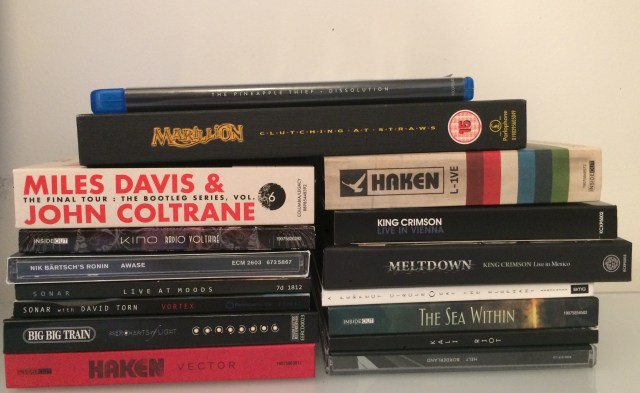
The music I enjoyed the most in 2018:-

Music of 2018.jpeg

  1. A Perfect Circle, Eat the Elephant
  2. Nik Bärtsch’s Ronin, Awase
  3. Big Big Train, Merchants of Light
  4. John Coltrane, Both Directions at Once: The Lost Album
  5. Miles Davis and John Coltrane, The Final Tour 1960: The Bootleg Series Vol 6
  6. Haken, L-1VE
  7. Haken, Vector
  8. Hely, Borderland
  9. Kali, Riot
  10. King Crimson, Live in Vienna
  11. King Crimson, Meltdown: Live in Mexico
  12. Kino, Radio Voltaire
  13. Marillion, Clutching at Straws reissue
  14. The Pineapple Thief, Dissolution
  15. Regal Worm, Pig Views
  16. Joe Satriani, What Happens Next
  17. The Sea Within, The Sea Within
  18. Sonar with David Torn, Vortex
  19. Sonar with David Torn, Live at Moods
  20. Travis and Fripp, Between the Silence

Live, I enjoyed Sons of Apollo, Black Country Communion, Peter Hammill, Steven Wilson, The Aristocrats, The Pineapple Thief, Fish, King Crimson, Nik Bärtsch’s Ronin, and Sonar with David Torn.

For music from previous years, see the lists from 20172016, 2015, 20142013 and 2012.

Posted in Music, Uncategorized | 8 Comments