Thanos Zartaloudis, The Birth of Nomos – Edinburgh University Press, November 2018

9781474442008Thanos Zartaloudis, The Birth of Nomos – Edinburgh University Press, 2018

Unfortunately only in an expensive hardback at present, but this looks a major study.

Delves into the history of the ancient Greek word nomos (and related words) to reveal the interdisciplinary depth of this term beyond its later meaning of ‘law’ or ‘law-making’
This is a highly original, interdisciplinary study of the archaic Greek word nomos and its family of words. Thanos Zartaloudis draws out the richness of this fundamental term by exploring its many uses over the centuries.

The Birth of Nomos includes extracts from a wide range of ancient sources, in both the original and English translation, including material from legal history, philosophy, philology, linguistics, ancient history, poetry, archaeology, ancient musicology and anthropology. Through a thorough analysis of these extracts, we gain a new understanding of nomos and its foundational place in the Western legal tradition.

Key Features

Assembles a genealogical history of the ancient Greek work nomos, showing how it contains a richness that is not reflected in its classical and modern usage as simply ‘law’ or ‘law-making’

Draws on works by ancient Greek philosophers, poets and tragedians including Homer, Hesiod, Alcman, Pindar, Archilochos, Theognis, Heraclitus, Aeschylus, Sophocles, Euripides and Plato

Includes extracts from ancient primary sources, in both the original and in English translation, to analyse how nomos has been used in the literary evidence and in context

Considers how nomos has been used by contemporary philosophers, including Agamben, Foucault, Heidegger, Schmitt, Deleuze and Axelos, and re-examines their interpretations

 

Posted in Uncategorized | 2 Comments

Books received – Bataille, Bousquet, Elders, Barney & Montag (eds.), de Ipola, Venn

IMG_3801.JPG

Georges Bataille, Une Liberté Souveraine; Antoine Bousquet, The Eye of War: Military Perception from the Telescope to the Drone; Fons Elders, Reflexive Water; Richard Barney and Warren Montag (eds.), Systems of Life: Biopolitics, Economics and Literature on the Cusp of Modernity; Emilio de Ipola, Althusser: The Infinite Farewell; Couze Venn, After Capital.

The Eye of War and After Capital were sent by the publishers, and Systems of Life was recompense for review work. The others were bought second-hand. Reflexive Water is probably best known for being the original place where the Michel Foucault-Noam Chomsky debate was published, but it also includes an interesting discussion between Henri Lefebvre and Leszek Kolakowski, and ones with Karl Popper and A.J. Ayer, among others.

Posted in Georges Bataille, Henri Lefebvre, Louis Althusser, Michel Foucault, Noam Chomsky, Uncategorized | Leave a comment

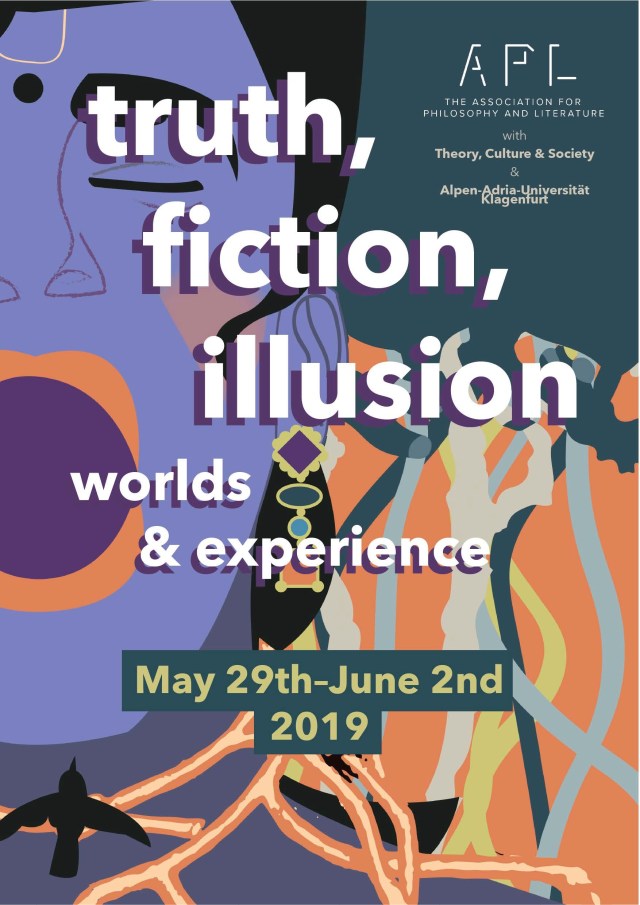
CFP: Truth, Fiction, Illusion: Worlds and Experience – APL conference, Klagenfurt, Austria, May 29-June 2 2019

CFP: Truth, Fiction, Illusion: Worlds and Experience – Association for Philosophy and Literature conference, with Theory, Culture & Society and Alpen-Adria Universität Klagenfurt, Austria, May 29-June 2 2019

aplflyer181120v2.jpg

Posted in Conferences, Uncategorized | Leave a comment

Law and Politics in the Anthropocene, Birkbeck, 10 December 2018

Law and Politics in the Anthropocene, Birkbeck, 10 December 2018

Free to attend, but registration required

Speakers: Alain Pottage (LSE) / Andreas Philippopoulos-Mihalopoulos (University of Westminster) / Daniel Matthews (University of Hong Kong) / Lilian Moncrieff (University of Glasgow) / Mark Maslin (UCL) / Nayanika Mathur (University of Oxford) / Rory Rowan (University of Zurich) / Vito de Lucia (UiT Arctic University of Norway).

Many now claim that we have entered a new climatic regime (the Anthropocene) that marks a transition from the previous geological epoch (the Holocene), a peri- od of 12,000 in which human civilisations emerged. The Anthropocene thesis con- tends that collective human action has become so potent that it is shaping the earth’s systemic functioning. In this way, the Anthropocene reveals a new ontol- ogy or mode of being-in-the-world in which human agency is intimately bound up with the functioning of the earth’s biogeochemical systems and cycles, situating human agency and our political formations within rather than set against the so- called ‘natural environment’. However, within most legal and political thought this ontology remains remarkably difficult to grasp. Throughout modernity legal and political forms have largely been understood to transcend any connection to the inorganic, the non-human or the environmental. The aspirations of human civ- ilisation are commonly thought to depend on the postulation of an anthropogenic superiority in which a ‘natural condition’ (or ‘state of nature’) is overcome in the pursuit of a truly ‘political’ life. The prospect of human survival in this new epoch is bound up with a range of nonhuman forces that our political and legal thought has largely approached as an uninteresting backdrop against which human dra- mas are played out. In the relatively stable conditions of the Holocene this ‘back- drop ontology’ was perhaps understandable. But the Anthropocene tells us that the backdrop is beginning to move, the scenery and props have come to life.

With a focus on questions of method, orientation and encounter, speakers will address the flowing concerns:

    • To what extent do the methodologies which have largely defined modernity – dialectics, historical materialism, genealogy and so on – continue to assists us in the context of the Anthropocene?
    • Towards what ought our thinking on this topic be both temporally and spatiallyorientated: an unjust past or an apocalyptic future; towards Europe or China; the global North or South?
    • What are the fields of law (environmental law, international law, corporate law) and politics (international relations, security studies, biopolitics) that need to be brought into conversation?
    • How can we nurture interdisciplinary literacy across the natural and social sciences, arts and humanities in order to address the challenges that the Anthropocene brings into view?

This event is organised by BIH Visiting Fellow, Dr. Daniel Matthews, and is supported by the Birkbeck Institute for the Humanities and the Birkbeck Centre for Law and the Humanities.


Posted in Uncategorized | Leave a comment

CFP: Violence, Space and the Archives – NUI Galway, 23-24 May 2019

CFP: Violence, Space and the Archives – National University of Ireland, Galway, 23-24 May 2019

We invite paper submissions from across the disciplinary spectrum for a conference on ‘Violence, Space and the Archives’ to examine the challenges and possibilities presented by archival work that interrogates the imbrications of violence and space.

Many research projects concerned with the spatial, contextual, and/or historical specificities of violence involve the assembling of an empirical corpus, however defined, in order to (re)construct moments of struggle and contestation. Archives are often constituted by, and reflect, the concerns of power. The archive is a site of silence as much as a site of statement. Still, archival collections often allow the voices of the dispossessed, the marginal, and those most subject to regimes of power, to speak, albeit often through a narrowed aperture. Along with the strategic concerns of officialdom, the archives may also give voice to alternative political desires and ambitions, revealed through moments of contestation and resistance. As a political technology, archives render the state’s claimed spaces visible and orderable through cataloguing, but may also underline the contingency of dominant configurations of power by revealing sites of refusal. Of course, ’the archive’ is not limited to institutional and official repositories, but also to a shared fidelity to unofficial and counter-hegemonic memories that refuse to be forgotten.

We invite 20 minute papers that explore some of the following non-exhaustive list of themes:

•     The silence of the archive

•     Political desires/spatial imaginaries

•     Making contested space/ rebel space/ oppositional space visible

•     Contentious episodes and the archive

•     Histories/genealogies of thought as archive

•     Collective memory and resistance

•     Humanitarian archives and histories of violence

•     Archiving in times of conflict

•     Conflict and digital archives

Send abstracts of 250-300 words, along with name and affiliation and a short bio (100 words) to violenceandspace@gmail.com by 21st January 2019

The conference takes place in NUI Galway and is organised by the Whitaker Institute’s Research Cluster on Conflict, Humanitarianism and Security in association with the Moore Institute, the School of Political Science & Sociology and the Peace and Conflict Specialist Group of the Political Studies Association of Ireland. It builds on the success of the 2018 Conference on Violence, Space, and the Political.

Organisers: Gary Hussey and Niall Ó Dochartaigh, School of Political Science and Sociology, NUI Galway

Posted in Uncategorized | 1 Comment

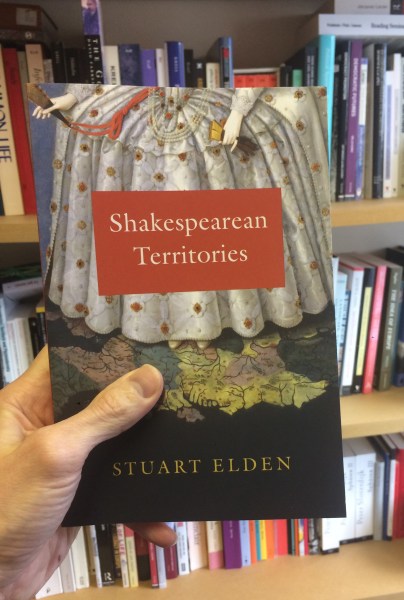
Advance copy of Shakespearean Territories (University of Chicago Press, 2018) received

STsI’ve just received an advance copy of Shakespearean Territories (University of Chicago Press, 2018). The book has been a long time in production, and the final stages were delayed by paper shortages and printer problems in the US. I’ve been told that warehouse copies will follow, which usually the sign for when the book is more generally available from other sellers.

Shakespeare was an astute observer of contemporary life, culture, and politics. The emerging practice of territory as a political concept and technology did not elude his attention. In Shakespearean Territories, Stuart Elden reveals just how much Shakespeare’s unique historical position and political understanding can teach us about territory. Shakespeare dramatized a world of technological advances in measuring, navigation, cartography, and surveying, and his plays open up important ways of thinking about strategy, economy, the law, and colonialism, providing critical insight into a significant juncture in history. Shakespeare’s plays explore many territorial themes: from the division of the kingdom in King Lear, to the relations among Denmark, Norway, and Poland in Hamlet,  to questions of disputed land and the politics of banishment in Richard II. Elden traces how Shakespeare developed a nuanced understanding of the complicated concept and practice of territory and, more broadly, the political-geographical relations between people, power, and place. A meticulously researched study of over a dozen classic plays, Shakespearean Territories will provide new insights for geographers, political theorists, and Shakespearean scholars alike.

Jeff Malpas, University of Tasmania
Shakespearean Territories is a truly groundbreaking volume that enriches our reading of Shakespeare at the same time as it illuminates our understanding of the nature and history of territory. An insightful and engrossing work, Shakespearean Territories demonstrates Elden’s unquestionable position as the most significant thinker of territory and the geographic working today—and in relation to the literary and dramatic no less than the political.”
Alexander Murphy, University of Oregon
“A work of meticulous scholarship, Shakespearean Territories teases out and explains a wide range of geographical themes present in Shakespeare’s plays with finesse and profound interpretation. Beyond the specific insights he offers on territory and geography as refracted through Shakespeare’s plays, Elden displays the substantial value of bridging literary and historical-geographical analysis.”
Garrett Sullivan, Penn State University
Shakespearean Territories offers illuminating analyses of Shakespeare’s works that are immersed in relevant scholarship on the colonial, geophysical, and corporeal aspects of territory. This is a fascinating textual analysis that builds upon the concept of territory with Elden’s characteristic nuance and depth.”
Contents

Introduction: Shakespearean Territories
Chapter 1: Divided Territory: The Geo-politics of King Lear
Chapter 2: Vulnerable Territories: Regional Geopolitics in Hamlet and Macbeth
Chapter 3: The Territories: Majesty and Possession in King John
Chapter 4: Economic Territories: Laws, Economies, Agriculture, and Banishment in Richard II
Chapter 5: Legal Territories: Conquest and Contest in Henry V and Edward III
Chapter 6: Colonial Territories: From The Tempest to the Eastern Mediterranean
Chapter 7: Measuring Territories: The Techniques of Rule
Chapter 8: Corporeal Territories: The Political Bodies of Coriolanus
Chapter 9: Outside Territory: The Forest in Titus Andronicus and As You Like It
Coda: Beyond Pale Territories

References to Shakespeare’s Plays
Notes


Posted in Shakespearean Territories, Uncategorized, William Shakespeare | 1 Comment

Tiago Santos Almeida, Canguilhem e a gênese do possível – Editora LiberArs 2018

canguilhem e a genese do possivel_capa.jpgTiago Santos Almeida, Canguilhem e a gênese do possível: Estudio sobre a historicização das ciências [Canguilhem and the genesis of the possible. A study on the historicization of sciences] – Editora LiberArs 2018

Tiago tells me that the Table of contents, Preface and Introduction are on Academia.edu, and that

The book will be released november 30, during the “6th Colloquium on History and Philosophy of Science: the Human Sciences”. I also attached the program. The colloquium will take place at the History Department of the Federal University of Goiás, Brazil.
181108_coloquio_filosofia-historia - cartaz-1.jpg
Posted in Georges Canguilhem, Uncategorized | Leave a comment

Stephen Legg and Deena Heath (eds.) South Asian Governmentalities: Michel Foucault and the Question of Postcolonial Orderings – Cambridge UP, 2018

9781108428514Stephen Legg and Deena Heath (eds.), South Asian Governmentalities: Michel Foucault and the Question of Postcolonial Orderings – Cambridge University Press, 2018

This volume analyses the ways in which the works of one of the most influential philosophers of the twentieth century, Michel Foucault, have been received and re-worked by scholars of South Asia. South Asian Governmentalities surveys the past, present, and future lives of the mutually constitutive disciplinary fields of governmentality – a concept introduced by Foucault himself – and South Asian studies. It aims to chart the intersection of post-structuralism and postcolonialism that has seen the latter Foucault being used to ask new questions in and of South Asia, and the experiences of post-colonies used to tease and test the utility of European philosophy beyond Europe. But it also seeks to contribute to the rich body of work on South Asian governmentalities through a critical engagement with the lecture series delivered by Foucault at the Collège de France from 1971 until his death in 1984, which have now become available in English.

1. Introducing South Asian governmentalities Deana Heath and Stephen Legg
2. Governmentality in the East Partha Chatterjee
3. Pastoral care, the reconstitution of pastoral power and the creation of disobedient subjects under colonialism Indrani Chatterjee
4. The abiding binary: the social and the political in modern India Prathama Banerjee
5. Colonial and nationalist truth regimes: empire, Europe and the latter Foucault Stephen Legg
6. Law as economy/economy as governmentality: convention, corporation, currency Ritu Birla
7. Do elephants have souls? Animal subjectivities and colonial encounters Jonathan Saha
8. Plastic history, caste and the government of things in modern India Sara Hodges
9. Changing the subject: from feminist governmentality to technologies of the (feminist) self Srila Roy
10. The tortured body: the irrevocable tension between sovereign and biopower in colonial Indian technologies of Rule Deana Heath
11. The subject in question Gerry Kearns

Posted in Uncategorized | Leave a comment

Adam Bobbette and Amy Donovan (eds.), Political Geology: Active Stratigraphies and the Making of Life – Palgrave 2018

978-3-319-98189-5Adam Bobbette and Amy Donovan (eds.), Political Geology: Active Stratigraphies and the Making of Life – Springer 2018. Looks an interesting collection but a great shame about the prohibitive price.

This book builds on the enthusiasm for the geological generated by the Anthropocene but expand beyond it in three ways. First, it will probe deeper into the politics, history, and contemporary practices of the geological sciences as a way of thinking, representing, and communicating the geos. This will open up the history of the earth sciences as a science that has been fundamentally imbricated with politics and that its politics has been one of making the geological sensible. Second, it will consider in detail geologies that are volatile and vulnerable and that because of this are subject to practices of governance. Finally, it will multiply the tradition of geological thought in the sciences by considering subaltern, amodern, vernacular, and counter traditions of geological practice and science and its political resonances. This volume will consider these three frameworks through essays historical, ethnographic and conceptual, mindful of the richness of empirical detail and the innovative consequences of looking at the intersections of geology and politics.
The book brings together key thinkers on geological politics and political geology as well as emerging topics in human and cultural geography. It will include ten clearly structured chapters, and will seek to solidify a field of inquiry that is of interest to geographers, philosophers of science, anthropologists and sociologists.

Posted in Uncategorized | Leave a comment

Cities and colonialism – Royal Academy, 3 December 2018, 6.30pm

Cities and colonialism: The Space of Colonialism – Royal Academy, 3 December 2018, 6.30pm – with Ana Naomi de Sousa, Aya Nasser, Yara Sharif and Léopold Lambert,

How have the urban spaces of Lisbon, Cairo and Jerusalem been shaped by colonialism? Join our panel as we discuss the impact of colonialism on contemporary urban landscapes.

Architecture has been used politically, to shape identities, form behaviours and as a tool to channel power. However, architecture also has the potential to subvert politics and to reappropriate space.

In the second event in The Space of Colonialism series, we look at the political potential of architecture through the lens of colonialism and the city. With a focus on Lisbon, Cairo and Jerusalem, we will explore how post-colonial politics continue to transform the built environment and shape public space in these different geographical contexts.

Our panel will examine how a colonial state can demolish and construct parts of a city to assert control, organising cities into spaces in which citizens are permitted or excluded. Join us for a discussion on the city as a stage for anti-colonial struggles.

The Space of Colonialism series is guest curated by Léopold Lambert and The Funambulist, a bi-monthly magazine dedicated to the politics of space and bodies.

Posted in Uncategorized | 1 Comment