2017 in review: round-up of LSE Impact blog top posts on academic writing
I linked to some of these, but this is a useful summary. Lots more links and discussion on writing and publishing here.
2017 in review: round-up of LSE Impact blog top posts on academic writing
I linked to some of these, but this is a useful summary. Lots more links and discussion on writing and publishing here.
AHR Conversation: Walls, Borders, and Boundaries in World History with Suzanne Conklin Akbari, Tamar Herzog, Daniel Jütte, Carl Nightingale, William Rankin and Keren Weitzberg.
Since 2006, the AHR has published nine “Conversations,” each on a subject of interest to a wide range of historians.1 For each the process has been the same: the Editor convenes a group of scholars with an interest in the topic, who, via e-mail over the course of several months, conduct a conversation, which is then lightly edited and footnoted, finally appearing (with one exception) in the December issue. The goal has been to provide readers with a wide-ranging consideration of a topic at a high level of expertise, in which the participants are recruited across several fields and periods. It is the sort of publishing project that this journal is uniquely positioned to undertake.
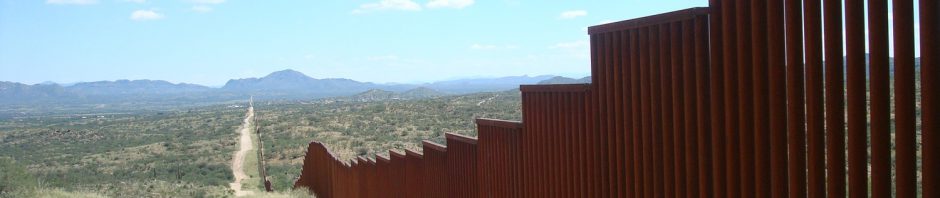
This year’s topic, “Walls, Borders, and Boundaries in World History,” has an obvious contemporary relevance, most dramatically in the calls to “Build That Wall” that were a shrill trope in the recent U.S. presidential campaign. Beyond this, the specter of building walls, defending borders, and reasserting boundaries haunts political life in many parts of the world, from the wall separating Israel and the Palestinian territories; to the potential redrawing of the boundaries of several nation-states, as regions—Kurdistan in Afghanistan, Catalonia in Spain—attempt to assert their independence; to the oft-heard pleas for borders to be policed or even closed in the face of what seems to be a worldwide refugee crisis. Contemporary public discourse on this subject is usually cast in moral terms: walls are seen as either good or bad; boundaries and borders are viewed either as regrettable obstacles to the virtues of openness and cosmopolitanism or as necessary to keep out things and people deemed undesirable. Our conversation will certainly attend to the contemporary aspects of our topic, but we want to add a historical perspective to thinking about “walls, borders, and boundaries,” while also remaining alert to the methodological and theoretical problems encountered in attempting to make sense of the many different phenomena and experiences evoked by our topic.
I’d also point to some of the pages on the site, rather than just the posts. Notably the resources pages on things like Writing and Publishing, Foucault and so on, which collect a lot of posts by theme.
Over the Christmas and New Year period I was in Tenerife, for a holiday and some cycling. Unfortunately in the second half of the time there I was unwell, and had dizziness and balance problems, so did no further cycling. But in the first half of the time I did a few shorter rides and the big climb I’d been planning to do. This was to ride to the Mount Teide observatories at Izaña. The road reaches 2330 metres above sea level, which is the highest I’ve been on a bike, and the climb began from Caletillas on the north-east coast. It was tough.
On a previous trip I’d cycled up to the Teide plateau from the southwest of the island. That was very hard, but I think this was tougher. There is a ridge running roughly south-west to north-east from the plateau, and the first part of the challenge was to get onto that. The climb from Afaro to Los Loros is itself an ‘hors catégorie’ climb, and it’s only 11 miles of the total. From there it was about 8 miles to the observatory, marginally easier, but with some drops that you have to reclimb. It was 55 mile ride in total, and I came down the way I went up. If you’re interested, there is a animated map video from relive.cc
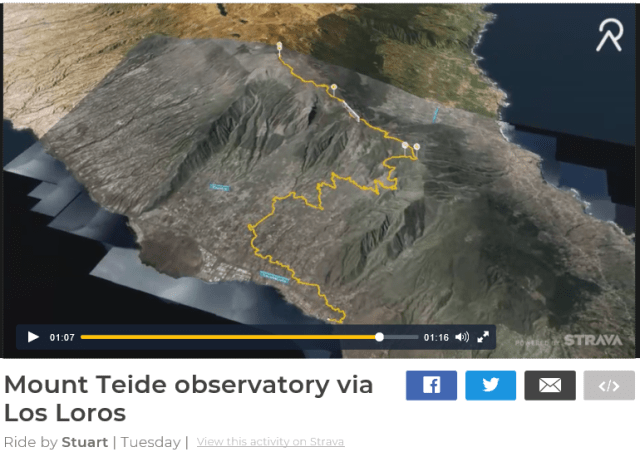
The Mount Teide volcano itself is much higher, but there is a cable car to the top. The highest point on the paved road can only be reached by descending from where I was into the crater, and then climbing again. But I think it’s only 20 metres higher than the point I reached, and would have added about 20 miles onto the ride. Another time, perhaps.
 Derek Gregory has a very nice tribute to Peter Meusburger, who died in December.
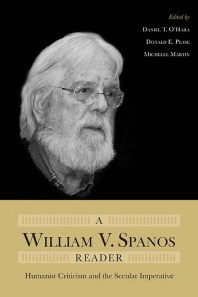 Literary critic and theorist William V. Spanos died on 29th December. His boundary 2 colleague Paul Bové has a brief report here. Although I never met him or heard him speak, I really liked his books Heidegger and Criticism, The Errant Art of Moby-Dick: The Cold War, the Canon, and the Struggle for American Literary Studies and America’s Shadow: An Anatomy of Empire.
A list of the novels and biographies I read in 2017. For the most part these are the reading I do which is not related to work, though some of the biographies blur that line. A mixed bag, of which a couple of the biographies made my list of favourite academic books. Ones I particularly liked were Still Time, Eight Months on Ghazzah Street, HHhH (though The 7th Function of Language was disappointing), and His Bloody Project. I enjoyed Sher’s diaries, and am looking forward to his King Lear diary this year. I’m starting the new year with Alex Danchev’s biography of Georges Braque, having liked his Cézanne this year. For lists from previous years see here, and for some responses to questions asked about my novel reading see here.
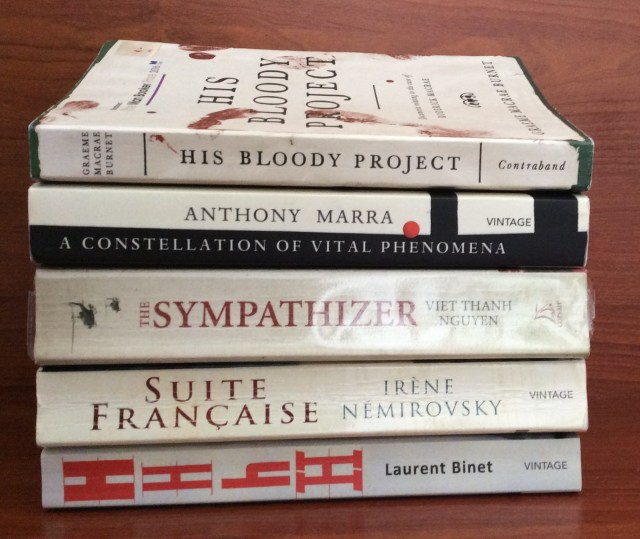
Holiday reading
This is my last day of work in 2017. Tomorrow we head to Tenerife for ten days holiday, hoping for sunshine and lots of cycling.
The last major work task I completed today was the copyediting queries for Shakespearean Territories. The book was submitted in early 2017, had two very thoughtful reports, and was resubmitted in the summer. University of Chicago Press employ really brilliant copyeditors. Several small mistakes were caught, references were tidied up, and a few unclear sentences were highlighted for me to rework. But it was not an invasive edit, and the text that it going to the printer is very much the one I submitted. The book is scheduled for publication in October 2018.
 Politically 2017 was bleak, so I’m going to focus on other things here. 2017 began for me with the publication of Foucault: The Birth of Power, the second of my Foucault books for Polity. I spent much of the year writing the third Foucault book, The Early Foucault, which has been progressing well (see my sequence of updates here); and I also did a lot of preparatory work for a book on Georges Canguilhem for Polity’s Key Contemporary Thinkers series (a little more here). Lots of that work was informed by visits to the archives in Paris, which I plan to revisit in 2018. I anticipate Canguilhem will appear in early 2019, and The Early Foucault sometime after that, depending on publication plans of early lecture courses.
One of my most popular posts this year was about why I prioritise writing books over articles, even in an era of research assessment. But I did publish two articles in 2017 – ‘Legal Terrain: The Political Materiality of Territory’; ‘Foucault and Shakespeare: Ceremony, Theatre, Politics’ (both links are open access). An archive discussion which I edited appeared in Theory, Culture & Society – “Danger, Crime and Rights: A 1983 conversation between Michel Foucault and Jonathan Simon”.
The Birth of Territory appeared in Chinese translation, which is the first book of mine (as opposed to articles or chapters) to appear in another language. Two more Chinese translations and three in Korean are under contract. The Lefebvre rural writing translation project with Adam David Morton is progressing, albeit slowly. A lot of work this year was logistical – funding, dealing with publishers, rights, etc. Hopefully next year will see some more intellectual labour on this.
My Foucault books got some generous praise and engagement. There are reviews of Foucault’s Last Decade by Kurt Borg in Foucault Studies and in Manchester Review of Books. There is one of Foucault: the Birth of Power at the LSE Review of Books by Syamala Roberts. A review of both books can be found in The Nation by Bruce Robbins and in 3am Magazine by Peter Gratton (along with Foucault’s The Punitive Society). There is a discussion with Dave O’Brien about Foucault: The Birth of Power at New Books in Critical Theory. All the reviews and interviews are linked here.
I had a very productive visit to ACCESS Europe at the University of Amsterdam between April and June 2017, and gave lectures or seminars there, at the British Library, University of Durham, SOAS, University of Oslo, the Bartlett School at UCL, the Institute of Historical Research, at the Rose Theatre Kingston, Maynooth University, the Royal Irish Academy and the Nordic Geographers meeting at the University of Stockholm. Many thanks to all who invited me or attended talks.
I organised two workshops for the Territory sub-theme of the ICE-LAW project, one in Amsterdam and one at Warwick. My reports on these two fascinating days are here and here.
I examined two excellent PhD theses this year – Yvonne Rinkart at Aberystwyth and Rachael Squire at Royal Holloway. Two of my own PhD students, Mara Duer and Lorenzo Vianelli, defended their own theses and passed subject to revisions. Congratulations to them all. I taught the Geopolitics Today class to our MA students, and hope to teach some political theory again in 2018.
Biggest disappointment was to be shortlisted for a major research professorship, but not to get it. To be clear, this was not a post outside Warwick, but a national competition that would have bought out my time. I was encouraged to rework it for another research fellowship scheme, but decided to wait: I need to decide if that is really the next big project for me.
I’ve already shared the academic books and music I liked the most in 2017. I’m hoping to read a few more novels before the end of the year, so am holding back on that list. Cycling was good this year, averaging over 100 miles a week, with Mont Ventoux, Lanzarote, Brecon Beacons and the Cotswolds all highlights. I’m looking forward to Tenerife for a bit more before the year is done.
Thank you all for reading this blog this year, and more in 2018.
The albums I enjoyed the most in 2017 were:-

Live, I enjoyed Shattered Fortress, Marillion, Haken, The Pineapple Thief, Big Big Train, Steve Rothery, The Neal Morse Band, Opeth, Frost, and Fish.
 don’t think I read as many new books this year as previous years, and the ‘to read’ piles get ever higher… But these are the academic books published in 2017 which I particularly liked:
Update: the lists for previous years are here – 2016, 2015, 2014, 2013
Such a lot of good books, it gives me faith in academic publishing and intellectual work. Books not on the above list, but published this year and which I’m looking forward to reading, include Bruno Latour, Facing Gaia: Eight Lectures on the New Climatic Regime (Polity); Ernst Jünger, The Worker: Dominion and Form (Northwestern); Eyal Weizman, Forensic Architecture: Violence at the Threshold of Detectability (Zone); Peggy McCracken, In the Skin of a Beast: Sovereignty and Animality in Medieval France (Chicago); Ethan Kleinberg, Haunting History: For a Deconstructive Approach to the Past (Stanford); Clive Barnett, The Priority of Injustice: Locating Democracy in Critical Theory (Georgia); Charles Withers, Zero Degrees: Geographies of the Prime Meridian (Harvard) and Catherine M. Soussloff, Foucault on Painting (Minnesota).
I should also mention Marcus Doel, Geographies of Violence (Sage), which is not on the list simply because it’s in a series I edit. More to look out for in 2018.

