Political Geology Workshop @ Cambridge, 17 November 2017

Conference on Political Geology at Cambridge

Angela's avatarMutable Matter

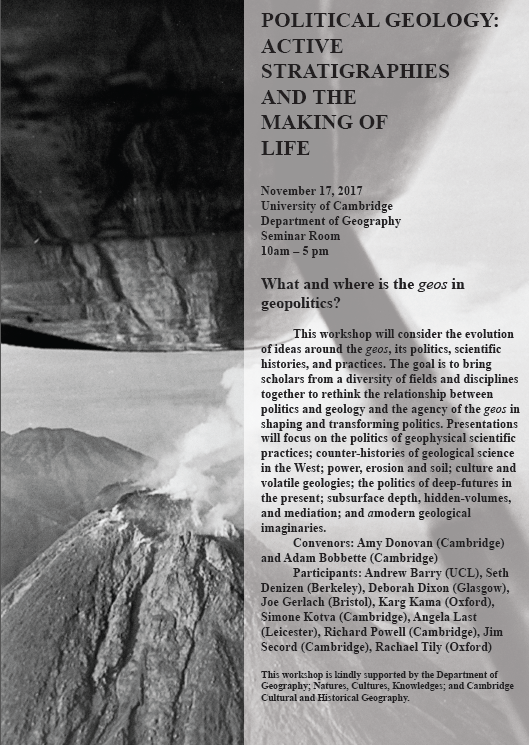
Political Geology: Active Stratigraphies and the Making of Life
Friday 17 November 2017
University of Cambridge
Department of Geography
Seminar Room
10am – 5pm

What and where is the geos in geopolitics?

This workshop will consider the evolution of ideas around the geos, its politics, scientific histories, and practices. The goal is to bring scholars from a diversity of fields and disciplines together to rethink the relationship between politics and geology and the agency of the geos in shaping and transforming politics. Presentations will focus on the politics of geophysical scientific practices; counter-histories of geological science in the West; power, erosion and soil; culture and volatile geologies; the politics of deep-futures in the present; subsurface depth, hidden-volumes, and mediation; and amodern geological imaginaries.

Convenors: Amy Donovan (Cambridge) and Adam Bobbette (Cambridge)
Participants: Andrew Barry (UCL), Seth Denizen (Berkeley), Deborah Dixon (Glasgow), Joe Gerlach (Bristol), Karg Kama (Oxford), Simone Kotva (Cambridge)…

View original post 83 more words

Posted in Uncategorized | Leave a comment

Michel Foucault « Un très beau feu d’artifice » (2016)

I shared news of this issue earlier this year, but it is perhaps worth a reminder – includes an interesting previously unpublished piece by Foucault.

Clare O'Farrell's avatarFoucault News

Michel Foucault « Un très beau feu d’artifice »
Critique
2016/12 (n° 835)

Présentation
En 1978, devant des étudiants californiens, Michel Foucault rêvait à haute voix de « livres bombes » : ils ne tueraient personne, mais « disparaîtraient peu de temps après qu’on les aurait lus ou utilisés ». La philosophie comme Mission impossible : « ce message s’autodétruira dans cinq secondes » ? Il est tentant d’imaginer le philosophe, à deux pas de Hollywood, rendant hommage à la célèbre série…

Mais les livres de Foucault ne se sont pas autodétruits. Mieux qu’à des bombes, ils ressemblent à ces fusées porteuses d’autres fusées que lancent, pour notre joie, les artificiers. Et cette œuvre, en effet, n’a cessé de susciter déploiements et redéploiements critiques.

« Après l’explosion », ajoutait malicieusement Foucault en 1978, « on pourrait rappeler aux gens que ces livres ont produit un très beau feu d’artifice ».

View original post 99 more words

Posted in Uncategorized | Leave a comment

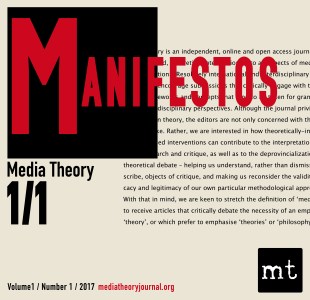
Media Theory – launch issue of new online, open access journal

Media Theory – launch issue of new online, open access journal edited by Simon Dawes.

cover_issue_1_en_US.jpg

Media Theory is an independent, online and open access journal of peer-reviewed, theoretical interventions into all aspects of media and communications.

Vol 1 No 1 (2017): Manifestos

Contributions from W.J.T. Mitchell, M. Beatrice Fazi, Rob Shields and others.

Posted in Uncategorized | Leave a comment

Speaking Volumes – series of short contributions at Cultural Anthropology organised by Franck Billé

Speaking Volumes – series of short contributions at Cultural Anthropology organised by Franck Billé. I have a piece in it on ‘terrain’. All open access.

Speaking Volumes by Franck BilléOpen author orcid page in new window

Having engaged with the recent volumetric turn in architecture and political geography, anthropologists are increasingly concerned with realms such as air, oceans, riparian environments, and outer space, as well as with their social, political, and cultural reverberations. This Theorizing the Contemporary series, which grew out of a panel at the 2014 annual meeting of the American Anthropological Association, brings into dialogue these converging interests in volumetric sovereignty and more-than-human geographies. The contributors suggest that this theoretical confluence can be especially illuminating for border processes and phenomena that extend beyond the two-dimensional.

Posts in This Series

Introduction: Speaking Volumes

by Franck BilléOpen author orcid page in new window

Buoy

by Aihwa Ong

Clotting

by Elizabeth Cullen Dunn

Downwind

by Jerry Zee

Electric

by Gökçe Günel

Fissure

by Klaus Dodds

Geometries

by Sarah Green

Lag

by Tina Harris

Remnants

by Yael NavaroOpen author orcid page in new window

Sectional

by Franck BilléOpen author orcid page in new window

Seepage

by Jason Cons

Spectrum

by Helga Tawil-Souri

Surface

by Clancy Wilmott

Terrain

by Stuart Elden

Voluminous

by Lauren Bonilla

Warren

by Caroline Humphrey

Posted in Uncategorized | Leave a comment

Audio and video recordings of Foucault – some updates to the list of those available online

untitledI’ve added a few things to the list of Foucault audio and video recordings available online. These include a 1972 interview on the re-edition of Histoire de la folie (small charge to download).

There are also five linked radio discussions with Jean Doat for L’usage de la parole on RTF. Two of these were published in 2013 and are available in English translation; the other three are available as recordings online:

  1. La folie en fête, January 7, 1963 (audio)
  2. Le silence des fous [The Silence of the Mad], January 14, 1963 (no audio; published in La grande étrangère, pp. 27-50; Language, Madness and Desire, pp. 7-24)
  3. La persécution, January 21, 1963 (audio)
  4. Le corps et ses doubles, January 28, 1963 (audio)
  5. Le language en folie [Mad Language], February 4, 1963 (no audio; published in La grande étrangère, pp. 51-70; Language, Madness and Desire, pp. 25-39)

I’ve also done a little bit of tidying up. Some of the links no longer worked, so I fixed those I could, but unfortunately some others have disappeared and I can’t find another sources for them. I’ve marked these as dead or removed, but left the original links just in case they become live again at some point.

Help with locating links to these recordings would be much appreciated; and of course if I have missed any recordings do please let me know.

Posted in Michel Foucault, Uncategorized | Leave a comment

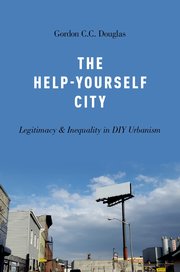
Gordon Douglas, The Help-Yourself City: Legitimacy and Inequality in DIY Urbanism, forthcoming from OUP

9780190691325Gordon Douglas, The Help-Yourself City: Legitimacy and Inequality in DIY Urbanism – forthcoming from OUP in early 2018.

When cash-strapped local governments fail to provide adequate services, and planning policies prioritize economic development over community needs, how do concerned citizens respond? In The Help-Yourself City, Gordon Douglas looks closely at the people who take urban planning into their own hands, dubbed “do-it-yourself urban design.” Through in-depth interviews with do-it-yourselfers, professional planners, and community members, as well as participant observation, photography, media, and policy analysis, Douglas demonstrates that many do-it-yourselfers employ professional techniques and expertise to enable and inspire their actions. He argues that many unauthorized interventions are created from a position of privilege, where legal repercussions are unlikely, while people from disadvantaged communities where improvements may be most needed face disincentives to taking such actions themselves. Presenting a needed social analysis of this growing trend, while connecting it to debates on inequality, citizenship, and contemporary urban political economy, The Help-Yourself City tells a street-level story of people’s relationships to their surroundings and the individualization of democratic responsibility.


Posted in Uncategorized, urban/urbanisation | Leave a comment

More Book Reviews up at Antipode open site

Open access reviews in Antipode

Peter Gratton's avatarPHILOSOPHY IN A TIME OF ERROR

Here

Moriel Ram (University College London) on Camillo Boano’s The Ethics of a Potential Urbanism: Critical Encounters Between Giorgio Agamben and Architecture, a book that presents Agamben’s work as a “concrete platform for the conceptual experiment to rethink the notion of potentiality and to re-examine how political theory can challenge our notions of the built environment”.

Nathan Poirier (Canisius College) on Harvey Neo and Jody Emel’s Geographies of Meat: Politics, Economy, and Culture – “both highly revered and highly tabooed … [meat is a] complex and sensitive issue … intertwined with culture, societies, politics, religion, and identity … The book expands on critical animal geographies by focusing on farmed animals … [extending and applying] concepts from anarchist geography”.

Jonathan Everts (Universität Bonn) on Steve Hinchliffe, Nick Bingham, John Allen and Simon Carter’s Pathological Lives: Disease, Space, and Biopolitics, which is “novel … ingenious …  the most thorough, detailed…

View original post 305 more words

Posted in Uncategorized | Leave a comment

“The Geography of Philosophy”, $2.6 Million Grant for Machery, Stich and Barrett

Philosophers Edouard Machery (Pittsburgh) and Stephen Stich (Rutgers) and anthropologist H. Clark Barrett (UCLA) have been awarded a $2,569,563 grant from the John Templeton Foundation to fund their project, “The Geography of Philosophy: An Interdisciplinary Cross-Cultural Exploration of Universality and Diversity in Fundamental Philosophical Concepts.”

Here’s a description of the project:

Throughout the history of philosophy, many thinkers have urged that some fundamental philosophical concepts are universal–used by all rational people. Historians and anthropologists have often been skeptical of these claims. Recently, cultural psychologists and experimental philosophers have begun to explore empirically whether fundamental philosophical concepts are shared across cultures. The results of these studies have been fascinating, provocative and equivocal. The goals of this project are (i) to move this exciting endeavor forward by dramatically expanding the methodologies, the range of cultures considered, and the cultural and disciplinary diversity of the investigators engaged in the inquiry; (ii) to motivate and enable researchers around the world to become involved in cross-cultural, interdisciplinary research on philosophical concepts by sponsoring workshops in Africa, Asia and South America where our research teams can interact with scientists and scholars in the region; (iii) to present our findings both in scholarly publications and in an integrated format accessible to non-specialists; (iv) to foster discussion about the implications of the findings for venerable philosophical debates and for practical contemporary issues.

SELRES_bbda2248-51b5-4625-a682-52ce67fab19bSELRES_2629ebb8-d49d-4310-b045-caad2c60c133The grant will fund work on the project from 2018-2021.SELRES_2629ebb8-d49d-4310-b045-caad2c60c133SELRES_bbda2248-51b5-4625-a682-52ce67fab19b

From Daily Nous (and thanks to dmf for the link)

Posted in Uncategorized | Leave a comment

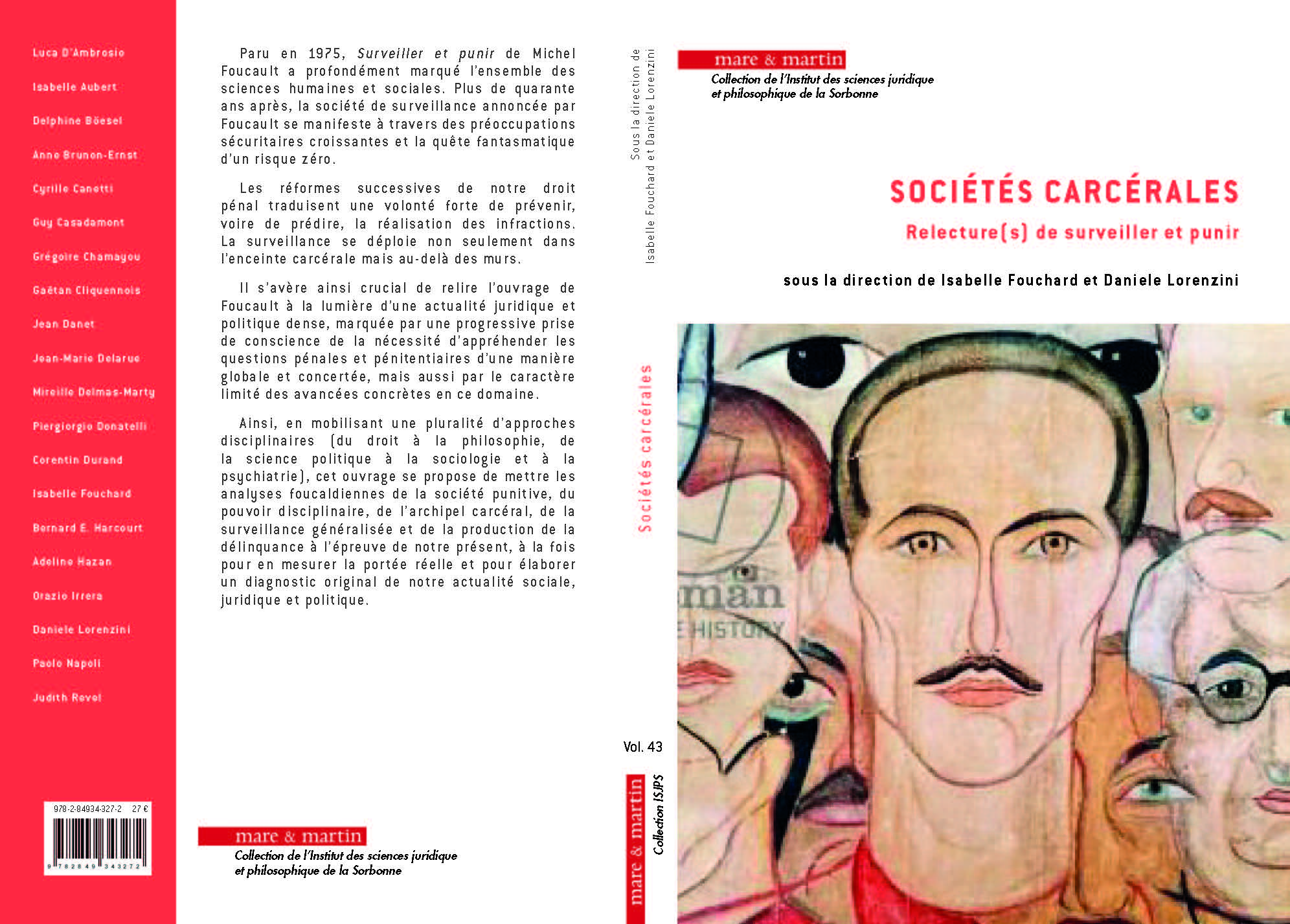
Sociétés carcérales. Relecture(s) de ‘Surveiller et punir’ (2017)

A new collection on Foucault’s Surveiller et punir.

Clare O'Farrell's avatarFoucault News

“Sociétés carcérales. Relecture(s) de ‘Surveiller et punir’”
sous la dir. de Isabelle Fouchard et Daniele Lorenzini
Paris, Mare & Martin, 2017. Forthcoming

Contributions de Luca D’Ambrosio, Isabelle Aubert, Delphine Böesel, Anne Brunon-Ernst, Cyrille Canetti, Guy Casadamont, Grégoire Chamayou, Gaëtan Cliquennois, Jean Danet, Jean-Marie Delarue, Mireille Delmas-Marty, Piergiorgio Donatelli, Corentin Durand, Isabelle Fouchard, Bernard Harcourt, Adeline Hazan, Orazio Irrera, Daniele Lorenzini, Paolo Napoli, Judith Revel

PDF of back and front cover

View original post

Posted in Uncategorized | Leave a comment

Damien Cahill and Martijn Konings, Neoliberalism – now out with Polity

9780745695525.jpgDamien Cahill and Martijn Konings, Neoliberalism – now out with Polity

For over three decades neoliberalism has been the dominant economic ideology. While it may have emerged relatively unscathed from the global financial crisis of 2007-08, neoliberalism is now – more than ever – under scrutiny from critics who argue that it has failed to live up to its promises, creating instead an increasingly unequal and insecure world.

This book offers a nuanced and probing analysis of the meaning and practical application of neoliberalism today, separating myth from reality. Drawing on examples such as the growth of finance, the role of corporate power and the rise of workfare, the book advances a balanced but distinctive perspective on neoliberalism as involving the interaction of ideas, material economic change and political transformations. It interrogates claims about the impending death of neoliberalism and considers the sources of its resilience in the current climate of political disenchantment and economic austerity.

Clearly and accessibly written, this book will be a valuable resource for students and scholars across the social sciences.

Posted in Uncategorized | 1 Comment