
10 Critical Theory books that came out in January – Wahnich, Allen, Mitchell, Dean & Villadsen, Danchev, Malm, Gasche, etc.
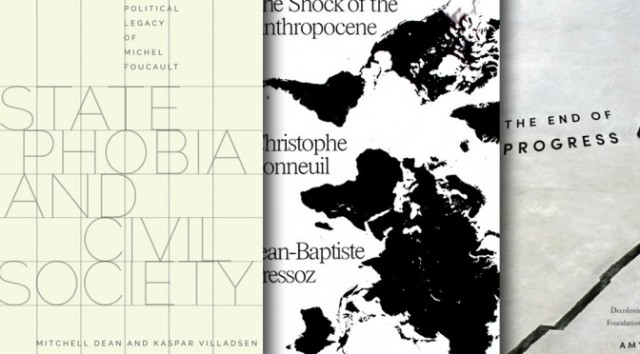
10 Critical Theory books that came out in January – Wahnich, Allen, Mitchell, Dean & Villadsen, Danchev, Malm, Gasche, etc.
Shakespeare’s Hamlet recently performed at the Calais refugee camp. See also the extraordinary photo essay by Léopold Lambert at The Funambulist
Calais performance will be latest in series company has staged at refugee settlements during its Globe to Globe world tour / The Globe Theatre’s touring production of Hamlet at the Zataari Refugee camp on the Jordanian-Syrian border.
Mark Brown Arts correspondent The Guardian
Friday 29 January 2016
Shakespeare’s Globe is taking its world touring production of Hamlet to the “Jungle” refugee camp in Calais.
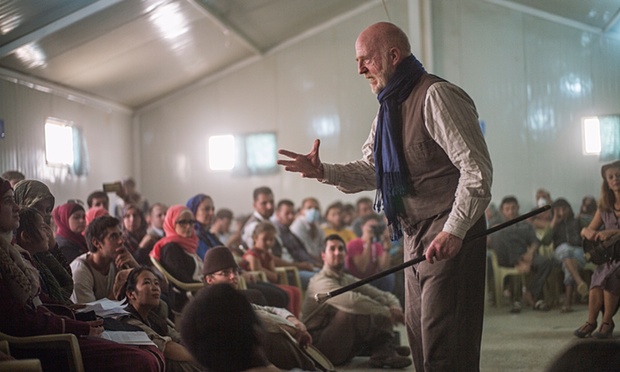 Photograph: Sarah Lee for the Guardian
The theatre company said its Globe to Globe tour, which aims to play Hamlet to every country in the world by 23 April, would arrive in Calais for a one-off performance on Wednesday.
It will be staged in partnership with the Good Chance theatre and performance project created in the camp by the playwrights Joe Murphy and Joe Robertson.
Tom Bird, producer of Globe to Globe, said: “We had heard what the guys were doing at Good Chance and we decided…
View original post 413 more words
News of Fiona McConnell’s forthcoming book on Tibet’s government in exile.
New issue of Society and Space now online.
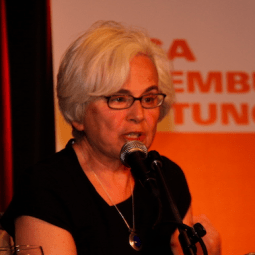 Verso have made available a list of open-access work by Ellen Meiksins Wood, who died recently.
Ellen Meiksins Wood (1942-2016) was a Marxist historian and political thinker of enormous significance. We are proud to publish many of her books and, in order to encourage readers to engage with her work more broadly, we have collected the following list of articles and interviews currently in the public domain. With the kind permission of her publishers a number of the pieces are being made freely available for the first time.
 Manifeste pour une géographie environnementale: Géographie, écologie et politique – now out with Presses de Sciences Po, edited by Denis Chartier and Estienne Rodary. Simon Batterbury is one of the Anglophone contributors, and sent me an English translation of the book’s blurb (original here):
French geography has always refused to address environmental issues in a truly political way. As environmental crises multiply, and facing the specter of eco-skepticism that haunts French political thought, geography can and must rebuild.
This Manifesto for environmental geography marks a collective will to overcome individualized practice and to question the epistemological place and the politics of geography confronted with environmental politics. It discusses the history of the discipline in its dealings with the politics of nature, develops international comparisons, especially with political ecology, and introduces the main areas of investigation for geography with a conceptual apparatus renewed by the Anthropocene.
It shows that geographers must leave behind the remnants of their disciplinary past, to accept that their discipline is fundamentally transformed by environmental issues. This is the only way for the discipline to remain scientifically and politically relevant in today’s world.
Contributors : Frédéric Alexandre • Aziz Ballouche • Simon P.J. Batterbury • Farid Benhammou • David Blanchon • Frédérique Blot • Sébastien Caillault • Pierre-Olivier Garcia • Emmanuèle Gautier • Pierre Gautreau • Alain Génin • Jérémy Grangé • Christophe Grenier • Baptiste Hautdidier • Christian A. Kull • Patrick Matagne • Kent Mathewson • Pierre Pech • Philippe Pelletier • Olivier Soubeyran • Jean-Marc Zaninetti.
 Please consider submitting a paper for the next Warwick Graduate Conference in Political Geography, held at the University of Warwick on 19-20 May, 2016. The topic of this year’s conference is:
We invite you to submit your abstracts no later than 8th March 2016. You can find the complete CFP with more details here and please feel free to contact us at politicalgeographywarwick@gmail.com if you have any further queries.
We are looking forward to a great conference and would be delighted to count you in. All potential participants should submit a title, abstract (of no more than 450 words), and evidence of institutional affiliation by March 8th, 2016 to politicalgeographywarwick@gmail.com.
Please note five travel grants of up to £100 each are available to support attendance; preference will be given to non-UK attendees. Potential grantees must submit a short text of no more than 500 words explaining their needs and motivations for this support. This should be done at the same time as submitting abstract to politicalgeographywarwick@gmail.com.
Posted on behalf of Mark Usher
State, territory, urbanism: Exploring the nexus between government and infrastructure
Convenors:
Mark Usher, University of Manchester (mark.usher@manchester.ac.uk)
Rhys Jones, Aberystwyth University (raj@aber.ac.uk)
Ingrid Medby, University of Durham (i.a.medby@durham.ac.uk)This session will consider how research on the techno-political nexus between sovereignty and the ‘stuff’ of public services, namely large technological systems, infrastructural capacity and logistical centres, can provide original insights into traditional issues of statehood, nation-building, governance and socio-economic restructuring. The logistical matrix and everyday infrastructural workings of the state have become a ‘matter of concern’ (Barry 2013) not only for civil engineers but increasingly for scholars in the humanities and social sciences (Mukerji 2009; Guldi 2012; Jones and Merriman 2012; Joyce 2013; Harvey and Knox 2015; Swyngedouw 2015). Here, what Foucault, Deleuze and Guattari called ‘collective equipment’- canals, roads, railways, dams, utilities and telecommunications systems inter alia – have been conceptualised as a networked technological medium through which administrative control over territory and population has been consolidated, organised and urbanised (McFarlane and Rutherford 2008; Bennett and Joyce 2010). This session invites submissions that further our understanding of the nexus between infrastructure, territory and the state through empirical and theoretical analysis. In particular, how are nation-states assembled and endowed with ontological solidity as technological networks emerge, consolidate and integrate (Mitchell 2002), and indeed, what happens to our understanding and experience of government when these systems fragment and disperse? Can we think of infrastructure as a strategic medium between cities and the nation-state? How can a topological and ‘volumetric’ (Elden 2013) understanding of infrastructural space advance existing theories of the state?
Potential themes could include, but are not limited to, the following:
– State formation, nation-building and techno-nationalism
– Restructuring, austerity and state dismantling
– Territorialisation, assemblages and worlding
– Urbanism, municipal governance and new state spaces
– Material politics of infrastructure and engineering
– Governmentality and material geographies of governance
– Failing states and infrastructural incapacity
– Techno-politics of logistics, circulation and mobilities
– Political subjectivity, biopolitics and cyborg citizens
– Socio-spatial theory and the post-structural state
Please send abstracts (250 words max) to mark.usher@manchester.ac.uk by Friday 12th February, with your name and affiliation included.
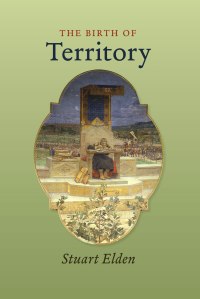 The Birth of Territory is reviewed in Political Theory by Hans Lindahl – requires subscription. Here’s the final paragraph:
From a philosophical viewpoint, Elden’s book is most interesting for the question it poses yet leaves unanswered: what is the relation between power and place? Taking for granted that there is a relation between the two terms, Elden goes ahead to painstakingly trace one specific way in which this internal connection obtains concrete historical form: territory. This ambitious historical inquiry is philosophically very modest, to the extent that its driving assumption remains largely unjustified. I would say, however, that this is its virtue, rather than its shortcoming. By insisting on the historically determinate way in which territory articulates power and place, Elden does a twofold service to political philosophers who would seek to unpack and justify the internal connection between place and power. On the one hand, and precisely because territory is one of the ways in which this internal connection manifests itself, political philosophers will find in his historically rich account of territory a manifold of clues as to the nature of the general relation between place and power. On the other hand, and because it is but one of the historical permutations of this general relation, he puts philosophers on guard against reifying as a conceptual necessity features of that relation which are in fact historically contingent. If Elden’s strong thesis, a thesis I happily endorse, is that there is a necessary relation between power and place, then the challenge confronting contemporary political philosophy is to understand whether and how processes of globalization instantiate a specific relation between power and place in a way that is both continuous and discontinuous with the territorial state.
The book is also reviewed in Progress in Human Geography by Marco Antonsich. Despite some generous praise at the beginning and end, the bulk of the review is quite critical. That isn’t unexpected, since we had an exchange in Progress a few years back about my piece ‘Land, Terrain, Territory‘, which was a draft of this book’s introduction (see here and here). What’s disappointing, and I think surprising, is that he continues to make similar points about the book that he did about that text. If the book were just about words, as he charges, it would have been a much shorter book, and would have taken much less time to write. And if the book looks superficially similar to “other books on the history of political theory”, I’d say that if such books really did cover the same ground it would also have saved me a lot of time. I taught political theory for several years before joining a Geography department, and the book was in part intended to bring a geographical focus in the study of its history. In part that was because I felt it wasn’t already there.
Some of his other criticisms have been raised by other reviewers, and I’ve discussed them in some of the responses to review fora on the book – full list of reviews and discussions here. There are many things I would amend if given the chance, and taking the story forward would indeed require me to engage with different issues, including what he calls the “operationalisation” of territory. But that was never intended to be the focus of this book.


