Jeroen Vandaele on translations of Foucault’s Surveiller et punir

Jeroen Vandaele, ‘What is an author, indeed: Michel Foucault in translation‘, Perspectives: Studies in Translatology, Vol 24 No 1, 2016, pp. 76-92 (requires subscription).

A very interesting piece which discusses translations of Foucault’s Surveiller et punir with lots of examples and comparisons.

Though the issue of translation occasionally surfaces in Foucault Studies, it remains an area that deserves more attention. To that effect, I briefly introduce some basic concepts of Translation Studies and then compare a chapter from Surveiller et punir (‘Les moyens du bon dressement’) with its English, Spanish, and Norwegian translations. Moving beyond the blatant errors, I argue that these translations are not generally ‘the same text in a different language’. Rather, concepts are carved up in translation; or the analysis shifts from the structural to the historical; or syntactic adjustments make Foucault sound like an instruction book writer. Although I have deep respect for the work of the translators, who have brought Foucault to multitudes of new readers, I also argue that Foucault interpretation could profit from a translational turn.

The article mentions my post ‘Beyond Discipline and Punish: Is it time for a new translation of Foucault’s Surveiller et punir?‘ from 2014, but while there I ranged across the work and only looked at the English translation, this piece concentrates on one key chapter and across three translations. It is also, of course, much better informed in theories of translation. Well worth a look, as it is revealing of just how much interpretation is embedded in any translation.
Posted in Michel Foucault, Publishing, Uncategorized, Writing | Tagged | Leave a comment

Foucault: the Birth of Power Update 11: clearing the decks and beginning to move from Foucault to Shakespeare

FBP update 11

The UCL talk last week was the last one in the diary until September – a very deliberate choice to open up some time that needed quite a bit of forward-planning to achieve. I might do one or two book events when Foucault’s Last Decade is out, but I’m not planning on things beyond that. In the second half of 2015 I’d already made a substantial reduction in travel, and didn’t get on a plane for six months – I really can’t remember the last time that was the case, probably in the PhD. All the trips to France have been by train.

I now have a substantial period of time ahead of me for consolidated writing. Completing a draft of Foucault: The Birth of Power in early January means that I hope to be able to submit it for review in the next couple of months. A week away meant I came back to it with fresh eyes. Because of the UCL talk I had to return to the material in Chapter Six, in order to produce a presentation, and was surprised at how smoothly it read. For the talk I didn’t have a prepared text, but a very image-heavy PowerPoint, with a very few quotes, and some scribbled notes alongside a print-out of the slides. The talk wasn’t a close reading of specific texts, unlike much of the book, but an overview of the collaborative research and activism, along with some general discussion of the sources I’ve worked with. For that I felt I really should be able to dispense with a formal text – something I generally prefer to do, but is often difficult with the textual way I usually work.

I’ve already ticked off several things on the ‘to do’ list, after some productive days at the British Library and some days back at home with my ‘Foucault library’. It needed a really thorough proof-read, some tightening of the argument, improving transitions, and a little reorganization. I am now fairly sure the key things are in the right place. I’m slowly clearly the desk of all the books related to this project, and doing some further bits of reading and re-reading. I know what else needs to be done, and some of that is in Paris. It’s good to have a bit of time to sit with the book in its current shape, and I plan to do that – not working on it quite so intensely, and then returning to it with some degree of distance.

IMG_1270.JPG

The key focus for the next several months will be Shakespeare. I already have a lot of material drafted for this project. Some of this is in good shape – I’ve published on King Lear and Coriolanus already, and the King John chapter draft is properly written and referenced. With other texts I have some quite detailed and extensive discussions drafted from talks – especially with Richard II, Henry V and Hamlet – and notes in various states on most of the other plays I plan to discuss. The idea is that I take a text or two per month and work intensely on what I already have. First up will be Richard II, the two parts of Henry IV, and Henry V. With Henry IV Part One I know I want to have a discussion of the map scene between Mortimer, Worcester, Glendower and Hotspur from Part I, but not sure what else I will focus upon; I plan to supplement the discussion of Henry V with one on Edward III. That should keep me going for a while – I will go back over all the other history plays, though don’t intend to discuss them in detail, and then the rough idea is to move to Hamlet and perhaps pair it with a shorter discussion of Macbeth. After that, we will see. I’ll certainly go back to the earliest drafted texts and edit and perhaps rework them, but I’m planning to do that as a much later part of the work.

As I’ve said before, I’m largely beginning with the primary text, focusing on various critical editions, and only later moving to the secondary literature. I’ve become increasingly interested in the variant forms of the texts in the Quartos and the Folio, as well as editorial emendations, so I spend a lot of time burrowing into the textual notes. I usually begin with the Arden Third Series edition, and then compare every important passage to the Oxford, Penguin and Cambridge editions. I then read the introductions to all these editions, as well as the Arden Second Series, and work through all their notes and other apparatus. (A few texts I’m working on are not yet in Arden 3, but those should be published before I complete this project.) This work then generally gives me a long list of relevant secondary literature to consult, gleaned from notes and suggestions for further reading, which I begin to work through. All this reading necessarily generates a long list of further references to chase up. And of course, there can be more specific searches for literature on topics or questions, and people continue to recommend things to read…

I’ve been reading a lot of more general secondary literature on various themes over the past several years, and have loads more on the reading list and in various to-read piles or shelves. But this literature is of course so vast that I can’t pretend to be exhaustive. I hope that as the work develops I will make substantial inroads into this, but I’m not sure how much actual citation and engagement there will be in the finished project. I’m hoping for a text that is informed by debates and aware of the issues, but isn’t so encumbered by them that it becomes unreadable to all but specialists.

I do have a few small writing projects to do – a piece on managing academic workload for The Times Higher Education; a short piece on Shakespeare’s tragedies for a textbook; an encyclopaedia entry – but I hope I can wrap those up in the next week or two. At some point, probably in August, I will need to turn to the talks I’ve committed to giving in Memphis, San Marino, and Giessen in September, October and December. And I will obviously need to begin thinking about teaching in the autumn as well. But for now, reading, thinking and writing, again and again, is the sole thing on the agenda…


Foucault’s Last Decade is available to pre-order – due in April. For more information on these two books, see the descriptions here. Audio and video recordings relating to them are here; and a full list of the updates I’ve been posting on the process of writing here. Some translations, bibliographies, scans and links are available at Foucault Resources.

Posted in Foucault's Last Decade, Foucault: The Birth of Power, Michel Foucault, Uncategorized | 2 Comments

Five strategies to get your academic writing “unstuck”

Five strategies to get your academic writing “unstuck”‘from Raul Pacheco-Vega at the LSE Impact of Social Science blog. This is a repost from his own blog, and the first of a series.

Posted in Publishing, Uncategorized, Writing | 2 Comments

Foucault and the Groupe Information Santé – a bibliography

Foucault’s involvement with the Groupe d’Information sur les prisons is fairly well-known, with important collections of documentary material published in French, a forthcoming English translation of material, and a growing secondary literature in French and English. His involvement with the Groupe Information Santé (GIS) – while not nearly as extensive – is much less examined. Their importance of course goes beyond Foucault’s role.

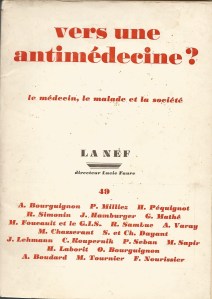
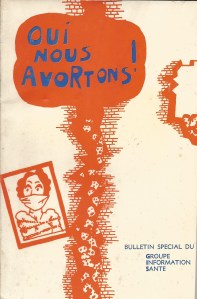
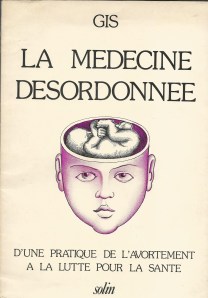
I’ve compiled a bibliography of the group for this site, including an initial manifesto where Foucault is the only named author; the report/bulletins of the group; and then specific pieces relating to the abortion-rights struggle and the Jean Carpentier case.

MLCONA.jpg

MD.jpg


I discuss Foucault’s involvement with the GIP and GIS in Foucault: The Birth of Power, Chapters Five and Six; and said a bit about the GIS in my recent talk to UCL’s Geography department – audio recording here.

For Foucault’s academic collaborative projects, see the bibliography here; and further resources on Foucault – lists/bibliographies, links, textual comparisons and some short translations – are here.

Posted in Foucault: The Birth of Power, Michel Foucault, Politics, Uncategorized | Tagged , , , , , | 1 Comment

Derek Gregory’s ‘Reach from the Sky’ Tanner lectures

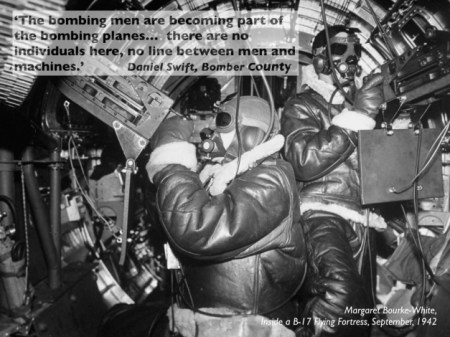
bioconvergence-and-the-bomber-crew-001Last week I took the short trip from London to Cambridge to attend Derek Gregory’s Tanner lectures – ‘Reach from the sky: aerial violence and the everywhere war’. The lectures covered a lot, from early aircraft to the Second World War, to Vietnam, Iraq and Gaza, and today’s drone warfare.
He delivered the two lectures on the first evening, and then on the second evening there was a discussion with Grégoire Chamayou, Jochen von Bernstorff and Chris Woods which I unfortunately couldn’t attend. All of this was filmed, and will be available online. I’ll share a link when available. And it will of course all be written up and published.

In the meantime, he has shared his own thoughts and many of the striking images on his Geographical Imaginations site.

He has also shared the videos from the ‘Through Post-Atomic Eyes‘ conference from October 2015 on YouTube, including his “Little Boys and Blue Skies: drones through post-atomic eyes“. More details here.

Update: Alex Jeffrey discusses the lectures here.

Posted in Conferences, Derek Gregory | 2 Comments

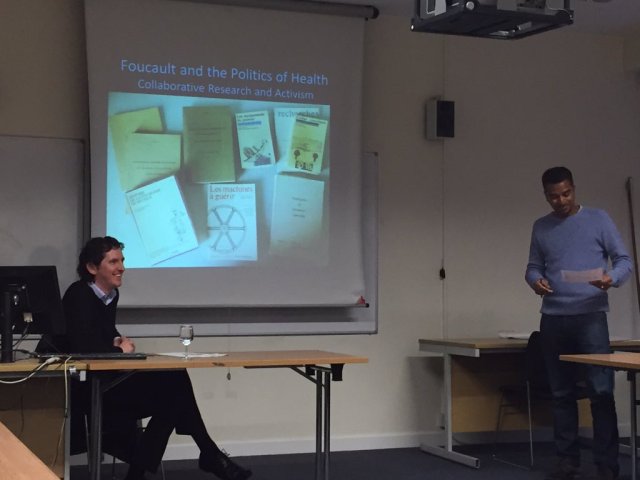
Foucault and the Politics of Health: Collaborative research and activism – audio recording of UCL talk

The audio recording of my talk of 12 January 2016 to the Geography Department seminar, University College London is now available here. The introduction is by Tariq Jazeel.

“Foucault and the Politics of Health – Collaborative research and activism”

Concentrating on the early 1970s, this talk will discuss Foucault’s research and activist work concerning the politics of health. This is in three registers – the research in his Collège de France seminar; his work with Félix Guattari’s CERFI group; and his role in the activist organisation Groupe Information Santé. The sources for tracing his work in these areas are uncollected, sometimes anonymous, and often unpublished. The talk will draw on published reports and pamphlets, news sources, and material archived in Paris and Normandy.

The talk drew extensively on the work in Chapter Five of Foucault: The Birth of Power, but also discussed the various sources I’ve been using for my overall research on Foucault. There is some overlap with the talk I gave at the LSE late last year, but the specific focus on health and in particular the discussion of the Groupe Information Santé is new.

The LSE talk and other recordings are available here. For bibliographical details of the academic collaborative research work, see here; on the GIS here.

CYhZE40WkAATki_.jpg-large

with Tariq Jazeel, photo by Andy Fugard

Posted in Conferences, Foucault's Last Decade, Foucault: The Birth of Power, Michel Foucault, Politics | 3 Comments

Top posts on Progressive Geographies this week

  1. Appeal by Sartre, Foucault, Guattari, Deleuze and others on imprisonment of Italian intellectuals, 1977
  2. Red Notes, Italy 1977-8: ‘Living with an Earthquake’ – entire pamphlet online
  3. Academic Books of 2015 – my top twenty
  4. Michel Foucault on refugees – a previously untranslated interview from 1979
  5. Foucault – uncollected notes, lectures and interviews
  6. Discussion of Lefebvre’s Rhythmanalysis
  7. Raul Pacheco-Vega on writing and working spaces
  8. Society and Space Editorial team changes
  9. David Bowie – space on the shelf for Blackstar, but a very big hole…
  10. Books received – several more for the Foucault work, including the new Œuvres
Posted in Uncategorized | 1 Comment

David Harvey, The Ways of the World – now published (and in paperback), and open access extract

9781781255315_26David Harvey, The Ways of the World is now published, and an open access extract is available here.

This book presents a sequence of landmark works in David Harvey’s intellectual journey over five decades. It shows how experiencing the riots, despair and injustice of 1970s Baltimore led him to seek an explanation of capitalist inequalities via Marx and to a sustained intellectual engagement that has made him the world’s leading exponent of Marx’s work. The book takes the reader through the development of his unique synthesis of Marxist method and geographical understanding that has allowed him to develop a series of powerful insights into the ways of the world, from the new mechanics of imperialism, crises in financial markets and the effectiveness of car strikers in Oxford, to the links between nature and change, why Sacré Coeur was built in Paris, and the meaning of the postmodern condition. David Harvey is renowned for originality, acumen and the transformative value of his insights. This book shows why.
Posted in Uncategorized | Tagged | 2 Comments

The editorial process at Contemporary Political Theory

CPTA very interesting and detailed discussion of the editorial process at Contemporary Political Theory, by Samuel Chambers (open access).

Posted in Publishing, Uncategorized | Leave a comment

Mapping Post-Capitalism

Some interesting representations of post-capitalism – follow the link to read more about them.

edmundberger's avatarDeterritorial Investigations

View original post

Posted in Uncategorized | 2 Comments