Foucault: the Birth of Power Update 5 – more on his collaborative work and drafting Chapter Two on Théories et institutions pénales

FBP 5

Most of the most recent work on this book project has been on the section of Chapter Two discussing the Nu-Pieds revolts. An analysis of these, and the repression that follows, takes up the first seven lectures of Théories et institutions pénales. It’s a fascinating story, and nowhere else does Foucault give so much attention to a struggle between people and state power. I will be speaking about this part of the course at the Historical Materialism conference in November, though the brevity of that talk will mean I can only highlight a few major themes. If you don’t read French, Barry Stocker’s analyses of the first few of these lectures are very useful. Chapter Two now exists in a complete, long, draft – a discussion of the Nu-Pieds; then on the shift from Germanic law to the Monarchical State, and the legal system of the high Middle Ages; then a discussion of the inquiry in multiple registers, also drawing on the Rio lecture and preparatory reading material. I presented a version of the last part, and a bit from the second, in Nottingham in September (audio here).

As mentioned before, the most recent French edition of Didier Eribon’s biography has some documents relating to the election of Foucault to the Collège de France, and I went back to these one more time. Jules Vuillemin wrote both the proposal for the chair in ‘History of Systems of Thought’ and Foucault’s nomination for it. Both pieces are interesting and show an insight into Foucault’s work and planned future projects in 1969-70. I reworked the sections in the introduction accordingly. I remain fascinated by the project on heredity he outlines in the ‘Titres et travaux’ proposal for this chair and briefly mentions elsewhere. We know that he gave a course at Vincennes on this topic, and extensive reading notes are archived in Paris, but I’ve yet to see the course itself, if indeed any trace remains.

Because the English translation of The Punitive Society is now published the next work was going through the material I had drafted on that course and checking all my initial translations to Graham Burchell’s official ones, and inserting the double page references. Next will be to read the whole text again, this time in English, and see what work needs to be done to this material to shape it into Chapter Three.

I also dealt with the copy-editing queries for Foucault’s Last Decade. This was not a major task, due to the text being polished when I submitted it, and a good copy-editor. Good, for me, means careful and with great attention to detail, thus smoothing the text and saving you from silly errors, but not someone who thinks they can rewrite the text better than the author. The proofs are due later this month, which is earlier than originally planned. This is also when the text will go to an indexer. I have only done the index to one of my books, and since that experience have given it either to (paid) graduate-students or professionals. So, that book moves forward, and is due for publication in May 2016. At the moment Polity only have a limited webpage available, but it should be updated soon. Contrary to what the page currently says, the book will be available in both paperback and hardback. The backcover text is there though, but not yet the cover, which has been agreed, and will form a nice pair with The Birth of Power. I’ll share when I can. Endorsements are currently being solicited.

In the last couple of days I’ve taken a brief break from Foucault to do some work on Lefebvre, including writing the preface to the forthcoming translation of Marxist Thought and the City, and to attend a meeting of the Durham Institute of Advanced Study advisory council, but I hope to return to Foucault at the beginning of next week.

You can read more about both books, along with links to previous updates, here. Additionally a lot of resources I produced while writing Foucault’s Last Decade are available here. It includes a list of audio files, a bibliography of collaborative projects, a list of short pieces which did not appear in Dits et écrits, comparison of variant forms of texts, a few short translations, and so on.

Posted in Foucault's Last Decade, Foucault: The Birth of Power, Michel Foucault, Publishing, Writing | 2 Comments

Today’s writing task – beginning work on a preface to Henri Lefebvre’s Marxist Thought and the City

Today’s writing task – beginning work on a preface to Henri Lefebvre’s Marxist Thought and the City, forthcoming in late 2016 with University of Minnesota Press.

IMG_1110

Posted in Henri Lefebvre, Publishing | 4 Comments

The politics of human shielding: a supplemental essay by Neve Gordon and Nicola Perugini

Neve Gordon and Nicola Perugini on the politics of human shielding – an open site supplement to an essay in Society and Space, open access for a limited time.

Posted in Uncategorized | Leave a comment

Top posts on Progressive Geographies this week

Posted in Uncategorized | Leave a comment

Books received – Duménil and Lévy, Massumi, Nietzsche, Clark, Shakespeare, Comité d’action santé, Langlois

BooksA pile of recently acquired books – Dumenil and Levy’s The Crisis of Neoliberalism, Brian Massumi’s Ontopower, Friedrich Nietzsche’s Writing from the Early Notebooks, Timothy Clark, Ecocriticism on the Edge, the Penguin edition of Shakespeare’s Richard II, Comité d’action santé, Médicine, and Denis Langlois, Guide du militant. Clark’s book was sent from the publisher, but the rest were bought, most second-hand.

The text from the Comité d’action santé is from 1968, and I think is a kind of forerunner of the work of the Group d’information santé; Langlois’s book is from 1972 and comes from the same intellectual and political context as the GIS and associated groups. Both are for the Foucault project.

Posted in Foucault: The Birth of Power, Friedrich Nietzsche, Michel Foucault, Shakespearean Territories | Tagged , | Leave a comment

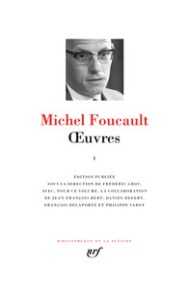
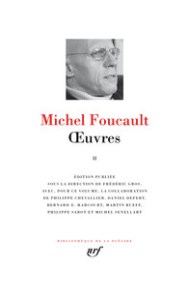
Foucault, Oeuvres: more details on the Pleiade edition, c.3600 pages in two volumes

product_9782070149575_195x320More details of the Bibliothèque de la Pléiade edition of Foucault’s OeuvresTwo volumes, 1712 and 1792 pages – all the books under his name, plus a selection of shorter texts.

Not clear if that includes the 1954 book Maladie mentale et personnalité, as opposed to the 1962 reedition as Maladie mentale et psychologie, and the extent to which this is a full critical edition of the texts. A proper annotated text of the variant editions of Naissance de la clinique would be useful, for example. A team of people, led by Frédéric Gros were involved, so I expect it will be much more than a simple set of reprints. It’s expensive – €120 for the set – but if it adds to the texts then it might be worthwhile.

1Son œuvre, entre philosophie, histoire et littérature, est difficile à situer. Les disciplines traditionnelles peinent à la contenir. Sa chaire au Collège de France s’intitulait «Histoire des systèmes de pensée». Lui-même ne cessa jamais de relire Kant, Nietzsche, Heidegger, mais il cite moins les classiques de la philosophie que d’obscurs traités, règlements ou manuels conservés dans des fonds d’archives, royaumes des historiens. Des historiens «professionnels» de son temps Foucault partage d’ailleurs l’ambition : ouvrir l’histoire à de nouveaux objets. Il reste que ce sont bien des problématiques philosophiques que renouvellent ses «histoires» (de la folie, de la sexualité), ses «archéologies» (des sciences humaines, du savoir), ses récits de «naissance» (de la clinique, de la prison)…

2Outre un choix de textes brefs, articles, préfaces ou conférences, cette édition rassemble tous ses livres personnels. Leur influence est immense. Mais leur réunion ne vise pas à former une autobiographie intellectuelle. «Je ne veux pas de ce qui pourrait donner l’impression de rassembler ce que j’ai fait en une espèce d’unité qui me caractériserait et me justifierait.» Voyons plutôt en elle ce que Foucault disait d’Histoire de la folie en 1975 : «J’envisageais ce livre comme une espèce de souffle vraiment matériel, et je continue à le rêver comme ça, une espèce de souffle faisant éclater des portes et des fenêtres…»

Posted in Michel Foucault, Publishing | Leave a comment

Stuart Elden, “Territory – Political Technology, Volume, Terrain”, video of Architectural Association lecture

The video of my lecture on “Territory – Political Technology, Volume, Terrain“, given as a Landscape Urbanism Open School Event, Architectural Association lecture on  7/10/2015 is now available. The volume is very quiet, and it begins a few moments in due to a recording problem. For those that know what I’ve published on these topics, there will not be much new, but this was for an MA student audience, and may be a good introduction to my work.

Territory is a political and geographical notion, of course, but can only be adequately understood if we understand its implications in a range of registers, including economic, strategic, legal, and technical ones. Territory can be un- derstood, following Foucault, as a political technology – not simply as a container or site of political struggle, but as a contested political process.

The particular focus of this talk will be on the physical, material nature of territory. It will think about the relation of territory to terrain, which is a geo-strategic question, an important concept in both physical and military geography. Terrain is important because it combines materiality, strategy and the need to go beyond a narrow, two-dimensional sense of the cartographic imagination. Instead, terrain forces us to account for the complexity of height and depth, the question of volume. Terrain also makes possible, or constrains, various military-strategic projects.

All attempts at fixing and defending territorial boundaries are complicated by dynamic features of the Earth, includ- ing rivers, oceans, polar-regions, glaciers, airspace and the sub-surface, both the sub-soil and the sub-marine. These questions are crucial for a political-legal theory of territory more generally. Essentially the key question is: how can theories of territory better account for the complexities of the geophysical and the built environment?

Posted in Boundaries, Eyal Weizman, Politics, terrain, Territory, Terror and Territory, The Birth of Territory | 2 Comments

‘No Posthumous Publications’ – responses to some questions about Foucault and the future publication of the History of Sexuality Vol IV

In the German interview with Daniel Defert I linked to earlier this week, it was revealed that the fourth volume of Foucault’s History of Sexuality will eventually be published. This is my attempt at answering some of the common questions – some I’ve received by mail, twitter, etc. and some that have been asked before.

[Update 29 August 2017: the book is now scheduled for publication in early 2018]

Didn’t Foucault want ‘no posthumous publications’?

– yes, but this wish has been interpreted more and more liberally over the past several years, and has been broken repeatedly recently, so this is not surprising. Dits et écrits in 1994 was a literal following of the wish – a posthumous collection, but only of pieces which were published in some form in his lifetime, or a few which were authorised but appeared later due to publishing delays. It brought a number of pieces into/back into French which had been published in other languages. But it missed a few pieces which were published in his lifetime, and there were several more published soon afterwards which did not appear due to the strict interpretation.

What about the lecture courses? Aren’t they posthumous publications?

– Initially there were unauthorised Italian versions of ‘Society Must be Defended’ and I think The Abnormals, which the family tried to stop. When they failed, they decided to do the lecture courses properly, in critical editions. Initially the line was that these were transcripts of material already in the public domain as recordings – archived at the Collège de France, IMEC, Berkeley etc. The earliest published courses were very literal; as they continued editors began to use the course manuscript more and more to fill in missing details or provide variants or unspoken passages in notes. Then with the very early courses – Lectures on the Will to KnowThe Punitive SocietyThéories et institutions pénales – the editors used either a transcript of now lost tapes or the manuscript alone to reconstruct the course. In the first of these, an entire manuscript, ‘Oedipus Knowledge’ is appended. So you could say there has been a gradual erosion of the wish.

What other posthumous publications have there been?

–  Quite a few. Some interviews have appeared, some lectures given outside of Paris, documents relating to political activity, etc. Some small books have appeared in French of texts, some of which previously had appeared in English, and many of which are now being translated. I’ve linked to several ‘uncollected notes, lectures and interviews‘ on this site, and have a piece forthcoming in Foucault Studies which is an attempt at a comprehensive bibliography of ‘The Uncollected Foucault‘ (i.e. stuff that isn’t in Dits et écrits).

– What’s in the fourth volume?

It’s entitled Les aveux de la chair – Confessions, or Avowals, of the Flesh. It’s the book on the early Church that Foucault frequently talks about. It likely links to the work presented in the On the Government of the Living course, and the ‘Battle for Chastity’ essay says it is from this volume. Foucault presented work given elsewhere as related to this – the ‘Sexuality and Solitude’ essay, for instance, or one of the two 1980 ‘About the Beginning of the Hermeneutic of the Self’ lectures. But as to what the text itself contains, very few people know for sure. The only people who have seen the manuscript, as far as I know, are Foucault’s family and Daniel Defert.

– Was it a finished text? No, but nearly. Foucault drafted it in the late 1970s and early 1980s, and then put it aside to concentrate on the work on antiquity, which appeared in volumes II and III. He felt that material was needed to set the work on Christianity in its proper context. In the last months of his life he returned to the typescript – itself a telling sign as his texts were handwritten until very late stages – and edited it. He says that he expects it to appear in October 1984, and indicates there was little work to do. But that final work is interrupted by his illness, and then death.

What else might be forthcoming?

– We know of some courses which exist, including ones from Vincennes and Tunisia (there is an entire course published in Arabic, for instance). There are other lecture courses given outside of Paris where tapes exist. The editors of the Collège de France courses mention several other manuscripts – a dossier on hermaphrodites, ‘Liberalism as a way of government’, material on technologies of the self. Philippe Chevalier found a fragment of the original second volume of the History of Sexuality, on medieval Christianity… There is material available as audio recordings in archives which has not been transcribed. There are reports some Collège de France seminars were recorded, though I’ve never seen the tapes listed anywhere. As yet, the Bibliothèque Nationale has only made limited material available to researchers, so more may yet be found.

It is also worth noting, while newly available material has been translated quite quickly, that a lot of short pieces Foucault published in his lifetime have still not been translated into English.

When can we expect it?

– Not sure. It may be several years, since it seems likely that some of the other material, including the lecture courses, will appear first. Vrin also continue to publish work, and I understand the next volume will be a critical edition of the ‘Discourse and Truth’ lectures from Berkeley in 1983 – which appear in English as Fearless Speech. [Of course, now – August 2017 – we know that it will appear in February 2018. Vrin continue to publish new volumes of material, and there are plans for some other lecture courses underway.]

There is much more about this, as well as all the sources for these claims, in my forthcoming book Foucault’s Last Decade.

Posted in Daniel Defert, Foucault's Last Decade, Michel Foucault, Publishing | 7 Comments

The Drone Papers – leaked material at The Intercept

drone-reaper02-440x440Derek Gregory and Jeremy Crampton both link to the Drone Papers at the Intercept, a new set of leaked materials. Here’s the beginning of Jeremy Scahill’s introduction.

Drones are a tool, not a policy. The policy is assassination. While every president since Gerald Ford has upheld an executive order banning assassinations by U.S. personnel, Congress has avoided legislating the issue or even defining the word “assassination.” This has allowed proponents of the drone wars to rebrand assassinations with more palatable characterizations, such as the term du jour, “targeted killings.

Derek has promised further analysis when time allows.

Posted in Uncategorized | Leave a comment

Eduardo Gudynas, David Harvey, Ecuador and ‘sympathetic colonialism’ – links to Spanish/English versions of both texts

I’ve updated this post with links to a translation of the Gudynas piece and the official translation of the response.

stuartelden's avatarProgressive Geographies

harveyb-e1385602308638Eduardo Gudynas has recently criticised David Harvey and his research team in Ecuador for ‘simpatico [sympathetic, nice or friendly] colonialism’ (Spanish/English).

The research team (Estefanía Martínez, Verónica Morales, Carla Simbaña, Japhy Wilson, Nora Fernández, Thomas Purcell and Jeremy Rayner) respond (Spanish/English);

An earlier English translation of the response can be found at My Desiring Machines.

Updated 16 October 2015 with links to translations.

View original post

Posted in Uncategorized | Leave a comment