Wilderness Group Tour: PhD dissertations and writing/support/accountablity groups

This is the post that sparked the two reflections on writing I shared earlier today. Interesting reading on ‘writing groups’. I firmly believe there is no one way to write that will work for everyone (or even for the same people for different projects), but there are so many people continuing to struggle with ways that don’t work for them, I think these kinds of discussions can only be valuable.

Michael Collins's avatarThe page “Newfoundland Literature” does not exist

I was recently asked to make a brief presentation about dissertation writing/support groups. I was one of four presenters at a workshop hosted by the University of Toronto’s School of Graduate Studies. I had a few thoughts about these writing groups, why there is such a hunger for them among PhD candidates, and why they usually seem to be of limited success. What follows is a modified script of my presentation. It speaks primarily to my experiences at the University of Toronto, but may be of broader interest and use.

I’ve been a member of at least three writing or accountability groups since beginning work on my dissertation, and I’ve been invited to join more.

One group met (still meets) weekly (usually), at a café on campus, to set goals for the week ahead and to review how each member did (or did not) meet goals set at the previous…

View original post 1,528 more words

Posted in Uncategorized | 1 Comment

Top posts this week on Progressive Geographies

Posted in Uncategorized | Leave a comment

How Do We Write? Two reflections on ‘dysfunctional academic writing’

janus_smallHow Do We Write? Two very interesting reflections on ‘dysfunctional academic writing’ at In the Middle.

A conversation has unfolded on Facebook over the last week on the topic of How We Write. Two of us who were involved in that conversation would like to push it forward, first offering our own experiences here, and then going on to collect the experiences of others who are also willing to share, perhaps (if there’s sufficient interest) putting together a collective resource on How We Write. (Note that this is not to be confused with ‘How To Write’ – these are idiosyncratic, self-flagellating approaches to the process.) So please add your experience in the comments, or share it in another way, and let us know if this kind of collective resource is something you’d like to read and/or contribute to.

The impetus for this conversation was a wonderful blogpost by Michael Collins on the occasion of a roundtable hosted by the School of Graduate Studies at the University of Toronto, on how to facilitate dissertation-writing groups. Michael’s thoughtful engagement with his own experience of writing – posted and reposted on a number of Facebook pages – led to an outpouring of personal accounts of the dissertation-writing years, both from those currently in the trenches and those for whom those years are very much in the rear-view mirror. What emerged was a clear sense of the diversity of writing practices that are out there: there’s no single ‘right’ way to write, and exposure to that range of practices might help those who are in the process of mastering academic writing to feel more confident in their own abilities, most of all by demonstrating that such ‘mastery’ is an ongoing – potentially limitless – effort.

Posted in Writing | 3 Comments

The challenge of open plan offices and the importance of quiet

Portrait of a Gentleman in His Study — Lorenzo Lotto

Portrait of a Gentleman in His Study — Lorenzo Lotto

Two interesting pieces in blogs I follow. First, Clare O’Farrell’s extended discussion of open-plan offices at her personal blog Refracted Input; and then Mark Carrigan asking ‘were universities ever quiet?‘ at The Sociological Imagination.

I too would be horrified by a move to open-plan, due to a whole range of reasons Clare identified. But I have just spent the last several weeks at a research center at NYU where there is a very different way of working to what I’ve become accustomed to in the past. The offices are on the 19th floor of Metrotech 1 in Brooklyn, and the basic design is to have offices around the periphery, with lots of cubicle desks clustered around the central area which has the elevators. It’s a big building, and the offices are clearly arranged in hierarchical order, not just to do with size, but also who has the best views. To be fair, most are pretty impressive, but the view towards Manhattan wins.

1208962_10100616286668983_927690756_n

View towards Manhattan from CUSP’s Brooklyn office

Even those of us in offices – Warwick has an office for whichever of us is visiting at that time – tend to keep doors open unless we’re on the phone. The security was good enough that I felt comfortable leaving the door open when I left for a few moments, even with laptop on display. I quite liked the atmosphere there, had more conversations than I would have done otherwise, and managed to get a lot of work done. But part of the reason for the relative quiet was that there are no undergraduates in this center, and the postgraduates are clustered on the other side of the floor. For a research-intensive environment such as this I can see something of the appeal. But ultimately I agree with both Mark and Clare – for writing, nothing beats a secluded space, with noise controlled and solitude.

Posted in Universities | Leave a comment

Critical Theory’s eight books that came out in May – including Balibar, Luxemburg, Lotringer and Foucault

may-2015-critical-theory-books-672x372Critical Theory’s eight books that came out in May – including Balibar, Luxemburg, Lotringer and Foucault (though not sure the Foucault is actually out just yet).

Posted in Uncategorized | Leave a comment

Alberto Toscano and Jeff Klinke, Cartographies of the Absolute – now out from Zero books

While I’d linked to some preparatory material, I hadn’t realised this was now out. Thanks to Adam David Morton for the link.

Alberto Toscano and Jeff Klinke, Cartographies of the Absolute from Zero books.

Cjhp5450f81b684c1an capital be seen? Cartographies of the Absolute surveys the disparate answers to this question offered by artists, film-makers, writers and theorists over the past few decades. It zones in on the crises of representation that have accompanied the enduring crisis of capitalism, foregrounding the production of new visions and artefacts that wrestle with the vastness, invisibility and complexity of the abstractions that rule our lives.

Posted in Alberto Toscano | Tagged , | Leave a comment

Martijn Konings, The Emotional Logic of Capitalism

I jumped the gun with saying this was out back in February, but it is out now. If you buy from SUP direct, the code LOGIC will give a 20% discount.

stuartelden's avatarProgressive Geographies

Now out, an intriguing new book on capitalism – Martijn Konings, The Emotional Logic of Capitalism.

pid_25513

The capitalist market, progressives bemoan, is a cold monster: it disrupts social bonds, erodes emotional attachments, and imposes an abstract utilitarian rationality. But what if such hallowed critiques are completely misleading? This book argues that the production of new sources of faith and enchantment is crucial to the dynamics of the capitalist economy. Distinctively secular patterns of attraction and attachment give modern institutions a binding force that was not available to more traditional forms of rule. Elaborating his alternative approach through an engagement with the semiotics of money and the genealogy of economy, Martijn Konings uncovers capitalism’s emotional and theological content in order to understand the paradoxical sources of cohesion and legitimacy that it commands. In developing this perspective, he draws on pragmatist thought to rework and revitalize the Marxist critique of…

View original post 9 more words

Posted in Uncategorized | Leave a comment

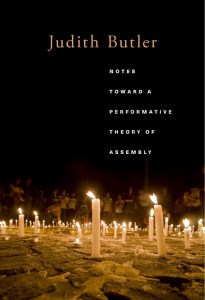
Judith Butler, Notes towards a Performative Theory of Assembly – forthcoming from Harvard UP

Judith Butler, Notes towards a Performative Theory of Assembly – forthcoming from Harvard University Press. Thanks to Derek Gregory for the alert.

Butler

Judith Butler elucidates the dynamics of public assembly under prevailing economic and political conditions, analyzing what they signify and how. Understanding assemblies as plural forms of performative action, Butler extends her theory of performativity to argue that precarity—the destruction of the conditions of livability—has been a galvanizing force and theme in today’s highly visible protests.

Butler broadens the theory of performativity beyond speech acts to include the concerted actions of the body. Assemblies of physical bodies have an expressive dimension that cannot be reduced to speech, for the very fact of people gathering “says” something without always relying on speech. Drawing on Hannah Arendt’s view of action, yet revising her claims about the role of the body in politics, Butler asserts that embodied ways of coming together, including forms of long-distance solidarity, imply a new understanding of the public space of appearance essential to politics.

Butler links assembly with precarity by pointing out that a body suffering under conditions of precarity still persists and resists, and that mobilization brings out this dual dimension of corporeal life. Just as assemblies make visible and audible the bodies that require basic freedoms of movement and association, so do they expose coercive practices in prison, the dismantling of social democracy, and the continuing demand for establishing subjugated lives as mattering, as equally worthy of life. By enacting a form of radical solidarity in opposition to political and economic forces, a new sense of “the people” emerges, interdependent, grievable, precarious, and persistent.

Posted in Judith Butler | 4 Comments

# MAPS /// Manifesto for an Alternative Cartography

An interesting new cartographic project by Léopold Lambert.

Léopold Lambert's avatarThe Funambulist

Map created by Léopold Lambert for The Funambulist (2015) / Access a high-quality version here (6MB) (license: Creative Commons Attribution-NonCommerical-ShareAlike 4.0)

I made this map in complement of last week’s article that introduced a few hypotheses about new ways of envisioning governance. It represents the world, no longer by its national borders but, rather through its regional ones. Although this article insisted on the importance of the scale of governance to resist national essential identities, the choice for administrative regions is less an emphasis on this particular scale — after all, regional identities can be quite hermetic too — than an attempt to blur our cartographic imaginary constructed, day after day, by the same conventions (North should be up, countries’ borders should be shown, oceans should be blue, etc.). This map does not try to replace this conventions by others, but simply to offer an alternative among an infinity of…

View original post 263 more words

Posted in Uncategorized | 2 Comments

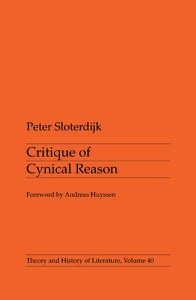
Where should you start with reading Peter Sloterdijk? – reading guide updated

image_miniWhere should you start with reading Peter Sloterdijk? I updated my guide to Henri Lefebvre yesterday, and have now updated the guide to Sloterdijk – there are two new translations coming out later this year – Stress and Freedom and In the Shadow of Mount Sinai – as well as a book on Sloterdijk by Jean-Pierre Couture.


Posted in Peter Sloterdijk | Leave a comment