Capitalismo global y regeneración urbana | Homenaje a Neil Smith

A conference on Neil Smith’s work coming up in Barcelona in September.

asevillab's avatarmultipliciudades

El grupo Espais Crítics organiza un encuentro en Barcelona entre el 14 y el 16 de diciembre para celebrar críticamente la memoria de Neil Smith. El evento se desarrollará en el MACBA —además de un paseo crítico por el Raval— y contará con ponencias invitadas de Deborah Cowen, Don Mitchell, Tom Slater, María Dolors García Ramón, Luz Marina García Herrera y Fernando Sabaté Bel. García Herrera y Sabaté Bel son responsables del volumen que la serie Espacios Críticos de Icaria dedicará a Neil Smith y cuya publicación coincidirá con el congreso (más información sobre la serie de libros aquí y aquí).

El encuentro contará con un espacio para comunicaciones; pueden remitirse propuestas hasta el 14 de junio. Les dejo a continuación más información:

COLOQUIO INTERNACIONAL
CAPITALISMO GLOBAL Y PROCESOS DE REGENERACIÓN URBANA
HOMENAJE A NEIL SMITH
Barcelona, 14, 15 y 16 de septiembre de 2015
Neil Smith, desaparecido prematuramente…

View original post 909 more words
Posted in Uncategorized | Leave a comment

Interview with Arnold L. Farr by Margath Walker – On critical theory, liberation and Herbert Marcuse

An excellent discussion of the work of Herbert Marcuse at the Society and Space open site.

Posted in Uncategorized | 1 Comment

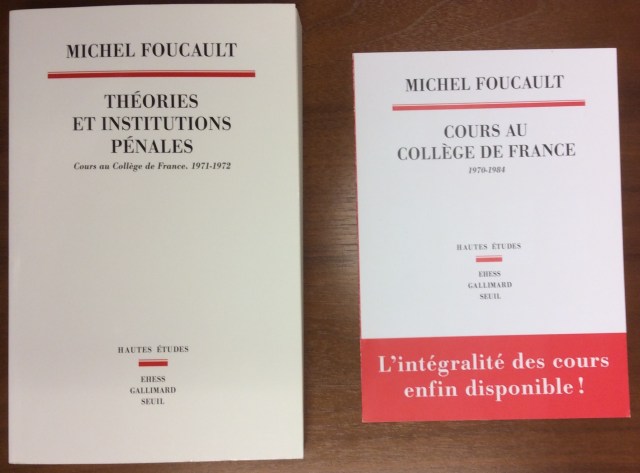
Hot off the press – Foucault’s Théories et institutions pénales is published

Hot off the press – Foucault’s Théories et institutions pénales is published. This is the last Collège de France course to appear, though it is the second in sequence, from 1971-72. Bernard E. Harcourt edited the text, it comes with a ‘Situation du cours’ by him and François Ewald, and some additional material: the first French translation of an English summary of a lecture Foucault gave in Minnesota in 1972, “Cérémonie, théâtre et politique au XVIIe siècle”; a letter from Étienne Balibar to Harcourt; and an essay on Foucault and historians by Claude Olivier Doran.

TIP published

Many thanks to Bernard for giving me this copy – and for previously sharing an early version of the transcription.

[Update: the image on the right is not a book, but an advertising flyer for the series as a whole.]

Posted in Foucault's Last Decade, Foucault: The Birth of Power, Michel Foucault | Tagged , , | 3 Comments

W.G. Sebald’s tips for writing – from his final fiction workshop

9383015W.G. Sebald’s tips for writing – from his final fiction workshop, but lots here for writers of non-fiction to think about. Here’s the first section:

On Approach 

  • Fiction should have a ghostlike presence in it somewhere, something omniscient. It makes it a different reality.
  • Writing is about discovering things hitherto unseen. Otherwise there’s no point to the process.
  • By all means be experimental, but let the reader be part of the experiment.
  • Expressionism was really a kind of willful avant-gardism after the First World War, an attempt to wrench language into a form it does not normally have. It must have purpose, though. It hasn’t really occurred in English but is very common in German.
  • Write about obscure things but don’t write obscurely.
  • There is a certain merit in leaving some parts of your writing obscure.
  • It’s hard to write something original about Napoleon, but one of his minor aides is another matter.
Posted in Writing | Tagged , , | 1 Comment

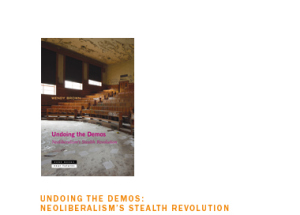
Wendy Brown on Undoing the Demos: Neoliberalism’s Stealth Revolution

Radio interview with Wendy Brown on her new book – interview begins about 8.30 minutes in, and goes to around 50 minutes.

Jeremy Schmidt's avatarJeremy J Schmidt

A radio interview based on Wendy Brown’s new book. BROW_UND

View original post

Posted in Uncategorized | 1 Comment

Data visualising Kant’s vocabulary – Valerio Pellegrini

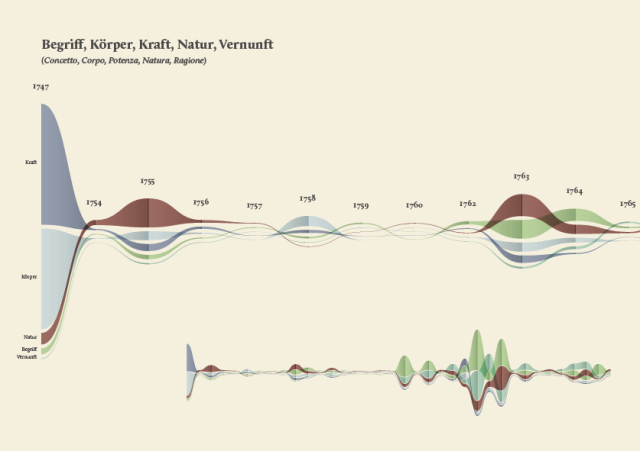
Data visualising Kant’s vocabulary – a design project by Valerio Pellegrini’s in his Master in Communication Design at Politecnico di Milano. Here’s a brief description and one sample image, but there are several different types.

The tool stems from a collaboration between the DensityDesign Research Lab and a group of researchers from the University of Milan focused on Kantian Studies, based on the exploitation of data visualization as support for the analysis of the text. The usual research work is based on browsing thousands of pages, looking where and how lemmas appear, identifying structures and patterns of evolution and other elements useful to support the reconstruction and the interpretation of one author’s thought. The idea of combining data visualization with text annotation stems from the will of providing, in a single environment, both a synoptic vision of the whole corpus and the ability to collect together hundreds of notes and comments in their specific context.

Thanks to Eduardo Mendieta and Daily Nous for the link.

Kant

Posted in Immanuel Kant | 2 Comments

Geographica Helvetica – new website and papers open access

graphic_gh_cover_homepageGeographica Helvetica – the Swiss journal of Geography has a new website and its papers are open access.

Since the current editorial team took over the journal has been making a number of major innovations, and continues to publish very interesting material.

Posted in Geographica Helvetica | 1 Comment

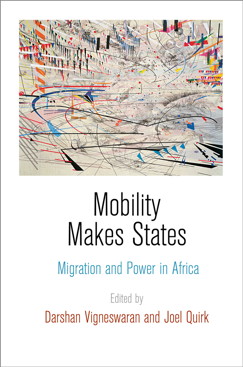
Mobility Makes States: Migration and Power in Africa, edited by Darshan Vigneswaran and Joel Quirk – now published

Mobility Makes States: Migration and Power in Africa, edited by Darshan Vigneswaran and Joel Quirk – now published by University of Pennsylvania Press.

15384

Human mobility has long played a foundational role in producing state territories, resources, and hierarchies. When people move within and across national boundaries, they create both challenges and opportunities. In Mobility Makes States, chapters written by historians, political scientists, sociologists, and anthropologists explore different patterns of mobility in sub-Saharan Africa and how African states have sought to harness these movements toward their own ends.

While border control and intercontinental migration policies remain important topics of study, Mobility Makes States demonstrates that immigration control is best understood alongside parallel efforts by states in Africa to promote both long-distance and everyday movements. The contributors challenge the image of a fixed and static state that is concerned only with stopping foreign migrants at its border, and show that the politics of mobility takes place across a wide range of locations, including colonial hinterlands, workplaces, camps, foreign countries, and city streets. They examine short-term and circular migrations, everyday commuting and urban expansion, forced migrations, emigrations, diasporic communities, and the mobility of gatekeepers and officers of the state who push and pull migrant populations in different directions. Through the experiences and trajectories of migration in sub-Saharan Africa, this empirically rich volume sheds new light on larger global patterns and state making processes.

Posted in Uncategorized | Leave a comment

Warwick Borders, Race, Ethnicity and Migration Network Public Lecture 2015 – Sara Ahmed: “Brick Walls: On Racism and Other Hard Histories”

Warwick Borders, Race, Ethnicity and Migration Network Public Lecture 2015

Brick Walls: On Racism and Other Hard Histories

Professor Sara Ahmed, Goldsmiths, University of London

Wednesday 20th May 5pm-6.30pm
Room S0.11, Social Sciences Building, University of Warwick

In her book, On Being Included: Racism and Diversity in Institutional Life, Sara Ahmed considered how diversity work is often described as “a banging your head against a brick wall job.” In this lecture, she reflects further on brick walls as the hardening of histories, or as how histories becomes concrete. But walls that are hard for some (because of who they are, or what they do) do not appear for others. This lecture will invite reflection on how some borders that are tangible and material (that can stop or block bodies from entering) can be understood and lived by others as immaterial (as phantom walls). Thinking through and with walls, the material stuff of power, allows us to explore how diversity work (both the work we do when we try to transform an institution and the work we do when we do not quite inhabit the norms of an institution) can be an experience of shattering and of assembling worlds from being shattered.

The event will be followed by a drinks reception

This is a public lecture and all are welcome.

http://www2.warwick.ac.uk/fac/cross_fac/bremnetwork/events/#Sara-Ahmed

If you have any queries about this event please contact Dr Hannah Jones, Sociology h.jones.1@warwick.ac.uk

Posted in Uncategorized | Leave a comment

Linnet Taylor – Towards a contextual and inclusive data studies: a response to Dalton and Thatcher

A commentary on critical data studies at the Society and Space open site.

Posted in Uncategorized | Leave a comment