Roberto Esposito, Persons and Things: From the Body’s Point of View

Roberto Esposito, Persons and Things: From the Body’s Point of View, now out from Polity.
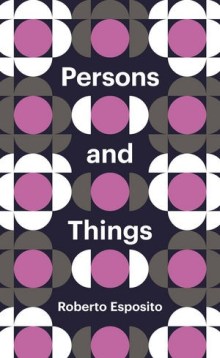
What is the relationship between persons and things? And how does the body transform this relationship? In this highly original new book, Roberto Esposito – one of Italy’s leading political philosophers – considers these questions and shows that starting from the body, rather than from the thing or the person, can help us to reconsider the status of both.
Ever since its beginnings, our civilization has been based on a strict, unequivocal distinction between persons and things, founded on the instrumental domination of persons over things. This opposition arose out of ancient Roman law and persisted throughout modernity, to take its place in our current global market, where it continues to generate growing contradictions. Although the distinction seems to appear clear and necessary to us, what we are continually witnessing in legal, economic, and technological practice is a reversal of perspectives: some categories of persons are becoming assimilated with things, while some types of things are taking on a personal profile.
With his customary rigour, Roberto Esposito argues that there exists an escape route out of this paradox, constituted by a new point of view founded in the body. Neither a person nor a thing, the human body becomes the decisive element in rethinking the concepts and values that govern our philosophical, legal, and political lexicons.


Posted in Politics, Roberto Esposito | 2 Comments

Gatherings: The Heidegger Circle Annual – special issue on the Black Notebooks

Gatherings: The Heidegger Circle Annual – special issue on the – Black Notebooks. Contents at above link, or download whole issue as pdf.


Posted in Martin Heidegger, Politics, Publishing | 2 Comments

Michael Joyce’s novel ‘Foucault, in Winter, in the Linnaeus Garden’ – reviewed at Berfrois

Michael Joyce’s novel Foucault, in Winter, in the Linnaeus Garden – reviewed at Berfrois by Dave Ciccoricco.

Joyce

… Interrogating the status and resonance of unsent letters is one of the tantalizing tasks of Michael Joyce’s latest novel, Foucault, in Winter, in the Linnaeus Garden.

Even more seductive is the novel’s framing conceit, an imagined life of Foucault spanning several weeks of his dark Swedish winter in Uppsala, in 1956, at the end of his relationship with the composer Jean Barraqué, and at the beginning of the project that would become his first major work, Madness and Civilization: A History of Insanity in the Age of Reason. As Joyce writes in his preface, “This novel takes the form of an historical fantasy consisting of letters, all imaginary and most of them unsent, which thus ‘fiction’ an imaginary history that is at least doubly fictional: an imagined imagined life of the philosopher Michel Foucault” (9). Literary culture may at times be all too guilty of perpetuating overly romantic conceptions of creative madness and a parasitic fascination with the figure of the mad philosopher, and Joyce enters the same fraught territory in aestheticizing Foucault. Joyce himself, in the novel’s “Afternote,” acknowledges the possible risks involved in pursuing the kind of work that might offend Foucauldian devotees (189). But these are snares he deftly avoids. The novel affords a compelling meditation on what we might call the nexus of madness, philosophy, and literature, one that conveys a productive and troubled time for Foucault with an intensity and artfulness befitting of one of the most artful philosophers of the twentieth century…

Posted in Michel Foucault | Leave a comment

Thomas Sheehan’s new translation of Heidegger’s ‘What is Metaphysics?’

Thomas Sheehan’s new translation of Heidegger’s ‘What is Metaphysics?’ is available to download here.

Posted in Martin Heidegger | Leave a comment

Top posts this week on Progressive Geographies

Posted in Uncategorized | Leave a comment

International Political Sociology virtual issue with open access papers – On War Today

The editorial team of International Political Sociology is happy to announce its latest IPS Virtual Issue: “On War Today”.

This special issue collects a sample of articles previously published in International Political Sociology that engage contemporary politics of war. We selected two themes that have featured prominently in international political sociology. The first focuses on political issues at stake in visualising war and the bodies of soldiers and what representational methods tell us about the relation between war and politics today. The second issue concerns the idea of new wars. Between them the selected articles explore the nature of contemporary wars, if there is anything new about them, and what a critical and international political sociological war studies can be today.

The articles will be freely accessible until the end of 2015.

http://onlinelibrary.wiley.com/journal/10.1111/(ISSN)1749-5687/homepage/virtual_issue__on_war_today.htm

Posted in Uncategorized | 2 Comments

CFP Theatre, Performance, Foucault! – 4th July 2015 – King’s College London

Theatre, Performance, Foucault!
TaPRA Theatre, Performance, and Philosophy working group interim event – a one-day symposium

4th July 2015 – King’s College London

Michel Foucault was not only one of the most controversial and provocative thinkers of the 20th Century, he was also one of its most inventive and penetrating researchers: his work restlessly innovating new methodological openings around which other thinkers would forge entirely new disciplinary fields. Notoriously hard to pin down, his work evades easy categorisation – indeed, who was Foucault? – poststructuralist philosopher, historian of ‘systems of thought’, ‘radical journalist’ – Foucault seems to have been all of these things, and so much more. It is perhaps for this reason that his work retains its currency for us. Fundamentally, what makes Foucault’s work compelling comes down to the question that he repeatedly asked – a question that remains just as vital and urgent today: ‘what are we at the present time?’

It is with this question in mind that the Theatre, Performance and Philosophy Working Group of the Theatre and Performance Research Association (TaPRA) is delighted to host a one-day symposium entitled: “Theatre, Performance, Foucault!” as its interim event. If Foucault was fond of employing theatre as a metaphor in his work, in this symposium we wish to take that metaphor literally: how does Foucault’s work help us to understand contemporary and/or historical problems in theatre and performance today?

The symposium will consist of curated round-tables, twenty-minute papers and ten-minute provocations. If you would like to contribute a paper or provocation to the symposium, please submit a max. 200-word abstract and brief biography by 23rd May to Tony Fisher (tony.fisher@cssd.ac.uk), Kélina Gotman (kelina.gotman@kcl.ac.uk), and Eve Katsouraki (e.katsouraki@uel.ac.uk). We will get back to you with a response by 31st May.

Papers and provocations may address any aspects of Foucault’s thinking and/or Foucauldian approaches to theatre and performance, including the following:

– Theatre, performance and biopolitics

– Theatre, performance and state power

– Theatre, performance and ethics

– Theatre, performance and genealogy

– Performance and discipline(s)

– Theatre, Foucault & the non-human life / animal rights

– Performance, Foucault & ecology

– Theatre and the social sciences

– Theatre, performance and archaeology

– Theatre, performance and the history of ‘madness’

– Theatre, performance and the history of sexuality

– Theatre, performance and discourse

– Performance, Foucault & his heirs

Please note: You need to be an existing member of TaPRA to present or attend. If you are not, you can become a member at the cost of £10. Registrations will open by the end of May and you can register via Eventbrite (details to follow).

For more information, please visit http://www.tapra.org.

Posted in Uncategorized | 2 Comments

Zamora and Behrent (eds.) Foucault and Neoliberalism – forthcoming in November 2015 from Polity

The English version of the book which caused a storm last year – Daniel Zamora and Michael C. Behrent (eds.) Foucault and Neoliberalism – is forthcoming in November 2015 from Polity.

1509501762Michel Foucault’s death in 1984 coincided with the fading away of the hopes for social transformation that characterized the postwar period. In the decades following his death, neoliberalism has triumphed and attacks on social rights have become increasingly bold. If Foucault was not a direct witness of these years, his work on neoliberalism is nonetheless prescient: the question of liberalism occupies an important place in his last works. Since his death, Foucault’s conceptual apparatus has acquired a central, even dominant position for a substantial segment of the world’s intellectual left.

However, as the contributions to this volume demonstrate, Foucault’s attitude towards neoliberalism was at least equivocal. Far from leading an intellectual struggle against free market orthodoxy, Foucault seems in many ways to endorse it. How is one to understand his radical critique of the welfare state, understood as an instrument of biopower? Or his support for the pandering anti-Marxism of the so-called new philosophers ? Is it possible that Foucault was seduced by neoliberalism?

This question is not merely of biographical interest: it forces us to confront more generally the mutations of the left since May 1968, the disillusionment of the years that followed and the profound transformations in the French intellectual field over the past thirty years. To understand the 1980s and the neoliberal triumph is to explore the most ambiguous corners of the intellectual left through one of its most important figures.

Posted in Michel Foucault | Leave a comment

Consolidated list of all the Michel Serres primary bibliography posts

Very valuable work by Christopher Watkin, now consolidated into a single resource.

Christopher Watkin's avatarChristopher Watkin

All the categories for the comprehensive Michel Serres primary bibliography are now up and running. I will keep adding titles over the coming months as I come across them, but in order to make the bibliography easier to navigate I have gathered below links to all the sections, as well as to the entire bibliography.

I hope that it will serve as a useful resource both for those who want to discover Serres’s thought for the first time and for those who want to explore his writing more deeply.

  1. single-authored and co-written books

  2. prefaces, edited books and book chapters

  3. archival material

  4. single-authored and co-written articles

  5. interviews

  6. 6a: audio and video (with links); 6b: audio and video (with embedded video)

  7. newspaper and magazine articles

And here is the link to the whole bibliography on one page (warning: there are many embedded videos and it may take a long time to load).

View original post

Posted in Uncategorized | Leave a comment

Translating from French into English

Some thoughts from Clare O’Farrell on translation, with examples from Foucault and Cixous.

Clare O'Farrell's avatarRefracted Input

I just came across this interesting passage in an article by Dave Hickey on The Brooklyn Rail discussing his experiences teaching French theory.

[…] since the texts we read were written in French and being read in French or translation, there are some eccentricities of the French language that need to be acknowledged. First, the standard English vocabulary is about 900,000 words. The standard French vocabulary is about 100,000 words, so French words aren’t surrounded with garlands of synonyms and adjectives. Each word does a lot of work in French, so it is possible to write a sentence in French in which the same word appears four times and means something different every time. American translators, sadly, thanks to the New Yorker, are fearful of iteration, and identical French words blossom into bouquets of synonyms. Americans fall back on synonyms to avoid iteration and this blurs meaning and euphony…

View original post 420 more words

Posted in Uncategorized | Leave a comment