Ernesto Laclau

Another nice tribute to Laclau, by Jon Beasley-Murray

Jon's avatarPosthegemony

Ernesto Laclau

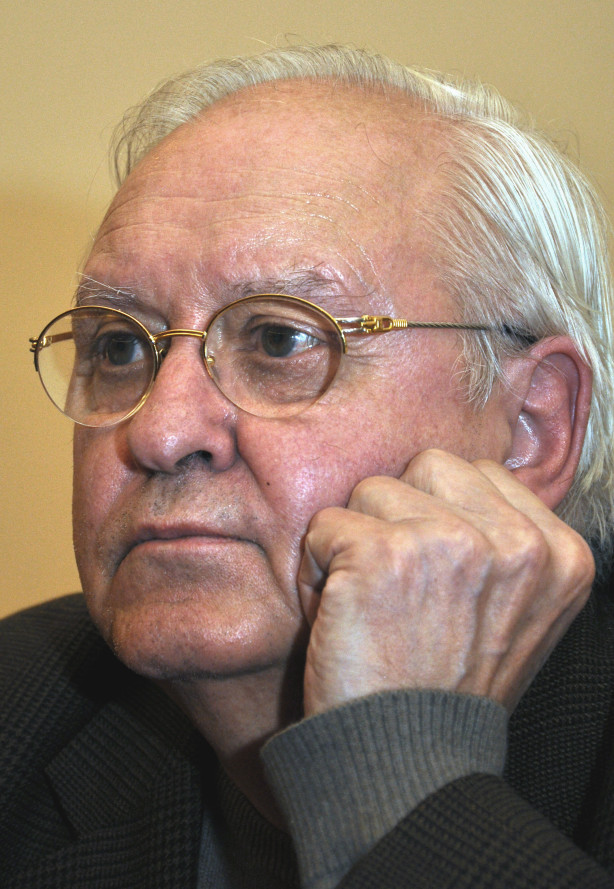
I have spent almost the entirety of my academic career reading, and responding to, Ernesto Laclau, who has died at the age of 78. Ernesto was one of the great systematic thinkers of the past fifty years, possibly the most influential Latin American theorist of the twentieth and twenty-first centuries, and one of the most significant influences on Anglo-American cultural and political theory as a whole. We all write to some extent in his shadow and in his debt, myself perhaps more than anyone.

“Hegemony” was Laclau’s signature concept. He was not the first theorist of hegemony, but he made the term his own and spent decades elaborating a theoretical structure around the basic recognition of the contingency of political allegiances. This insight first came to him as an activist in 1960s and 1970s Argentina, faced with Peronism’s extraordinary capacity to mobilize people of all classes and every political inclination…

View original post 960 more words

Posted in Uncategorized | Leave a comment

The Marking Boycott And Its Aftermath

A good analysis of the latest developments in the UK higher education pay dispute.

Pablo K's avatarThe Disorder Of Things

Justice League Super Hero Strike

In the face of a UK higher education marking boycott due to start in 11 days time, universities have come forth with a new pay offer. Having unilaterally imposed a 1% rise (read: real terms cut) for 2013/14, they are now proposing 2% for 2014/15, with a small bonus for those on the lowest band to bring them up to a living wage level (at Sussex, that’s an increase on the existing annual pay of £13,621). A consultative ballot is open to union members, and the boycott is delayed. It seems likely that there will be appetite for the deal, given the general tone of despondency and how drained staff are by repeated small scale actions and by mounting work pressures. There had, after all, been doubts that a boycott could compete with aggressive tactics from management (including threats to deduct full pay from anyone who participated in the boycott).

We might…

View original post 1,018 more words

Posted in Uncategorized | Leave a comment

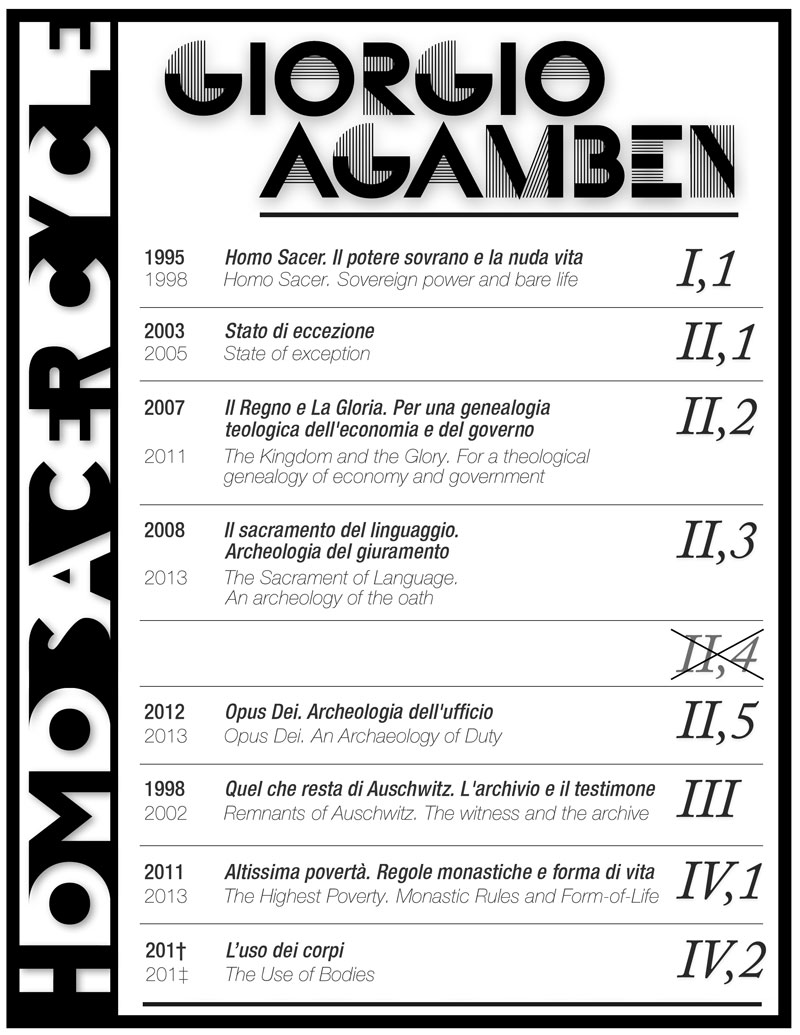
Giorgio Agamben – The Homo Sacer series structure in visual form

Some minor errors fixed. Thanks to Lorenzo Vianelli for spotting these, and Nicholas for amending the image.

stuartelden's avatarProgressive Geographies

Thanks to Nicholas Dahmann for updating this image. According to some reports, II, 4 will not be published and the designation of Opus Dei as II, 5 may have been an error. The Use of Bodies is the last planned volume.HomoSacer800

It is available to download in various size jpgs – 800×1035; 1280×1656; 1600×2071; 2550×3000 – and pdf.

View original post

Posted in Uncategorized | 2 Comments

Ernesto Laclau (1935–2014)

Another tribute to Ernesto Laclau, from Adrià Porta Caballé

Posted in Uncategorized | Leave a comment

Ernesto Laclau RIP

A few thoughts on Ernesto Laclau and a link to an interview with him and Chantal Mouffe.

David F. Ruccio's avataroccasional links & commentary

catolica5

Ernest0 Laclau was, by all accounts, a decent, gentle man and a path-breaking scholar on the Left.

I first became aware of Laclau in terms of his participation in the famous “modes of production” debate in the 1970s (I was working on my senior thesis at the time, on modes of production in Peruvian history). Later, of course, Laclau shifted his attention to the theory of hegemony, radical democracy, and new social movements (in work with his wife Chantal Mouffe) and then finally to populism.

I met Laclau only a couple of times, most recently at the Rethinking Marxism 2006 conference, where he spoke in a plenary session (along with Ella Shohat and Antonio Callari) on “Imperialism and the Fantasies of Democracy.” He was a member of the international Advisory Board for Rethinking Marxism from its inception.

This is from an interview conducted in 1998:

Ernesto, what were your first…

View original post 440 more words

Posted in Uncategorized | Leave a comment

Elisabeth Roudinesco on Judith Butler at the Verso blog and in Le Monde

Judith Butler, the Iconoclast: Elisabeth Roudinesco on Judith Butler – English here; French here.

Posted in Judith Butler | Leave a comment

Peter Sloterdijk, ‘The Domestication of Being’ – discussed at Aphelis

At his Aphelis blog, Philippe Theophanidis discusses versions and translations of Peter Sloterdijk’s essay “Die Domestikation des Seins. Für eine Verdeutlichung der Lichtung”.

The excerpt quoted [here] comes from a translation of the fourth and final chapter of the essay. For a while this English translation was hosted both at the Goethe Institute website and at Peter Sloterdijk official website. Those links no longer work, but the text can be access using the Internet Archive’s Wayback Machine here and here. The same text is available as a PDF on Scribd. There are slight differences between the French and English translations (in the English version, a part of a sentence is missing, a quote by Heidegger is shorten). At the time of writing, a complete English translation of the whole essay still doesn’t exist. [more discussion here]

See also my recent guide to reading Sloterdijk here.

Posted in Peter Sloterdijk | Leave a comment

Robert J. Mayhew, Malthus: The Life and Legacies of an Untimely Prophet

MalthysRobert J. Mayhew’s book Malthus: The Life and Legacies of an Untimely Prophet has just been published by Harvard University Press.

Thomas Robert Malthus’s An Essay on the Principle of Population was an immediate succès de scandale when it appeared in 1798. Arguing that nature is niggardly and that societies, both human and animal, tend to overstep the limits of natural resources in “perpetual oscillation between happiness and misery,” he found himself attacked on all sides—by Romantic poets, utopian thinkers, and the religious establishment. Though Malthus has never disappeared, he has been perpetually misunderstood. This book is at once a major reassessment of Malthus’s ideas and an intellectual history of the origins of modern debates about demography, resources, and the environment.

Against the ferment of Enlightenment ideals about the perfectibility of mankind and the grim realities of life in the eighteenth century, Robert Mayhew explains the genesis of the Essay and Malthus’s preoccupation with birth and death rates. He traces Malthus’s collision course with the Lake poets, his important revisions to the Essay, and composition of his other great work, Principles of Political Economy. Mayhew suggests we see the author in his later writings as an environmental economist for his persistent concern with natural resources, land, and the conditions of their use. Mayhew then pursues Malthus’s many afterlives in the Victorian world and beyond.

Today, the Malthusian dilemma makes itself felt once again, as demography and climate change come together on the same environmental agenda. By opening a new door onto Malthus’s arguments and their transmission to the present day, Robert Mayhew gives historical depth to our current planetary concerns.


Thanks to Sebastian Budgen for the link.

Posted in Uncategorized | Tagged , , , | 1 Comment

A tale of two regicides (2014)

Clare O’Farrell links to what looks like a really interesting essay by Jayne Mooney.

Clare O'Farrell's avatarFoucault News

Mooney, J.
A tale of two regicides
(2014) European Journal of Criminology, 11 (2), pp. 228-250.


Abstract

This paper examines two attempted 18th century cases of regicide: those of Robert François Damiens against Louis XV and Margaret Nicholson against George III, which have similar circumstances yet, on the face of it, strikingly different outcomes. For both assailants were seemingly unremarkable individuals, employed for much of their working lives as domestic servants, the attacks were relatively minor and both were diagnosed as ‘mad’. However, Margaret Nicholson was to be confined for life in Bethlem Royal Hospital for the insane, whereas Robert François Damiens was tortured and torn apart by horses at the Place de Grève. The name of Damiens resonates today amongst scholars of criminology through the utilization of his execution by Michel Foucault in the opening to his seminal work Discipline and Punish: the Birth of the Prison (1975)…

View original post 48 more words

Posted in Uncategorized | Leave a comment

Henri Lefebvre on holiday – and other pictures

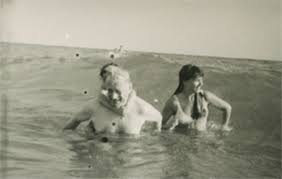
UnknownWhile looking for something else, I came across this picture of Henri Lefebvre on holiday with his then-wife Nicole Beaurain and daughter Armelle in the early 1970s.

There are a couple of other archive pictures here, including Lefebvre at the Moureux petrochemical factory he discusses in Introduction to Modernity and elsewhere. I’ve seen some pictures of Lefebvre in the Norbert Guterman archive, and there are some others online, but there are not that many widely available. This one comes from Beaurain’s private collection.

Posted in Henri Lefebvre | 2 Comments