Latour’s Gifford lectures – text now available as pdf

Update 2019: These links seem to be dead, but the pdf of the lectures can be found here; and the videos here. The lectures are now available as a book – details here.

Bruno Latour has made the text of his Gifford lectures available as a pdf on his site –Facing Gaia: Six lectures on the political theology of nature. Thanks to Owain Jones for the link (it seems this may have been available for a while; but news to me). The lectures were all video-recorded and I linked to them a while back – the links are all at the Edinburgh site.

Posted in Bruno Latour | 7 Comments

The Birth of Territory – author meets critics session at the AAG

Claudio Minca and Jeremy Crampton have organised an ‘author meets critics’ session on The Birth of Territory for the Association of American Geographers in Tampa next year. The panellists will be Juliet Fall, Alec Murphy, Joe Bryan and Anssi Paasi, with Claudio and Jeremy introducing, chairing and discussing. Stephen Legg is organising a more historical geography-orientated group for the Royal Geography Society-Institute of British Geographers meeting later in the year. I’m very grateful for the interest the book has had, and it will be good to discuss it in these sessions.

Posted in Conferences, The Birth of Territory | Leave a comment

Books received – Heidegger Gesamtausgabe volumes

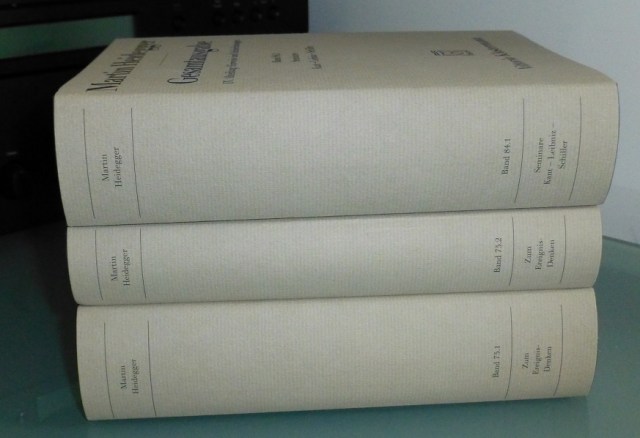
Heidegger booksRecently received, two huge volumes of the Heidegger Gesamtausgabe. The first, itself in two parts, is Volume 73, one of the manuscripts Heidegger chose not to publish in his lifetime, under the title of Zum Ereignis Denken. This follows from the important Beiträge zur Philosophie (Vom Ereignis) – Contributions to Philosophy (Of the Event). The second is Volume 84.1, only part one of another two-part volume, this time of seminar materials on Kant-Leibniz-Schiller. This part comprises seminars from 1931-36. The second part is not due out until 2014 or 2015.

The two parts in a single volume number, while perhaps understandable in the case of Volume 73 given the size of the manuscript, shows poor planning on the part of Volume 84. There are other instances when some volumes have double numbers – i.e. 29/30 and 56/57. But the edition is getting towards the end now, and these new volumes are constrained by previously published volumes and the numbers chosen for them. Divisions I (published writings) and II (lecture courses) are now complete, and Division III (unpublished writings and lectures) is almost finished – the most interesting-looking volume we are still awaiting here is Volume 80, which will include early versions of well known talks. Division IV includes seminar materials, notebooks, some correspondence (though much has been published outside this edition) and preliminary sketches. Most of the seminars are now published, though a couple of volumes remain; none of the notes and correspondence are yet published in this edition. A definite case of diminishing returns in what is left, but still a lot of material to work through.

Posted in Martin Heidegger, Publishing | 1 Comment

Criticism and critique: On academic books

An interesting post on how books are received for their promise rather than read and appreciated, with some good examples.

Posted in Uncategorized | Leave a comment

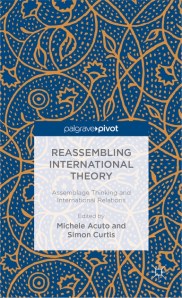
Reassembling International Theory – new edited collection

ReassemblingComing out later this month, an interesting looking collection entitled Reassembling International Theory: Assemblage Thinking and International Relations, edited by Michele Acuto and Simon Curtis. Outrageous price of £45 for 136 pages though.

What can ‘assemblage thinking’ contribute to international theory?

Assemblages have been invoked in several disciplines to make sense of the heterogeneity of the elements of society and the ways in which these are politically intertwined. Can parallel developments be prompted in IR?

Reassembling International Theory investigates how the contemporary debates on assemblages in social theory can contribute to generating critical considerations on the connections and dissociation of political agency, physical world and international dynamics. It draws on a variety of international relations experiences and on conversations with key ‘assemblage’ theorists to tease out the theoretical and methodological implications, ontological and material dynamics, as well as the politics of assemblage thinking.

Including contributions from Rita Abrahamsen, Roland Bleiker, Antoine Bousquet, Christian Bueger, David Chandler, Stephen Collier, Olaf Corry, Xavier Guillaume, Graham Harman, Debbie Lisle, Maximilian Mayer, Aihwa Ong, Mark Salter, Saskia Sassen, Peer Schouten, Nick Srnicek and Michael Williams, this text will appeal to scholars in International Relations, Political Sociology and Human Geography.

Posted in Books | 1 Comment

Our new paper on intelligence now online

Crampton, Roberts and Poorthuis on ‘The new political economy of geographical intelligence’ now available online.

Jeremy's avatarOpen Geography

cover

Very excited to announce our paper “The New Political Economy of Geographical Intelligence” is now online at the publisher’s website for the Annals of the Association of American Geographers.

The publishers have provided a link for free access to the first 50 people (click here for free access)! (Edit: these have unfortunately all been claimed)

The regular link which will remain after those free accesses are used up is this one http://www.tandfonline.com/doi/full/10.1080/00045608.2013.843436

Abstract

A troubling new political economy of geographical intelligence has emerged in the United States over the last two decades. The contours of this new political economy are difficult to identify due to official policies keeping much relevant information secret. The U.S. intelligence community increasingly relies on private corporations, working as contractors, to undertake intelligence work, including geographical intelligence (formally known as GEOINT). In this article we first describe the geography intelligence “contracting nexus” consisting of tens of thousands…

View original post 174 more words

Posted in Uncategorized | Leave a comment

L’origine de l’herméneutique de soi. Conférences prononcées à Dartmouth College, 1980

Interesting new publication of Foucault’s lectures. These particular ones have long been available in English, but there appears to be new material in this volume, and more to come in the series.

Clare O'Farrell's avatarFoucault News

Foucault-Origine-Couv

Michel Foucault, L’origine de l’herméneutique de soi. Conférences prononcées à Dartmouth College, 1980, Paris, Vrin, coll. « Philosophie du présent / Foucault inédit », 2013 (168 pages, ISBN 978-2-7116-2509-3, 14€).

Édition établie par Henri-Paul Fruchaud et Daniele Lorenzini.
Introduction et apparat critique par L. Cremonesi, A.I. Davidson, O. Irrera, D. Lorenzini, M. Tazzioli.

En novembre 1980, Michel Foucault prononce en anglais, à Dartmouth College, deux conférences intitulées Truth and Subjectivity et Christianity and Confession. Dans ces conférences, à travers l’étude des techniques de soi, et notamment de l’examen de conscience et de l’aveu, dans l’Antiquité gréco-romaine et le christianisme primitif, Foucault retrace la généalogie du sujet moderne et de l’herméneutique de soi qui nous caractérise encore aujourd’hui.

Cette édition présente pour la première fois la traduction française des conférences de Dartmouth College, avec les variantes de la version prononcée par Foucault le mois précédent à l’Université de…

View original post 314 more words

Posted in Uncategorized | Leave a comment

Foucault Doctoral Workshop – call for papers

Posted on behalf of Philippe Bonditti:

Call for papers (in English and French) for the Foucault Doctoral Workshop organized by the Association pour le Centre Michel Foucault (Paris).

It will take place next January 15th and 16th 2014 at IMEC (Abbaye d’Ardenne, near Caen) on the theme:

From ‘Security societies’ to (neo-)liberalism. Foucault, the Modern International and World Politics.

 Proposals should be sent either in French or English before December 15th, 2013.

All information regarding the modalities of participation appear in the document – English and French.

Posted in Conferences, Michel Foucault | Leave a comment

Rousseau – Property, Land, Territory

Mark Purcell points to Rousseau’s ‘denunciation of property’ in the second discourse:

The first person who, having enclosed a plot of land, took it into his head to say this is mine and found people simple enough to believe him, was the true founder of civil society. What crimes, wars, murders, what miseries and horrors would the human race have been spared, had someone pulled up the stakes or filled in the ditch and cried out to his fellow men: “Do not listen to this imposter. You are lost if you forget that the fruits of the earth belong to all and the earth to no one!”

It is a powerful passage, and I use this very quote at the beginning of The Birth of Territory (p. 1), to suggest that territory is, in some ways, like this claiming of land. I spend a little time discussing the quote, and the implications of what Rousseau goes on to say immediately afterwards. This raises the question that the book then goes back as far as Ancient Greek myth to investigate – “But where did this idea of exclusive ownership of a portion of the earth’s surface come from? What kinds of complexities are hidden behind that seemingly straight-forward definition?” (p. 2-3).

In the book’s coda I return to Rousseau, and suggest that while this is a powerful critique, conceptually he comes too late, because he was

writing at a time, in the mid-eighteenth century, when politics was fundamentally conceived as operating with discrete, bounded spaces under the control of a group of people, usually the state. Where those boundaries were was still open to question, of course, and what political structures should operate within the area was widely debated, as it was in Rousseau’s own writings. But the effective structure was now widely assumed: it had become the static background behind the action of political struggles (p. 328).

I suggest that this attitude can be found in his own writings, in a number of instances, but most explicitly when he suggests that “once the State is instituted, consent consists in residence; to dwell in the territory is to submit to sovereignty” (Social Contract, IV, 3.6). Rousseau is too much a thinker of his time.

Posted in Jean Jacques Rousseau, Politics, Territory, The Birth of Territory | 2 Comments

David Tennant as Richard II @TheRSC – some thoughts

David-Tennant_2705271bI went to see Shakespeare’s Richard II in Stratford yesterday. David (Dr Who) Tennant was King Richard, but a very strong cast generally – Oliver Ford Davies as the Duke of York, Michael Pennington as John of Gaunt, Nigel Lindsay as Henry Bolingbroke/Henry IV and Jane Lapotaire as the Duchess of Gloucester.

The reviews of this have been very positive. The two parts of Henry IV follow next year, and this is part of Gregory Doran’s plan to present the entire Shakespeare corpus over the next six years.

This is probably my favourite of Shakespeare’s history plays, and I’ve given two talks on it as part of the Shakespearean Territories project – in Nottingham and Corner Brook, Newfoundland (neither were recorded, unfortunately). In those talks and the draft material for the book I’m most interested the spatial and geographical aspects, such as banishment, pilgrimage, and return; and in the economic questions of land use and misuse that run through the play. Richard is accused of being England’s landlord, rather than King – with the appropriation of lands from John of Gaunt and others, turning them into resources to fund his Irish wars. As he says, ‘We are enforced to farm our royal realm’; and as Gaunt says in one of the play’s most powerful speeches, England ‘Is now leased out – I die pronouncing it – Like to a tenement or pelting farm’. This is a play filled with the language of soil, land, earth, and ground, but with a strong economic sense. There is a lot to be said about all these issues, which I hope to explore fully as I develop the argument.

But in the stage production I was more drawn to thinking about questions of political authority and sovereignty, the question of legitimacy and the rights of rulers and subjects. These are obviously crucial to the play, which is centred around the deposition of Richard, and is often equated to the threat to Elizabeth in Shakespeare’s own time.  The production was good on historical context – setting the opening scene more centrally in the wake of Gloucester’s death than does the script itself – but its resonances with issues today were also striking. Many of the reviews have noted how Tennant’s Richard assumes the majesty of his role only as he is deposed, but this is partly down to Shakespeare’s text. There is an economic aspect going on here, such as in the attempt at an exchange of the trappings of kingship for the meagre possessions of a religious man – ‘I’ll give my jewels for a set of beads,/My gorgeous palace for a hermitage,/My gay apparel for an almsman’s gown,/My figured goblets for a dish of wood’…

A beautifully written play, almost entirely in verse, and acted superbly. Tickets are almost unavailable for the Stratford and Barbican runs (though there are apparently a few left for the latter). It’s also being broadcast live to cinemas on November 13th.

Posted in Shakespearean Territories, William Shakespeare | 1 Comment