CFP: Origins of Truth: a conference on Foucault’s Lectures on the Will to Know (2013)

Conference on Foucault’s Lectures on the Will to Know in New York.

Clare O'Farrell's avatarFoucault News

Call for Papers

 Origins of Truth: Foucault’s Lectures on the Will to Know

 November 8-9, 2013

A conference presented by

the Foucault Society

and

Stony Brook University Department of Philosophy

Location:

Stony Brook Manhattan

387 Park Avenue South

New York, NY

Keynote: Todd May, Clemson University: “The Will to Know”

Guest Speaker: Eduardo Mendieta, Stony Brook University

In celebration of the publication of Michel Foucault’s Lectures on the Will to Know: Lectures at the Collège de France, 1970-1971

(Palgrave Macmillan, 2013), we invite participants to a conference in New York City.

 As the first of Foucault’s annual courses, Lectures on the Will to Know set an agenda for his intellectual journey of the 1970s and 1980s. Its publication in English translation opens up new directions for research into power, knowledge and the “formation of discourses.”

Papers are invited which analyze Lectures on the Will to Know – its sources, themes…

View original post 241 more words

Posted in Uncategorized | 1 Comment

Mendieta on Kleingeld’s Kant and Cosmopolitanism

Mendieta on Kleingeld on Kant.

Posted in Uncategorized | Leave a comment

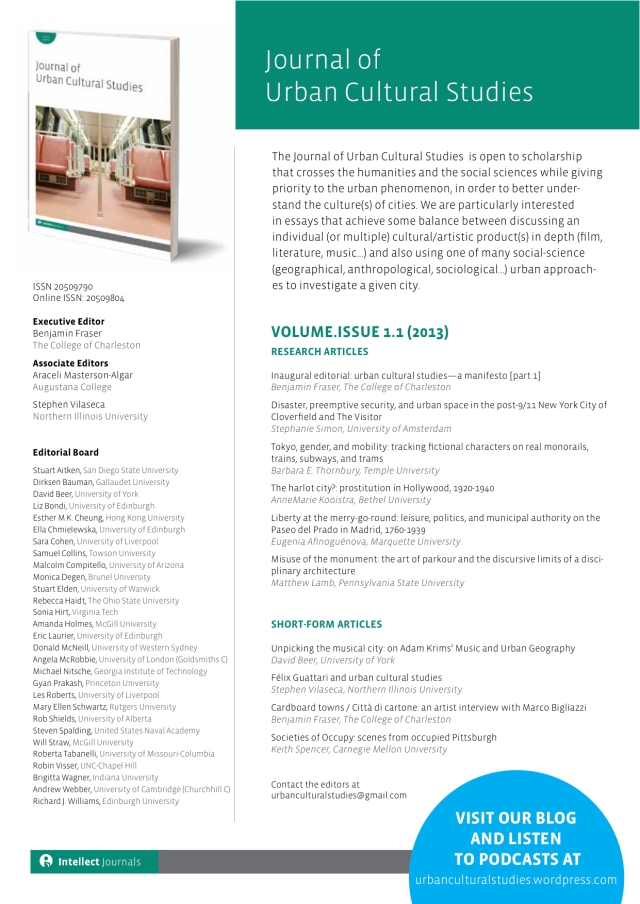
[newer] eflyer – Journal of Urban Cultural Studies (Intellect)

Table of contents for the first issue of this new journal.

urbanculturalstudies's avatarurbanculturalstudies

View original post

Posted in Uncategorized | 1 Comment

Producing Urban Asylum

Jonathan Darling from University of Manchester has a new website for his ESRC project Producing Urban Asylum.

Posted in Uncategorized | 1 Comment

Call for Papers

Call for papers for a conference on Geographies of Neoliberalism in Oxford in February 2014.

ambermurreyndewa's avatargeographiesofresistance

Geographies of Neoliberalism 

and Resistance After the Crisis: 

The State, Violence, and Labour

An Interdisciplinary Conference from the 

Departments of Geography and International Relations

University of Oxford

Halford Mackinder Lecture Theatre

February 15, 2014

Keynote Speaker: Samir Amin

Special Appearance: Ward Churchill

Although the global financial crisis of 2008 exposed inherent instabilities and contradictions within the system of capitalist production and speculative finance, neoliberal ideology and policies have become more politically durable, economically ‘necessary’, and culturally hegemonic than ever.  This academic conference engages with the deepening inequalities and structural violence caused by reinvigorated manifestations and re-articulated processes of neoliberalism (exclusion, domination, ‘accumulation by dispossession’).  It seeks to widen the discussion of the present crisis to include analyses of (dis)organised resistance against and amid neoliberalism as well as perspectives of neoliberal crisis in the longue durée, including examinations of structural adjustment programmes, trade liberalisation and the privatisation of public assetssince…

View original post 444 more words

Posted in Uncategorized | Leave a comment

Alexander Betts, Survival Migration

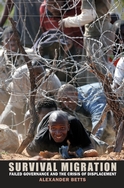
Survival MigrationAlexander Betts, Survival Migration: Failed Governance and the Crisis of Displacement is now out.

International treaties, conventions, and organizations to protect refugees were established in the aftermath of World War II to protect people escaping targeted persecution by their own governments. However, the nature of cross-border displacement has transformed dramatically since then. Such threats as environmental change, food insecurity, and generalized violence force massive numbers of people to flee states that are unable or unwilling to ensure their basic rights, as do conditions in failed and fragile states that make possible human rights deprivations. Because these reasons do not meet the legal understanding of persecution, the victims of these circumstances are not usually recognized as “refugees,” preventing current institutions from ensuring their protection.

In this book, Alexander Betts develops the concept of “survival migration” to highlight the crisis in which these people find themselves. Examining flight from three of the most fragile states in Africa—Zimbabwe, the Democratic Republic of Congo, and Somalia—Betts explains variation in institutional responses across the neighboring host states. There is massive inconsistency. Some survival migrants are offered asylum as refugees; others are rounded up, detained, and deported, often in brutal conditions. The inadequacies of the current refugee regime are a disaster for human rights and gravely threaten international security. In Survival Migration, Betts outlines these failings, illustrates the enormous human suffering that results, and argues strongly for an expansion of protected categories.

Posted in Books, Boundaries, Politics | Leave a comment

Mezzadra and Neilson, Border as Method

Sandro Mezzadra and Brett Neilson’s Border as Method, or, The Multiplication of Labor is now out. The table of contents and introduction are available as pdf here. Thanks to Charles Heller for the link.

Border as MethodFar from creating a borderless world, contemporary globalization has generated a proliferation of borders. In Border as Method, Sandro Mezzadra and Brett Neilson chart this proliferation, investigating its implications for migratory movements, capitalist transformations, and political life. They explore the atmospheric violence that surrounds borderlands and border struggles across various geographical scales, illustrating their theoretical arguments with illuminating case studies drawn from Europe, Asia, the Pacific, the Americas, and elsewhere. Mezzadra and Neilson approach the border not only as a research object but also as an epistemic framework. Their use of the border as method enables new perspectives on the crisis and transformations of the nation-state, as well as powerful reassessments of political concepts such as citizenship and sovereignty.

Posted in Boundaries, Politics | Tagged , | Leave a comment

Mary Beard on ‘the damn footnotes’

Mary Beard has a good discussion of footnotes in her TLS column. Here’s the beginning:

I know what I like, and don’t like, in a footnote: an accurate and precise reference to what ever is being discussed (I mean not a reference to Smith (2008), when Smith (2008) is a book of 1000 pages — but Smith (2008) 245-47); a certain modesty (not a vast multi-lingual bibliography of modern theoretical works, semi-relevant to the topic, designed only to display the learning of the author… you know ‘the seminal work in Slovenian remains..’); and value-added wit (I like a footnote to reward those who bother to consult it with an extra bit of thought-provocation and humour).

But it is one thing knowing what one likes, quite another actually managing to do it oneself.

I have spent the last week or so trying to complete and check the footnotes from my book of the Sather lectures (on Roman Laughter), now long overdue. And a rather gloomy experience it has been…

Posted in Publishing, Writing | 1 Comment

African Geographical Review – Special Issue Call for Papers

Posted on behalf of Kevin DeJesus:

African Geographical Review – Special Issue Call for Papers

Out of Place, Into Extremis:

       Critical Geographic Perspectives on the State of Forced Migration in Africa

Guest Editors: Kevin M. DeJesus, Rhode Island College and Daisuke Maruyama, Kyoto University

This special issue of African Geographical Review seeks to provide a comprehensive, contemporary compendium of perspectives on forced migration across the African continent. This initiative draws from critical geographical analytical frameworks to elucidate the experiences, dilemmas, trends and interventions in the experience of internally displaced persons, refugees and refugee returnees from every sector of the continent. This special issue is conceived of as an analytical and empirical resource for which those scholars across disciplines, refugee advocates and humanitarian professionals may utilize to further apprehend the great complexities of the human geographies of survival forcibly displaced persons engender in their quest to locate spaces of refuge. Indeed, as Feminist Critical Geographer Jennifer Hyndman noted so presciently over a decade ago, the very acts of mobility/immobility, border crossings and the pursuit of humanitarian supports amidst grave circumstances, is both immensely spatialized and politicized.[1]

Displaced persons endure complex ecological, political, sociological and material factors which shape the making of new geographies of everyday life amidst often dreadful conditions. This special issue intends to center geographic thought and analysis in the critical assessment of policy and practice concerning refugee and IDP policy-making, humanitarian intervention, contexts of contested borders of selves and nations, local reception and the challenges of return and reintegration. The geographies of return and so-called reintegration encompass profoundly vital questions and problematics, across scales, whereas making place upon returning to a home perhaps only known long ago, if ever, often engenders new dislocations. The spectrum of the experiences of flight to return are inherently, dynamically and vitally geographical, and therefore, it is the goal of this special issue to comprehensively consider this wide range of human experiences and processes that displaced persons often creatively contend with in the face of sharply-scaled social, economic and political barriers, borders and bureaucracies.

Papers concerning the following themes, and those others related to the critical geographies of forced migration on the continent are welcome. Particularly, scholars from the continent are  encouraged to participate in this project.

-Scaling injustice: Critiques of country-specific refugee and IDP policy approaches/macro-level critiques of global refugee regimes, aid to refugees/IDPs in Africa;

-Paradoxes, Problematics and Purpose in the Production of Humanitarian Space: Critical approaches to refugee and IDP encampment as a spatial strategy of humanitarian management and the role of the nation-state;

-National citizens and Pan-African Approaches: Forced migration and the role of national borders in forcibly transnational lives amidst a quest for unified policy (i.e. 2009 African Union Convention on Internally Displaced Persons);

-Protecting Self and Place: Transit refugees, geographies of resources, and resistance to forced re-location;

-Making sacred space: The role of religion, the religio-political and religiously inspired actors in humanitarian aid provision and social-psychological needs in extremis;

-Livelihoods and Local Resources:  Ecological change and resource development/destruction: innovations in policy and practice

-Spatial analysis, crisis mapping, and human rights of the displaced: Reflections on Africa

-Spaces of change: Cultural anomie, coping and emergent social practices in everyday spaces of living refuge (i.e. refugee/IDP encampment and shifts in dowry practices);

-Re-inventing home: Spaces of the family and the experience of flight, long-term displacement and re-location;

-Spatializing social structure and communities dislocated: Social organization and re-organization in emergency and long-term spaces of refuge;

-The experience of displacement and how gender works: Women and men in the meeting of everyday material and social needs amidst shifting contexts of place;

-Spatial organization of social spaces of refuge: Re-conceiving of refugee encampment and the humanitarian spatial imagination

-Urban and Rural Spaces of Refuge: Critical mappings of urban and rural implacement of displaced persons, macro-urban refugee policy, informal spaces of refuge and localizing community solidarity and proximity, urban and rural livelihood resources.

Key Project Details: Please send your abstract of 250 words, by October 30, 2013, with the subject line: “AGR Special Issue” to: kevinm.dejesus@gmail.com

Selected manuscripts are due by January 3, 2014

For authors guidelines, please see here:

[1]Hyndman, J. (2000). Managing Displacement: Refugees and the Politics of Humanitarianism. Minneapolis, MN: University of Minnesota Press.

Posted in Boundaries, Politics | 1 Comment

Foucault’s Last Decade – third update

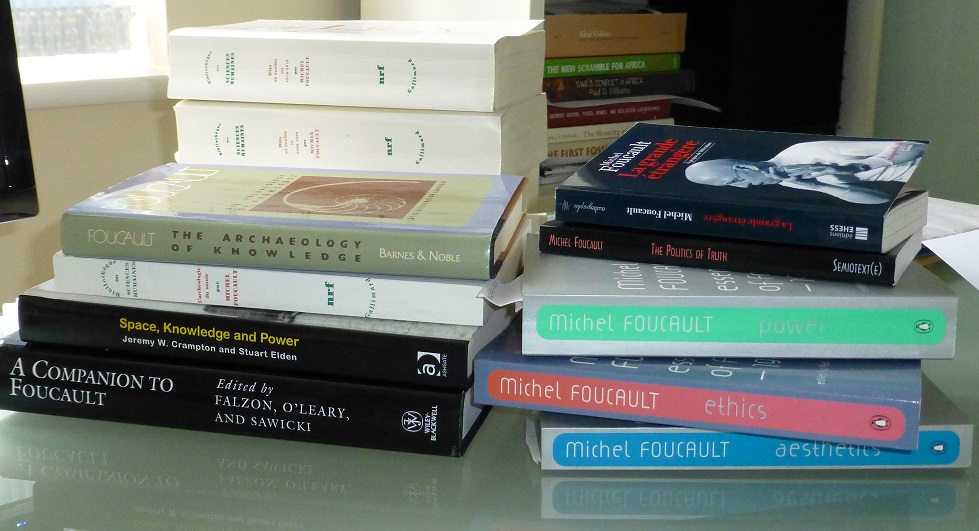
Foucault 3See first and second updates for background to the book I’m writing (and the brief prospectus here). Recent progress has been slower than I’d have liked, as I’m in the middle of moving home and office. Ideally I would now have moved to readings of Foucault’s 1971-72 and 1972-73 courses, but neither are yet published (the latter is due out later this year). There are some very important indications of content in the ‘Course summaries’ and in the May 1973 ‘Truth and Juridical Forms’ lectures from Rio (see my comments on the latter here). In addition an audience member’s notes of the 28th March 1973 lecture are in the Power, Truth and Strategy volume. I’ve drafted a few paragraphs on each course on the basis of these. But there is going to be so much more in the courses themselves. I don’t think there are audio recordings available in the archive for either course (the 1972-73 ones are definitely lost), but the edited courses are much better in any case. So, certainly not for the last time, I have had to leave a gap I will fill in later.

I also wrote a short bit on the three Rio lectures on medicine from October-November 1974 (which I previously discussed in Mapping the Present and a shorter piece entitled ‘Plague, Panopticon, Police‘; and say a bit more about here). They offer remarkable insights into Foucault’s seminars, rather than courses, at the Collège de France, and anticipate a number of later concerns and collaborative projects. They are the first time he talks about bio-politics, for instance, at least in currently published material.

Along the way, I made a full translation of the Manifesto of the GIP, pulled together a list of audio recordings, and made a couple of requests for help (here and here).

Posted in Foucault's Last Decade, Michel Foucault, Writing | Leave a comment