2013 publications

There will be three journal articles out in 2013, along with The Birth of Territory. Two of the articles are related to that book, but take arguments in different directions and link to future projects on Shakespeare and Foucault. The third links to The Space of World project – though I am unsure where that is going at the moment.

– ‘The Geopolitics of King Lear: Territory, Land, Earth’, for Law and Literature. There will be commentaries on this piece and a response.

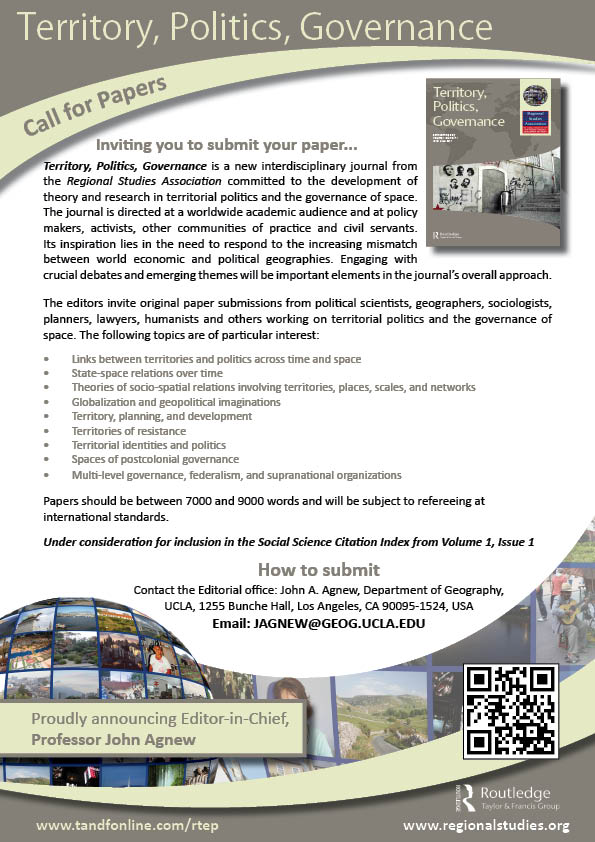
– ‘How should we do the history of territory?’ for the launch issue of the new R.S.A. journal Territory, Politics, Governance. This paper was initially intended for an edited book coming out of The Foucault Effect 1991-2011 conference, but I was told that wasn’t going ahead so I was looking for another outlet. John Agnew asked if I might have something to submit to the journal and, after a round of reviews and some fairly small revisions, has just accepted it.

– ‘Secure the Volume: Vertical Geopolitics and the Depth of Power’ for Political Geography. This is an edited version of the lecture I gave in Edinburgh at the RGS. It will have commentaries from Peter Adey and Gavin Bridge, and a response from me.

Posted in Michel Foucault, My Publications, Territory, The Birth of Territory, The Space of the World, William Shakespeare | Leave a comment

Global Politics: A New Introduction – second edition

Routledge now have a page up for the second edition of this textbook – 696 pages. It is due out in December. There are a number of new chapters, and revisions to the others. I have a chapter in here entitled ‘Why is the World Divided Territorially?’ The first edition had some really positive reviews, and I’ve heard good things about its usefulness in the classroom – each chapter is written as an answer to a question, which came from the editors talking to students about what they expected to learn. The first edition had a companion website with supplementary material. I guess that will be updated soon. An interesting- and, I think, successful – approach. Writing the chapter was a challenge though.

Posted in My Publications, Politics, teaching, Territory | Leave a comment

Michel Foucault – Le beau danger

Interesting short book of an interview – which breaks off incomplete – with Claude Bonnefoy from 1968. Relates to Foucault’s books of the 1960s, especially History of Madness, The Birth of the Clinic, The Order of Things and the soon-to-be-published The Archaeology of Knowledge. The introduction suggests that the plan of Foucault and Bonnefoy was to publish a book of interviews, but this idea was abandoned. The book is with a prestigious press, and the introduction is by Philippe Artières (who has worked with IMEC) and he thanks both Daniel Defert and Foucault’s family. Clearly a further relaxation of the ‘no posthumous publications’ request…

Posted in Michel Foucault | Leave a comment

Eyal Weizman – Mengele’s Skull and Forensic Architecture

Eyal Weizman’s The Least of All Possible Evils is getting much attention at the moment, but his short co-authored book with Thomas Keenan, Mengele’s Skull: The Advent of a Forensic Aesthetics is well worth a read too.

In 1985, the body of Josef Mengele, one of the last Nazi war criminals still at large, was unearthed in Brazil. The ensuing process of identifying the bones in question opened up what can now be seen as a third narrative in war crime investigations—not that of the document or the witness but rather the birth of a forensic approach to understanding war crimes and crimes against humanity.

In the period coinciding with the discovery of Mengele’s skeleton, scientists began to appear in human rights cases as expert witnesses, called to interpret and speak on behalf of things—often bones and human remains. But the aesthetic, political, and ethical complications that emerge with the introduction of the thing in war crimes trials indicate that this innovation is not simply one in which the solid object provides a stable and fixed alternative to human uncertainties, ambiguities, and anxieties.

The complexities associated with testimony—that of the subject—are echoed in the presentation of the object. Human remains are the kind of things from which the trace of the subject cannot be fully removed. Their appearance and presentation in the courts of law and public opinion has in fact blurred something of the distinction between objects and subjects, evidence and testimony.

Also recently available is a short essay – bi-lingual English and German – entitled Forensic Architecture: Notes from Fields and Forums. His Society and Space lecture – also on the Forensic Architecture project – should be available on video soon. I’ll link to it as soon as it’s online.

Posted in Eyal Weizman, Society and Space | 3 Comments

Very good piece on the politics of flags – with a link to the Korea flag incident at the Olympics – by Klaus Dodds and Alasdair Pinkerton.

Posted in Uncategorized | 1 Comment

Olympics 2012 – Megaevents virtual issue

This is a very topical virtual theme issue which draws papers from the Environment and Planning series of journals, including Society and Space. It begins with a newly written editorial by Francisco Klauser. The papers are open access. List of papers and links here.

Posted in Politics, Society and Space | Leave a comment

Speculative Realism book series – new titles

Graham Harman’s blog notes that three new titles have been contracted for the  Speculative Realism series he edits for Edinburgh University Press.

Levi R. Bryant, Onto-Cartographies: An Ontology of Space and Time

Jon Cogburn, After Quietism: Analytic Philosophies of Immanence and the New Metaphysics

Adrian Johnston, Adventures in Transcendental Materialism: Dialogues with Contemporary Thinkers

Posted in Books, Graham Harman, Levi Bryant | Leave a comment

Graham Harman on Tristan Garcia

Graham Harman has written an interesting and detailed review essay on Tristan Garcia, concentrating on Forme et objet, at Berfrois. Forme et objet has been sitting in my amazon.fr basket for a while – this piece convinced me I should actually buy it. Here’s the final paragraph of the essay:

Forme et objet is an intricate piece of work by an emerging philosopher who is now a force to reckon with. It will take even more time to digest than the considerable time I have already invested in trying to understand the whole of the book’s argument. For those who read French, Forme et objet is worth significant reading time during the months to come; for those who do not, it can be hoped that an English translation will appear as quickly as the great length of the book permits. Tristan Garcia is most likely a name that we will all be pronouncing hundreds or thousands of times in the decades to come.

Posted in Graham Harman, Tristan Garcia | 1 Comment

Writing grant and research proposals

Just found this really useful resource when looking for something else on Michael Watts’s site. Suggestions, examples, resources for writing dissertation proposals, grant proposals etc. While designed for (post)graduates and early career scholars, I think there is bound to be something useful here for all academics. I’ll be back before I submit my next grant.

Posted in Michael Watts, Uncategorized, Universities, Writing | 1 Comment

Foucault’s Pierre Riviere project

Clare O’Farrell’s Foucault News blog has just posted the abstract for a very interesting piece on Foucault’s Moi, Pierre Rivière project – Michael Sheringham, “Michel Foucault, Pierre Rivière and the Archival Imaginary“, Comparative Critical Studies 8.2–3 (2011): 235–257.

Sheringham talks about the book which includes the memoir, other documents, and some commentaries; Foucault’s use of the archive more generally; the film by René Allio; and the recent documentary Retour en Normandie. Sheringham also mentions a different film version, Je suis Pierre Rivière, directed by Christina Lipinska, which I didn’t know about (though he notes it has not been released on VHS or DVD, and rarely shown). It links to Foucault’s later work on ‘the lives of infamous men’; the Herculine Barbin memoir and the collaborative work with Arlette Farge.

Foucault’s collaborative work has been largely neglected in English scholarship, which is a shame given how important it clearly was to Foucault himself.

Posted in Arlette Farge, Michel Foucault | Leave a comment