
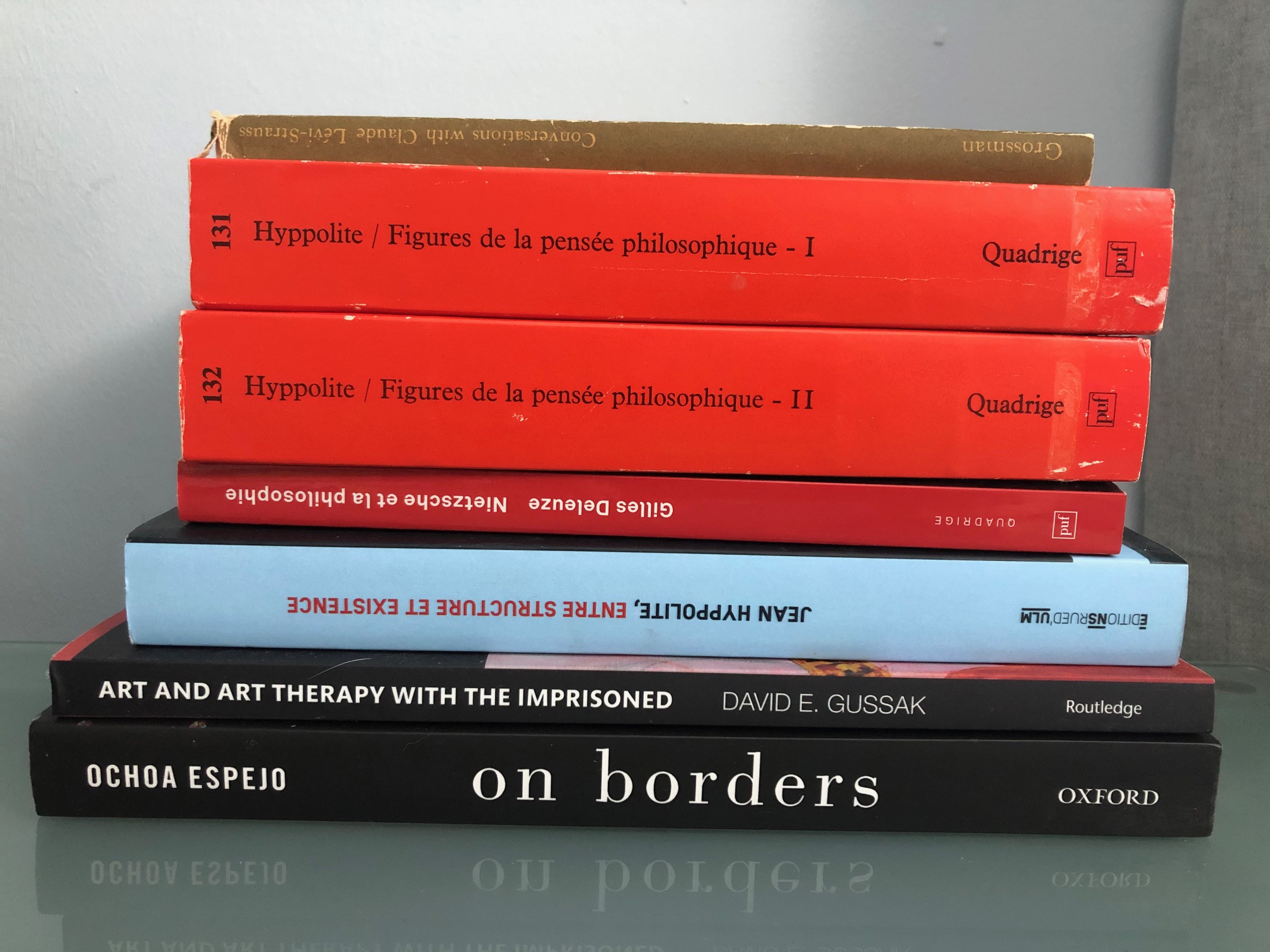
Some books by Lévi-Strauss, Hyppolite and Deleuze, along with Paulina Ochoa Espejo, On Borders: Territories, Legitimacy, and the Rights of Place and David Gussak, Art and Art Therapy with the Imprisoned, sent by the publisher.
Some books by Lévi-Strauss, Hyppolite and Deleuze, along with Paulina Ochoa Espejo, On Borders: Territories, Legitimacy, and the Rights of Place and David Gussak, Art and Art Therapy with the Imprisoned, sent by the publisher.
Cristina A. Bejan, Intellectuals and Fascism in Interwar Romania: The Criterion Association – Palgrave, 2019 and discussion at New Books Network with Steven Seegel

In 1930s Bucharest, some of the country’s most brilliant young intellectuals converged to form the Criterion Association. Bound by friendship and the dream of a new, modern Romania, their members included historian Mircea Eliade, critic Petru Comarnescu, Jewish playwright Mihail Sebastian and a host of other philosophers and artists. Together, they built a vibrant cultural scene that flourished for a few short years, before fascism and scandal splintered their ranks. Cristina A. Bejan asks how the far-right Iron Guard came to eclipse the appeal of liberalism for so many of Romania’s intellectual elite, drawing on diaries, memoirs and other writings to examine the collision of culture and extremism in the interwar years. The first English-language study of Criterion and the most thorough to date in any language, this book grapples with the complexities of Romanian intellectual life in the moments before collapse.
Ann Heberlein, On Love and Tyranny: The Life and Politics of Hannah Arendt – Anansi, translated by Alice Menzies, January 2021

In an utterly unique approach to biography, On Love and Tyranny traces the life and work of the iconic German Jewish intellectual Hannah Arendt, whose political philosophy and understandings of evil, totalitarianism, love, and exile prove essential amid the rise of the refugee crisis and authoritarian regimes around the world.
What can we learn from the iconic political thinker Hannah Arendt? Well, the short answer may be: to love the world so much that we think change is possible.
The life of Hannah Arendt spans a crucial chapter in the history of the Western world, a period that witnessed the rise of the Nazi regime and the crises of the Cold War, a time when our ideas about humanity and its value, its guilt and responsibility, were formulated. Arendt’s thinking is intimately entwined with her life and the concrete experiences she drew from her encounters with evil, but also from love, exile, statelessness, and longing. This strikingly original work moves from political themes that wholly consume us today, such as the ways in which democracies can so easily become totalitarian states; to the deeply personal, in intimate recollections of Arendt’s famous lovers and friends, including Heidegger, Benjamin, de Beauvoir, and Sartre; and to wider moral deconstructions of what it means to be human and what it means to be humane.
On Love and Tyranny brings to life a Hannah Arendt for our days, a timeless intellectual whose investigations into the nature of evil and of love are eerily and urgently relevant half a century later.
On 7 January 2021 I’ll be part of a panel discussion for the Abolition Democracy 13/13 series, hosted by Bernard E. Harcourt at the Columbia Center for Contemporary Critical Thought, and co-organised with Daniele Lorenzini of The Centre for Research in Post-Kantian European Philosophy at Warwick. We will be discussing Foucault’s 1972-73 lecture course The Punitive Society. Before the event, which will be live-streamed, participants have been asked to post a short piece about one or more ideas in the course. I’ve written a piece entitled ‘From Dynastics to Genealogy‘, which is a synopsis of a longer piece in progress.
It can be read here, and the other contributions from Goldie Osuri, Daniele Lorenzini, Bernard Harcourt, Rahsaan Thomas and others here. That last link has all the details of how to follow the discussion.

A strange year of reading. For long periods I found it very hard to concentrate on reading that wasn’t immediately useful for a writing project or other work task (and even then…). Novels were a particular struggle. I found reading diaries, memoirs and autobiographies a bit easier, and so there are quite a few of those in here. Perhaps this was in part to see how creative work had been done in the past in difficult circumstances.
When I’ve posted these lists before, I often get questions. Here’s what I’ve said in reply before.
Always worth a read – Antonio Gramsci on New Year’s Day, translated by Alberto Toscano.
 This text was first published in Avanti!, Turin edition, from his column “Sotto la Mole,” January 1, 1916.
Translated by Alberto Toscano for Viewpoint.
Every morning, when I wake again under the pall of the sky, I feel that for me it is New Year’s day.
That’s why I hate these New Year’s that fall like fixed maturities, which turn life and human spirit into a commercial concern with its neat final balance, its outstanding amounts, its budget for the new management. They make us lose the continuity of life and spirit. You end up seriously thinking that between one year and the next there is a break, that a new history is beginning; you make resolutions, and you regret your irresolution, and so on, and so forth. This is generally what’s wrong with dates. (continues…)
As with previous years, these are a list of academic books published this year which I read and appreciated. This means that good books which I haven’t yet read don’t feature, and I will of course miss many. Several of these are books I reviewed or endorsed, and some are by friends and colleagues. Certain publishers feature disproportionately. It’s of course biased by my interests and prejudices. So while there are doubtless many other good books this year, I can at least say that these are all worth reading.
Here are the lists from 2013, 2014, 2015, 2016, 2017, 2018, 2019

Alphabetical list of the music I enjoyed the most this year…
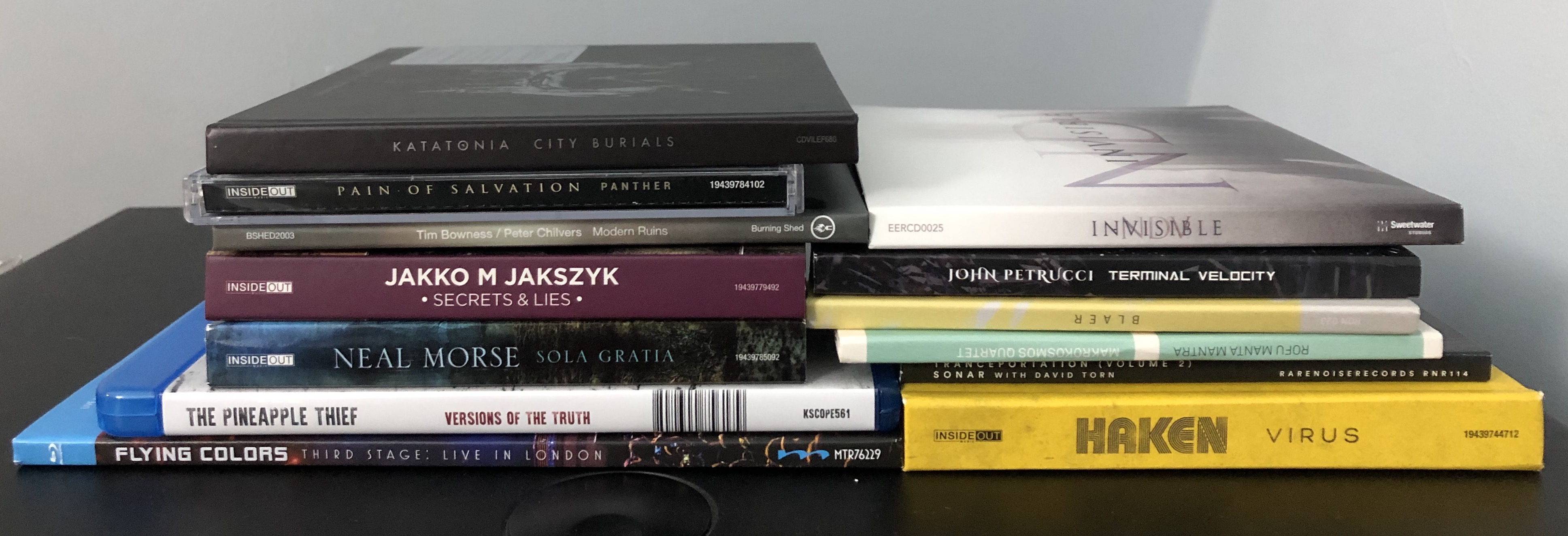
I really missed live music, with the only gig I attended The Aristocrats early in the year. Lots of things cancelled or postponed. But I did enjoy being able to stream some live concerts, especially from Nik Bärtsch’s Ronin and Mobile.
For previous years, see the lists from 2019, 2018, 2017, 2016, 2015, 2014, 2013 and 2012.
Geographers, sociologists, philosophers, etc. on covid-19
Where to start with reading Henri Lefebvre?
Stuart Hall’s documentary on Marx and Marxism
Georges Bataille – Oeuvres complètes and other French collections; English translations
My favourite academic books of 2019 [other years here]
Foucault audio and video recordings (other Foucault resources here)
Where to start with reading Peter Sloterdijk?
The Deleuze Seminars, Website Launch
Etienne Balibar – Being Communist, Becoming Other (audio)
Foucault – uncollected notes, lectures and interviews
The Early Foucault – research updates
Quite a lot of these are pages, rather than posts, and some are quite old. Not many posts this year seemed to get much attention, which is probably due to social media as much as anything else. I’ve been using Twitter more, and Facebook much less. But there are some things which don’t really work on those, so I imagine I’ll keep going with this site for a while longer. Thanks for reading this year.

On the Hermitix podcast (stream or download) I discuss The Early Foucault, forthcoming with Polity in 2021. Also on Youtube.
Stuart Elden is Professor of Political Theory and Geography at University of Warwick. He is the author of multiple books on the work of Michel Foucault, alongside other texts on Georges Canguilhem, Kant and Heidegger. In this episode we discuss his soon to be published book The Early Foucault
The Early Foucault can be purchased here: https://politybooks.com/bookdetail/?isbn=9781509525959


