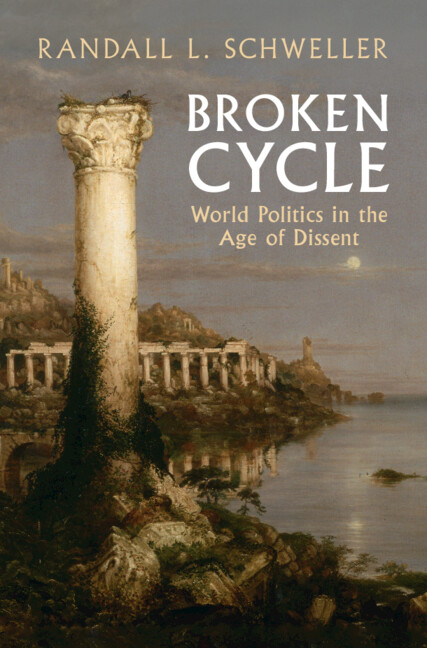
Why is the Liberal International Order unraveling – and will this lead to global disorder? Broken Cycle explores this urgent question by viewing international politics through a dynamic lens focused on the rise and fall of great powers – whose periodic global wars determine who rules and which ideas and values prevail in the reordered international system. Randall L. Schweller uncovers recurring patterns of change, offering a framework to anticipate the contours of the emerging world. Rather than tracking short-term diplomatic shifts, this book seeks the deeper rhythms of history – cycles of growth, expansion, and decline – that shape international politics over centuries. These patterns are not inevitable, but they are powerful. By understanding them, we gain insight into the forces driving today’s dissent – and tomorrow’s possibilities. This is a study of the structural forces that govern change, the crises that break the old order, and the ideas that rise in its place.
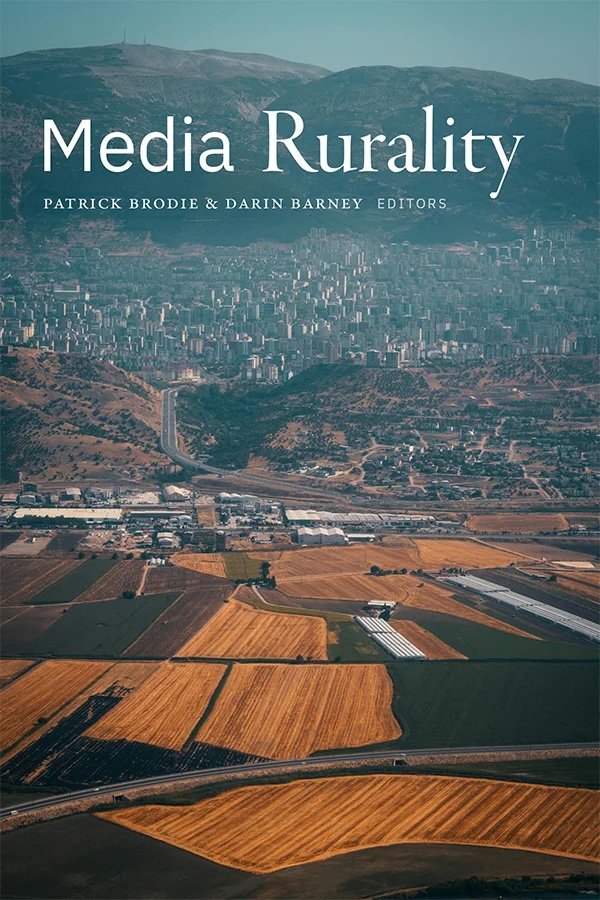
Patrick Brodie and Darin Barney eds. Media Rurality – Duke University Press, April 2026
Media Rurality investigates the centrality of rural places and people within the media systems and technologies that shape daily life in and across rural and urban settings alike. From the boglands of Ireland to data centers in the Oregon countryside to the homemade media systems of rural Tanzania, the contributors to this volume show how rural territories are highly mediated, technologized spaces profoundly enmeshed with global capitalism and colonialism. Approaching the study of rurality through a materialist lens that foregrounds infrastructure, this collection shows how rural spaces often bear the environmental brunt of capitalist development while being relegated to the economic and cultural periphery.
Contributors. Christopher Ali, Patrick Bresnihan, Patrick Brodie, Darin Barney, Jenna Burrell, Jordan B. Kinder, Burç Köstem, Cindy Lin, Emily Ng, Lisa Parks, Anne Pasek, Esther Peeren, Nicole Starosielski, Ishita Tiwary, Hunter Vaughan, Ayesha Vemuri, Megan Wiessner, Assatu Wisseh
In Wild Tides, Patrick Brodie maps the shifting fortunes of the Irish economy before the 2008 financial crisis up to 2020, outlining how the Irish state moved from rampant and irresponsible financialized development to incentivizing private media infrastructure and policy as instruments for economic recovery. Brodie contends that, while the Irish state’s investment in creative and technological sectors of media was supposed to bring resources back into the country and stabilize the economy, it instead rendered the country even more vulnerable to future instability and transferred wealth into the hands of multinational corporations. Through ethnographic work and close engagement with the Irish state’s policy and planning across a number of key media infrastructure sites, Brodie unfolds the very real environmental and social impacts of Ireland’s naturalized model of financialized, foreign direct investment-led infrastructural development. Richly researched and comprehensively argued, Wild Tides reveals the multifarious, unexpected ways that financialization reaches into the daily life of a nation.
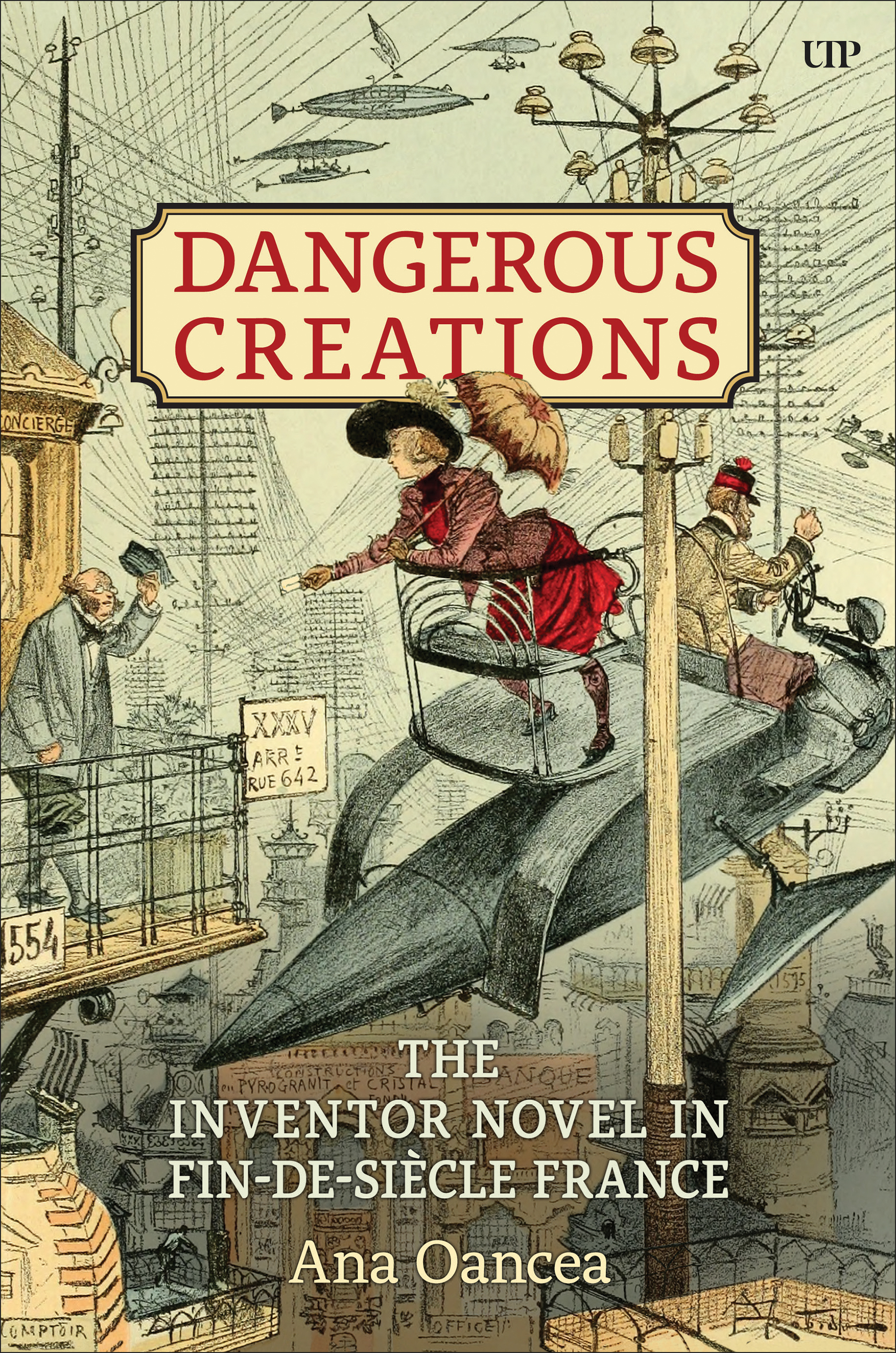
Dangerous Creations presents a master narrative of the inventor in fin-de-siècle French literature by analyzing the works of Jules Verne, Albert Robida, Émile Zola, and Villiers de l’Isle-Adam. Their writings challenge the role of science in shaping French national identity and aim to transform contemporary understandings of science and technology. The book reveals how Verne, Robida, Zola, and de l’Isle-Adam reimagine the figure of the inventor, reshaping the literary standards of their time. Universally male in these narratives, the inventor serves as a flawed exemplar of national heroism during the Age of Empire – a period marked by significant external threats and internal strife – while also embodying unrestrained creativity. Ultimately, the inventor novel reflects broader French anxieties surrounding scientific progress, empire, and gender. Ana Oancea explores the transmedia and transnational legacy of the fin-de-siècle inventor novel through vignettes that highlight similarly themed narratives in contemporary popular culture. These sections engage with films, television series, graphic narratives, and video games that reinterpret key aspects of the inventor narrative, shedding light on its power structures, racial and gender politics, and colonial aspirations.
In March last year I shared news of the discovery of typescript versions of Foucault’s two theses – what became the History of Madness and his introduction and translation of Kant’s Anthropology, annotated by Foucault – Emmanuel le Doeff, À la découverte des thèses annotées de Michel Foucault (open access).
The theses have now been fully digitised and are available here:
Folie et déraison. Histoire de l’expérience de la folie à l’âge classique, M. Foucault, Paris, Thèse principale de doctorat en Lettres, 1961. Page de titre. BU Henri-Piéron. Cote : FP TH 124 (1). Cliché : Colas Rosset
As I said at the time:
When I was researching The Early Foucault, I was curious about the early versions of Folie et déraison, but there was no typescript of this kind in Foucault’s own archive, or in Canguilhem’s. I did manage to see a copy of the printed text bound for the defence, which was the same as the 1961 Plon version except for the cover and endpapers. The history of the book’s printing and variants still causes confusion – there is a list of the different versions here. The version discussed in the above article obviously precedes all of these printed versions – a fascinating addition to the story of this text.
Nous espérons que la mise à disposition de ces documents à destination du public des spécialistes comme de toute personne intéressée par l’œuvre de Michel Foucault permettra de mieux comprendre les procédés d’écriture de celui qui reste l’un des plus importants philosophes contemporains.
In Good Vibes Only, Robin James argues that the vibes, the mathematical vectors driving modern technologies, have shifted. Considering the forms of governance performed by the algorithms fueling AI, recommender systems, facial recognition, and other contemporary technologies, James vividly illustrates our new biopolitical regime, one in which discourses of legitimacy function in place of norms to draw patriarchal, racial, and capitalist lines around personhood. James innovatively combines continental philosophy, popular music studies, and media studies to show how the math driving modern technologies translates into both political forms of governance and colloquial cultural practices ranging from social media posts to playlist categories to hip hop aesthetics. Qualitative atmospheres and abstractions are undergirded by quantitative orientations, utilized by users and platforms alike. Good Vibes Only breaks down the phenomenology of how these algorithmic “vibes” have shifted the way biopower governs, not with disciplinary or regulatory norms, but with orientations or lineages that it assesses for their capacity to carry patriarchal, racial, capitalist property relations into speculative realities.
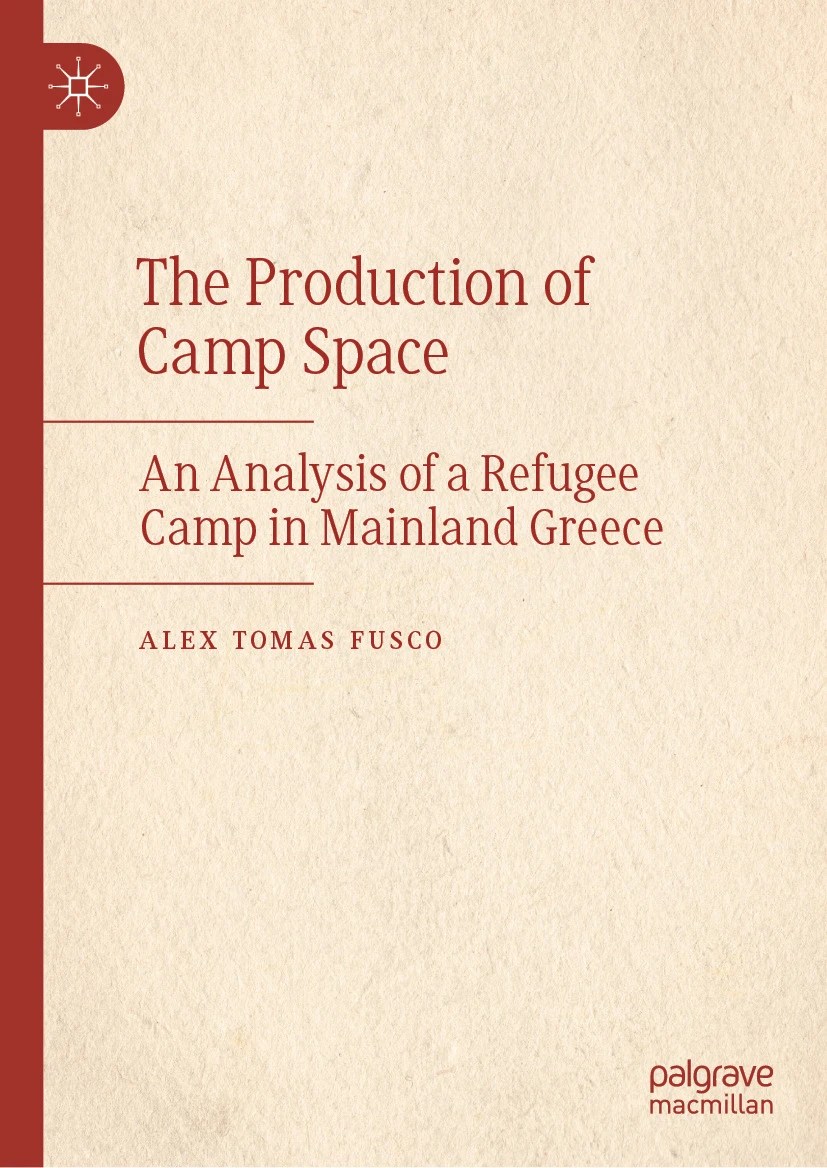
This book uses a Lefebvrian spatial framework to explore the ‘production’ of Ritsona refugee camp in Central Greece. Lefebvre’s multifaceted and reflexive conceptualisation of space allows for a macro analysis that locates the camp within the global structure and layout of society, but simultaneously facilitates a more localised exploration of space as an interplay between people, social practices and the built environment of the material camp. The first half of the book contextualises the camp and examines the broader processes and structures implicated in its production, exploring the emergence of the camp as an idea, and of the birth, development and proliferation of the material camp as a technology of control. The second half of the book, meanwhile, engages with the production of camp space at the level of the everyday and from the perspective of camp residents themselves, and is structured around concepts of domestic, neighbourhood and public space.
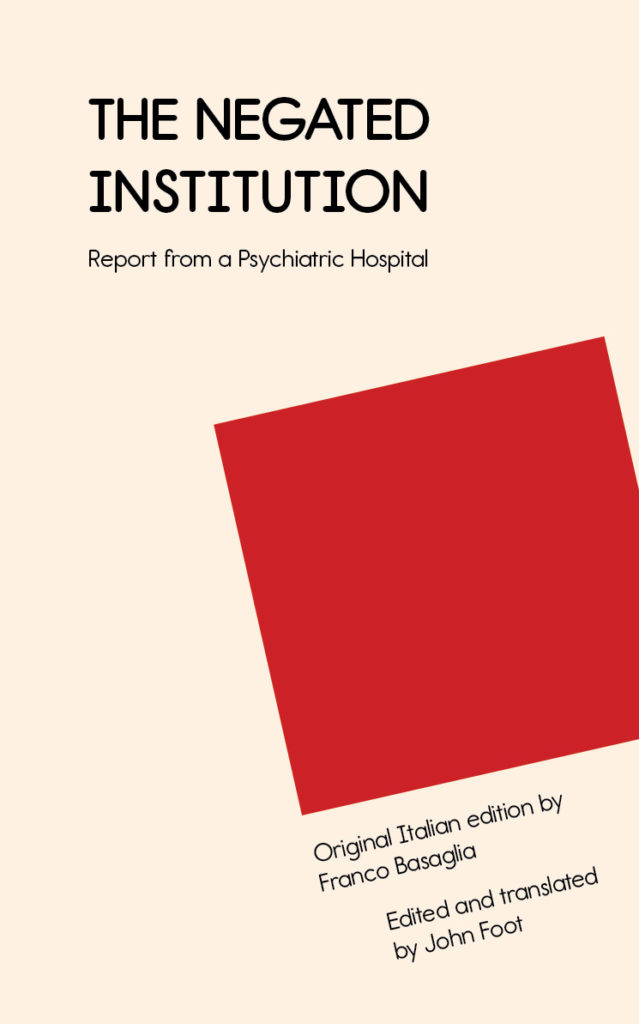
The Negated Institution: Report from a Psychiatric Hospital was first published in 1968 in Italian and caused an immediate sensation. It was an instant bestseller and was translated into numerous languages, but never into English. Edited by the Venetian psychiatrist Franco Basaglia, the book is a collection of writings, interviews, and debates which tell the story of the transformation of the Psychiatric Hospital in Gorizia, on the northeast border of Italy, into an open and “negated” institution. This story of an historically unique process of de-institutionalization—with the elimination of walls and barriers, the humanization of the hospital, the introduction of debates and meetings, the unlocking of wards, and the questioning of the very basis of all psychiatric hospitals—struck a nerve with the student and worker movements of 1968. It also gave a voice to the patients themselves, telling their stories of violence but also of liberation.
The Negated Institution was highly sensitive to the contradictions of this project of opening up and negation, and called for the abolition of the entire system of psychiatric asylums, as well as new ways of understanding and contextualising mental illness and mental health. It led to debates in many countries within and outside of psychiatry and played a part in the 1978 “Basaglia law,” which eventually closed down the entire psychiatric hospital system in Italy—the first example of such total closure in the world, which endures to our contemporary moment.
This is the first translation into English of this seminal text. The translator, John Foot, is an expert in the life and work of Franco Basaglia and has added notes and a critical introduction.
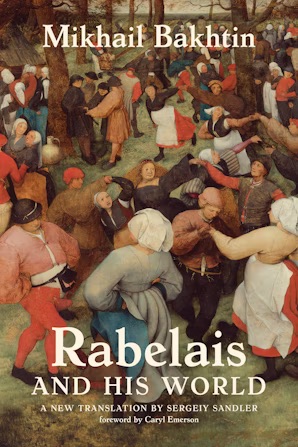
A new and improved translation of Mikhail Bakhtin’s classic and celebrated study of carnival.
Mikhail Bakhtin’s classic study of carnival, laughter, the grotesque, and medieval and renaissance folk culture has been the inspiration for countless new ideas in the humanities, in literature and the arts, and throughout human culture over the last half century.
Rabelais and His World is a study devoted to French Renaissance writer François Rabelais, author of GargantuaandPantagruel. Rabelais, Bakhtin argues, can only be properly understood against the backdrop of a millennia-old tradition of festivity and laughter, a tradition that included the Roman Saturnalia, medieval carnivals and feasts of fools, and Greek satyr plays and symposia from antiquity, as well as countless medieval works belonging to various smaller genres, circus shows, foul language and gesture, and much more.
Bakhtin claims this tradition is united by the imagery it uses and the worldview it expresses. Its imagery is ambivalent. It effaces the boundaries between bodies, connects in one image birth with death, praise with invective. Its worldview is optimistic, defeating all fears and all official seriousness with laughter.
The book’s new translation is informed by recent scholarship on Bakhtin and contains the most extensive scholarly apparatus this book has received to date.
Maria Antonietta Macciocchi (1922-2007) was a journalist, politician and academic. She is known for works including Daily Life in Revolutionary China (Italian and French in 1971; English in 1972). Her work on China was heavily criticised, and one example would be a roundtable organised by Esprit published in the journal to which she replied in November 1972.
This book was, however, important for the Tel Quel group, especially Philippe Sollers, and it was through Macciocchi that the Tel Quel group were invited to make their 1974 trip to China, which I write about here. That story intrigued me, and I was led from her obituary by John Francis Lane to pieces by Jadwiga Tedeschi and Robyn Marasco. There are periodic statements of her importance, but little of her work is translated and she seems to be rarely cited. This is a shame, since her work, especially on fascism, is particularly relevant today.
Macciocchi edited the Noi Donne magazine of the Italian Community Party, and later Vie Nuove, as well as writing for Unità, the paper founded by Antonio Gramsci. She studied in Paris, and later taught at the experimental University of Vincennes which was founded after May 1968.
She stood as the Italian Communist Party (PCI) candidate in a district in Naples in 1968, perhaps most interesting today because during her campaign she corresponded with Louis Althusser, about how to translate his theories and her political perspectives into a practical election campaign. Her letters about the campaign were published in Italian in 1969, in French in 1972, and translated as Letters from Inside the Italian Communist Party to Louis Althusser in 1973. The original Italian included some letters from Althusser, which are translated in the English edition, but he requested they were not included in the French edition. Macciocchi said that the letters “provided guidance and suggestions of approach [il y a donnait des indications et des suggestions de méthode]” but he believed, for reasons she did not want to judge, that “his letters would add nothing to the work [ses letteres n’ajouteraient rien à l’ouvrage]” (“Avant-propos pour l’édition française”, p. 8). Some contributions to the subsequent debate within the party were included in the second Italian edition and the translations. She was not selected to run again in 1972, in part because of her criticisms of the party in the Letters book. Her interest in China seems to have developed into a full turn to Maoism and she was eventually expelled from the PCI.
Her Pour Gramsci was published in the Tel Quel book series with Éditions du Seuil in 1974. A wide-ranging study of his work, it was important in the re-introduction of his work to French readers. Although some of his prison writings were translated in 1953, and his Oeuvres choisies in 1959, his Écrits politiques only began to be published in French in 1974. Cold War politics and internal divisions within French Marxism were behind some of the delays in his work becoming available in French. (The story of the early reception of his work in France has recently been told by Marco di Maggio, Camilla Sclocco and Anthony Crézégut. Crézégut’s article mentions a forthcoming book on Gramsci in France, but I have found no other trace of this.) The original edition of Pour Gramsci included texts by Gramsci in annexes; these were removed in the later reprints.
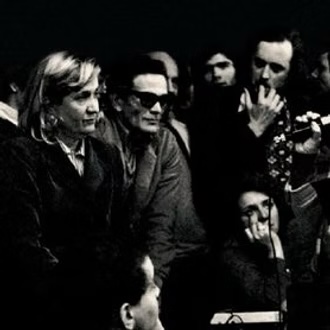
Macciocchi and Pasolini in Vincennes in 1974
Macciocchi taught a seminar at the University of Vincennes in 1974-75, Éléments pour une analyse du fascisme, the proceedings of which were published in two volumes in 1976. It included contributions from François Châtelet, Jean-Toussaint Desanti, Jean-Michel Palmier and Nikos Poulantzas. Poulantzas’s book on Fascism and Dictatorship had been published in 1970, and in this seminar he presented on the popular impact of fascism. Macciocchi presented on Gramsci’s theory of fascism, and fascism and women. The seminar was also interesting because it screened a lot of films with discussion. One of these was Nico Naldini’s 1974 film Fascista, with a discussion between Naldini and Pier Paolo Pasolini. The seminar is discussed by Alberto Toscano in Late Fascism (pp. 143-44) and briefly mentioned in an interview about the book. Macciocchi insists that the analysis had a political urgency, rather than just a historical interest (Vol I, 7).
Macciocchi’s 1976 book La Donna “Nera”: Consenso Femminile e fascismo [The ‘Black’ Woman: Female Consent and Fascism] has not been translated and is long out of print. It develops some themes of her teaching in Paris, arguing that an account of fascism also needs to discuss patriarchy. The “black” of the title refers not to race but to the Blackshirts, the squadristi or paramilitary squadrons of Fascist Italy. A shorter version of some of her arguments appeared in Tel Quel in 1976 and this was translated in Feminist Review in 1979, with an introduction by Jane Caplan. In the article, she describes Mussolini’s invention of the “female death squadron (widows, and mothers in mourning or semi-mourning)” for soldiers lost in the First World War, and his design for their “female dress, a dismal black uniform with a skull on the breast, for the women squadron members who attack ‘the Reds’ with daggers and hatpins” (p. 29/p. 70). The article was based on a 1975 conference paper in Milan, the proceedings of which were published as Sexualité et politique. That volume also contains papers by Sollers, Robert Castel, Luce Irigaray, Marcelin Pleynet and others.
A few days after the 1 November 1975 kidnap, torture and murder of Pasolini, she wrote a piece in Le Monde. She said that the crime was political, and she accuses Italian society as a whole, rather than just the actual murderers, because they “could not bear his defiance (of sexual, political, and artistic prohibitions)”. She continued to speak about the case, including a November 1977 piece in La Repubblica. The French version wasread at a February 1978 conference in Paris and appeared in Tel Quel later that year and then in English in October. She led a seminar 10-12 May 1979 at the Italian Cultural Institute in Paris and at Vincennes about him, with contributions by Italo Calvino, Sollers, Pleynet, Christine Buci-Glucksmann, Alain Finkielkraut and others, which was published as an edited book in 1980.
Much of her work could be seen as Freudian-Marxist, with an influence particularly from Wilheim Reich, alongside Althusser and Gramsci. This was condemned by other parts of the left, and her seminar was disrupted by protests. This was not at all uncommon at Vincennes. Some of the pamphlets against her are reproduced in the book from the fascism seminar (Vol II, 427-38). She ran seminars on fascism and women, feminine and feminist struggles and Marxism and feminism at Vincennes between 1975 and 1978, parts of which were edited as Les femmes et leurs maîtres in 1978.
She was a member of the European parliament between 1979 and 1984 for the Radical party. I don’t know much about her later work, but she seems to have turned from Maoism to Catholicism, writing an admiring book about Pope John Paul II.
Jane Caplan, “Introduction to ‘Female Sexuality in Fascist Ideology’”, FeministReview 1, 1979, 59-66.
Anthony Crézégut, “Gramsci’s Imaginary Prisons: Genealogy of a First French Edition (1947–1959)”, trans/ Sandrine Sanos and Sylvia Schafer, History of the Present: A Journal of Critical History 15 (2), 2025, 143-69.
Marco di Maggio, “‘Misunderstandings of hegemony’: Gramsci in the French Communist Party (1953–1983)”, Actuel Marx 62 (2), 2017, 154-69.
Maria Antonietta Macciocchi, Lettere dall’interno del PCI a Louis Althusser, Milano: Feltrinelli, 1969; Lettres de l’intérieur du parti: le Parti communiste, les masses et les forces révolutionnaires pendant la campagne électorale à Naples en mai 1968, Paris: François Maspero, 1970; Letters from Inside the Italian Communist Party to Louis Althusser, trans. Stephen M. Hellman, London: NLB, 1973.
Maria Antonietta Macciocchi, Daily Life in Revolutionary China, London and New York: Monthly Review, 1972.
Maria Antonietta Macciocchi, Pour Gramsci, Paris: Éditions du Seuil, 1974; Paris: Seuil/Points, 1975.
Maria-Antonietta Macciocchi, “Le Crime est politique”, Le Monde, 13 November 1975, 19.
Maria Antonietta Macciocchi, Éléments pour une analyse du fascisme: séminaire Paris VIII-Vincennes, 1974-1975, Paris: Union Générale d’Éditions, two volumes, 1976.
Maria Antonietta Macciocchi, La Donna “Nera”: Consenso Femminile e fascismo, Milano: Feltrinelli, 1976.
Maria Antonietta Macciocchi, “La sexualité féminine dans l’idéologie fasciste”, Tel Quel 66, 1976, 26-42; reprinted in Sexualité et politique: actes du colloque de Milan,1975, Paris: UGE 10/18, 1977, 239-73; “Female Sexuality in Fascist Ideology”, Feminist Review 1, 1979, 67-82.
Maria Antonietta Macciocchi, Les femmes et leurs maîtres: Séminaire Paris VIII-Vincennes, ed. Jacqueline Aubenas-Bastié, Bourgois, 1978.
Maria-Antonietta Macciocchi, “Pasolini: assassinat d’un dissident”, Tel Quel 76, 1978, 27-39; “Pasolini: Murder of a Dissident”, trans. Thomas Repensek, October 13, 1980, 11-21.
Maria-Antonietta Macciocchi ed., Pasolini: séminaire, Paris: Bernard Grasset, 1980.
Nicos Poulantzas, Fascisme et Dictature: La IIIe Internationale face au fascisme, Paris: Seuil/Maspéro, 1974 [1970];Fascism and Dictatorship: The Third International and the Problem of Fascism, trans. Judith White, London: NLB, 1974.
Nikos Poulantzas, “À propos de l’impact populaire du fascisme”, in Maria Antonietta Macciocchi, Éléments pour une analyse du fascisme: séminaire Paris VIII-Vincennes, 1974-1975, Paris: Union Générale d’Éditions, two volumes, 1976, Vol I, 88-107; “On the Popular Impact of Fascism”, The Poulantzas Reader, ed. James Martin, London: Verso, 2008, 258-69.
Camilla Sclocco, “Gramsci’s France and Gramsci in France”, International Gramsci Journal 5 (1), 2023, 109-23.
Armando Verdiglione ed. Sexualité et politique: Documents du congrès international de psychanalyse, Milan 25-28 novembre 1975, Paris: U.G.E., 1977.
This is the 71st post of a weekly series, posted every Sunday throughout 2025, and continuing into a second year. The posts are short essays with indications of further reading and sources. They are not as formal as something I’d try to publish more conventionally, but are hopefully worthwhile as short sketches of histories and ideas. They are usually tangential to my main writing focus, a home for spare parts, asides, dead-ends and possible futures. I hope there is some interest in them. They are provisional and suggestions are welcome. A few, usually shorter, pieces in a similar style have been posted mid-week. I’m not sure I’ll keep to a weekly rhythm throughout 2026, but there will be at least a few more pieces.
The full chronological list of ‘Sunday histories’ is here, with a thematic organisation here.