
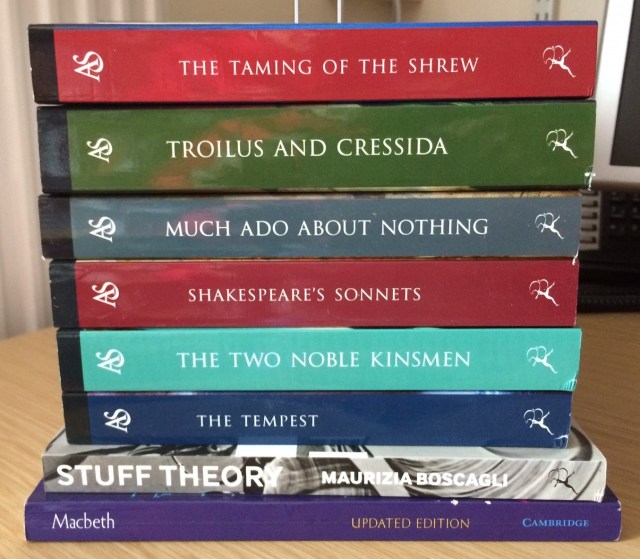
I recently did some review work for Bloomsbury, and asked for a number of the revised editions of the Arden Shakespeare; the one volume I didn’t already have; and Maurizia Boscagli’s Stuff Theory, in recompense.
I recently did some review work for Bloomsbury, and asked for a number of the revised editions of the Arden Shakespeare; the one volume I didn’t already have; and Maurizia Boscagli’s Stuff Theory, in recompense.
Five radio programmes on Foucault from France Culture.
Michel Foucault, France Culture radio, Émissions • Hors-champs • Michel Foucault,
5 émissions, mars 2016
A l’occasion de la sortie dans la Pléiade de l’œuvre de Foucault, toute une semaine avec Michel Foucault, il s’agira de penser avec Michel Foucault, grâce à Michel Foucault et d’envisager Michel Foucault demain. Comprendre l’ampleur à la fois intellectuelle, politique, historique et philosophique de son œuvre, sans faire œuvre testamentaire, ni patrimoniale, en tentant de se projeter dans ce présent intense.
L’énigme Foucault: Daniel Defert et Fréderic Gros
Les enjeux théoriques de l’oeuvre de Foucault: Jean Birnbaum et Philippe Artières
Foucault, la société punitive et l’Amérique avec Bernard Harcourt
Didier Eribon: Michel Foucault, du philosophe au militant
La trajectoire philosophique et politique de Michel Foucault
Pour cette dernière émission consacrée au philosophe Michel Foucault, l’historien Patrick Boucheron, le militant anti-sida Daniel Defert et le philosophe Fréderic Gros explorent la trajectoire philosophique et politique de…
View original post 15 more words
Peter Adey has a very good tribute to John Urry at the Theory, Culture & Society blog.
While waiting for the reader reports on Foucault: The Birth of Power I have been almost exclusively working on Shakespeare. That project is taking shape, and I’ve been developing conference and seminar papers into more polished prose, with fuller notes and much more careful checking of variant editions of texts. I’ve also been adding new material and discussions to the work. I now have new chapters on Richard II and Henry V – on economic and legal aspects of territory, respectively – in fairly good shape. Next I will work on Hamlet – again a text I’ve given lectures on before, and one on which I will also be speaking about in the autumn.
 I did have one more trip to Paris booked, in early April, when I worked through some more Foucault material at the Bibliothèque Nationale. I especially wanted to look at boxes 17-19, the last remaining boxes clearly relevant for the 1970s. As I’ve said before the catalogue is still rather vague at present, and there is enough misleading information in what I’ve looked at already that I couldn’t be entirely sure what they would contain. Boxes 18-19 are listed as on the theme of ‘Economie’, though ‘government and economy’ would describe the contents better. The material relates to the 1977-78 course Security, Territory, Population and the 1978-79 course The Birth of Biopolitics. Box 17 is not listed in the catalogue as yet, but it contains most of the images used in Surveiller et punir – which are more extensive than those in Discipline and Punish – as well as some that were not used; and lots of photocopies of material from Annales d’hygiène publique et de médecine légale used in Foucault’s early Collège de France seminars.
Reading the material in boxes 18 and 19 together reinforced the clear sense that the two courses are a continual inquiry, and that Foucault is led to the material in the second by the questions he raises in the first. There are, as ever, very detailed notes. Not all of the preparatory work was used in the course – standard practice for Foucault. The idea that Foucault was unable to do original research for the 1979 course because of the injuries following his car accident is now proved as nonsense – it was always a very peculiar suggestion. Equally it would be good if at least some of the contributors to the ‘Foucault and neoliberalism’ debate spent some time looking at Foucault’s notes from this period – I think they would be forced to agree that there is no clear differentiation in style between notes on ‘neoliberalism’ and on other lecture topics, and that Foucault is, as ever, trying to reconstruct the internal logic of texts and debates, rather than being converted to or by the material he is studying. In addition, there is a lot of material on the missing period between the historical 1978 lectures and the contemporary 1979 lectures – detailed notes on Smith, Malthus, Mill, Hayek, Polanyi etc.
As I had a little time left on this trip, I began looking through the next box in sequence. Boxes 20-23 are labelled as ‘Réforme, Pères de l’Eglise, etc.’, but I already know that box 24 – labelled as ‘Sém’, i.e. ‘Seminar’ – actually continues that theme. Box 20 begins a very detailed set of notes on Christian practices of confession in Protestant and Catholic traditions, with a mix of notes on secondary sources and detailed notes on theologians from a range of historical periods. Some of these notes were used in the On the Government of the Living course from 1979-80, and the editor of that course, Michel Senellart, makes reference to some of them in his footnotes; but they are also clearly preparatory work for the book on confession Foucault intended for the History of Sexuality series – both, I think, in its original form of the mid 1970s and the later version which treats a much earlier historical period. These are the books La chair et le corps, promised in History of Sexuality I, and Les aveux de la chair, noted as forthcoming in 1984 when History of Sexuality II and III were published. As I’ve found many times while working on these notes, it would be so useful if they were dated. But not only are they undated, they are filed thematically, and the change in handwriting, ink and paper suggests that notes from quite different time periods are combined together. I discuss all this work in detail in Foucault’s Last Decade, and while nothing I’ve found so far would change what I say there – though I might add some more precise indications of Foucault’s source material – it is fascinating actually now to be able to consult his working notes for these projects.
 The remaining boxes that I have not yet worked through which are listed in the catalogue concern either the late 1970s or early 1980s (the remaining boxes 21-23 on Christianity, and boxes 27-28 on antiquity) or the 1950s-1960s (boxes 31, 34-38). While undoubtedly interesting, these are either on a period I have already published on in Foucault’s Last Decade, or which I may turn to at some later point. But for this book, which treats 1969-74, as I didn’t trust the catalogue labels, I did really want to see what was in boxes 18-19. That accomplished, I have now worked through the relevant material of what is currently available. I now just need to wait for the referee reports before final revisions. In the meantime I am returning to Foucault’s collaborative book with Arlette Farge, Le Désordre des Familles, for a book chapter – the book is forthcoming in translation, and there will be a companion book of essays of which I’m delighted to be part. I’m reading and rereading some of Farge’s work from around this time to round out the account.
Foucault’s Last Decade is now available in most places, though it seems not yet in North America. For more information on these two books, see the descriptions here.
Audio and video recordings relating to them are here; and a full list of the updates I’ve been posting on the process of writing here. Some translations, bibliographies, scans and links are available at Foucault Resources.
An excerpt from Chapter Six of the manuscript of Foucault: The Birth of Power has recently been published by Viewpoint: “The Biopolitics of Birth: Michel Foucault, the Groupe Information Santé and the Abortion Rights Struggle” (open access).
 Some recent books bought – most for the Shakespeare work, but a few Foucault-related. Eliane Alio worked with Foucault at the Collège de France, and was an assistant on the book he wrote with Arlette Farge. Foucault’s book with Farge is the topic of a book chapter I’ll be writing soon. I picked up a copy of the new Discours et vérité précédé de La parrêsia when in Paris – this is a critical edition of the 1983 Berkeley lectures previously published in Fearless Speech. The book at the top, by Pierre Spriet on Shakespeare’s Richard III, is the answer to this query – my thanks to John Russell for the bibliographical assistance.
Another review of the recent Hannah Arendt documentary, Vita Activa.
David Beer, ‘In defence of writing book reviews’ in The Times Higher Education.
A very good piece, which makes a plea for the importance of this engagement. I know, as a former book review editor, how difficult it can be to get people to agree, and then to deliver, a review. ‘Life’s too short to write a book review…’, or ‘they don’t count’ were common comments. But, of course, these same people wanted their own books to be reviewed.
Of course, it’s not helped by some journals taking forever to publish them when they are submitted, by which time the book may be several years old. Lots of journals are now moving to online reviews, which can be posted much quicker. I don’t write as many reviews as I did earlier in my career, but I do still try to write some – they are usually worthwhile and can be fitted around other things, or act as direct inspiration for other work.
David’s piece is well worth a read…
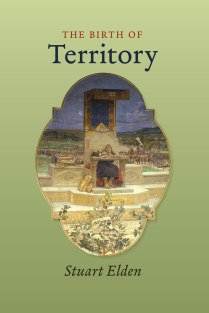 A thoughtful and generous review essay of my 2013 book The Birth of Territory has just been published – “Territory Delimited“, Tulsa Law Review by Bartholomew Sparrow (open access).
I was particularly pleased with these two general paragraphs, which follow a detailed survey of what the book tries to do:
The above summary does not do justice to The Birth of Territory. Elden offers us a rich, thorough, and instructive account of the dozens of conceptualizations of territory, evident in written texts, art, and oral tradition (such as Beowulf). The author’s close reading of the many philosophers, theologians, logicians, geographers, and other thinkers who articulate concepts of territory, but with whom many political theorists of the Western canon will be unfamiliar, is indicative of his ambition and erudition as a scholar, of the comprehensiveness of his research, and of the seriousness with which he conducted his study…
Another laudable quality of The Birth of Territory is the precision of Elden’s writing, notwithstanding the complexity of his subject, and the many evolving nuances—how two- plus millennia of philosophers, statesmen, and other figures conceptualized space, religion, and political power. Such clarity is by no means a given among political theorists or social scientists, and it is indicative of the thought and effort Elden has invested in the book.
Quite rightly, the piece then goes on to raise some critical questions. I don’t really understand the comment about anthropology and archaeology – while entirely correct that I don’t try to do that work, the intention was never to ‘slight’ them: it was a recognition of the limits of my ability, not a denigration of that work. It would indeed take academics with training in those disciplines to attend to “peoples who left little written record”. I really wouldn’t know where to start to answer the questions Sparrow raises here. In terms of the legacy of colonialism, I say a bit, and recognise some of these criticisms from other exchanges about the book. I’ve done my best to reply before, though I accept this is never going to be adequate to the complexity of this issue. (A full list of reviews and responses is here.)
The last, most extensive criticism is that the story stops with the late 17th and early 18th century, and doesn’t bring the story up-to-date. Well, that was never my intention here, and some of the most contemporary issues that Sparrow raises were addressed in detail in my 2009 book Terror and Territory, and a few related papers – where I discuss terrorism, the end of the Cold War, and globalisation. I don’t agree that territory has become less important in our global world, and I think it’s far too quick a conclusion to draw. But to answer these questions adequately would be another book or two at least; and perhaps most crucially, if attempted here would have prevented this book from doing what it does attempt, as the review goes on to recognise.
What Stuart Elden has accomplished is more than enough. The Birth of Territory constitutes research of immense benefit to scholars of political theory, intellectual history, geography, and political sociology. It stands as a tour de force of conceptual history.
My thanks to Bartholomew for these detailed engagement with the work.
Michael Naas on forms of life in Plato – audio recording from a talk at Memorial University of Newfoundland. A fascinating talk on bios and zoe throughout Plato’s work – which adds much needed nuance to the rather crude distinction Agamben draws. I had a brief discussion of the need for this in a paper on ‘Heidegger’s Animals‘, but that section was cut from the finished version. Naas goes well beyond what I could have accomplished, and makes me glad I never embarked on trying to develop that cut part.
Peter Gratton, who introduces the talk, says a bit about it here. As he concludes: “It was a tour de force, where one could pick up certain influences, such as Derrida, but one which left our classics people quite thrilled with the care and erudition.”
(Technical note: I had to download the audio file to listen to it, rather than stream it, but downloading worked fine.)
New Hannah Arendt documentary reviewed in the NYT.
New documentary on Arendt reviewed in the NYT: In ‘Vita Activa: The Spirit of Hannah Arendt,’ a Thinker More Relevant Than Ever – The New York Times


