Intervention – ‘Merkel’s Geography: Maps and Territory in China’

An interesting piece on maps, territory and China-German relations by my Warwick colleague Marijn Nieuwenhuis.

Antipode Editorial Office's avatarAntipodeFoundation.org

by Marijn Nieuwenhuis, University of Warwick

Maps are vital for the geographic imaginary of the state. They are, as David Harvey (2001) and others (see, for example, Crampton and Elden 2007; Elden 2013) remind us, instruments of a Foucauldian power/knowledge nexus that interlock in a particular mode of governmentality. Their authoritarian and authoritative representation of reality legitimises and makes possible state governance and the exercise of violence over territory. There exists, however, a mismatch between the cartographic need to map territory and the historically dynamic nature of territory itself. Territory is neither a static container nor a dehistoricised social relation. It is instead a formative force and a historically contingent category. Maps need therefore to be constantly adjusted to reflect changing political realities. The consequence is a weakening of their authoritative nature which, in turn, can potentially damage the geographic imaginary of the state. In other words, territory is…

View original post 1,553 more words
Posted in Uncategorized | 1 Comment

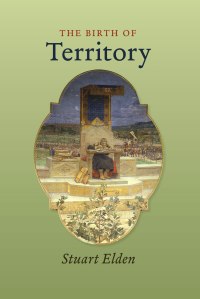
David Storey reviews The Birth of Territory in Journal of Historical Geography

David Storey reviews The Birth of Territory in Journal of Historical Geography (requires subscription or email me). Here’s the final paragraph.

12 The Birth of Territory

This is a work of history, political science, law and philosophy as well as a work of geography. In telling the story of territory, Elden also touches usefully on a range of other issues such as the periodization of history and the retrospective application of terms such as ‘middle ages’ and ‘renaissance’. The meticulousness of the research is evident in the extensive footnotes, with 2750 in total and running to almost 150 pages. The breadth of sources and the range of ideas mean that Elden is, in many respects, following on in a similar vein to many of the writers whose work he deals with here.

Posted in Politics, The Birth of Territory | 3 Comments

Can you imagine a world with ice?

Phil Steinberg explains the rationale behind a workshop at Durham next week, at which I am one of the invited discussants. I say a bit about how my work on territory might relate to the Arctic, and ice, in this post.

philsteinberg's avatar

That headline’s not a typo.

Lots of people are wondering what it would mean to have a world without ice. However, even as glaciers melt and sea level rises there’s still going to be a lot of ice around for a long time, especially in the winter. In fact, ice is likely to become more important as commercial enterprises and the states that support them become increasingly active in the polar regions.

Greenland-ice-edge

View original post 277 more words

Posted in Boundaries, Conferences, Politics, Territory | Leave a comment

Archipelago/Funambulist Conversation between Léopold Lambert and Stuart Elden on Territory and Volume

Archipelago-Banner-header

I’ve linked to content on Archipelago – the podcast companion site to Léopold Lambert’s The Funambulist – before. This time it’s a discussion with me, conducted at the CUSP offices in New York, and mainly discussing my 2013 article “Secure the Volume: Vertical Geopolitics and the Depth of Power“. The discussion covers the early work of Paul Virilio, Eyal Weizman’s Hollow Land, the fractured political geographies of the West Bank, and Léopold and my travels there. At the end I say a bit about my work on Shakespeare. Many thanks to Léopold for doing this – and all he does at his two sites.

You can listen to the discussion here.

Posted in Boundaries, Eyal Weizman, Foucault's Last Decade, Jeremy Crampton, Michel Foucault, My Publications, Paul Virilio, Peter Sloterdijk, Politics, Shakespearean Territories, Travel, urban/urbanisation, William Shakespeare | 1 Comment

The work of editing – adding references to translations II

In a previous post I said a bit about one of the tasks of editing a translation. I’ve now completed the Heidegger references I discussed in that previous post. The references to Hegel, Jaspers, Heraclitus, Homer, Lukács and Lenin took relatively little time – they were either references to whole works or used standard numbering for the Greeks. The unreferenced Kant passage was surprisingly easy to locate. There were only a few to Nietzsche, but they took a bit of work – old editions of Nietzsche’s notes are notoriously difficult to match up with new editions, but I found the relevant passages in the Kritische Studienausgabe. As far as I’m aware these passages are not translated in any English collection.

Marx was more of a challenge. There were a few passages from Capital, the dissertation, the 1857 introduction to the Contribution to the Critique of Political Economy, The Poverty of Philosophy; several to The German Ideology and over twenty to the 1844 Economic and Philosophical Manuscripts. The order of the edition used of the latter is clearly different to the English Penguin/NLR version, so that took quite a bit of time. With a few exceptions – about five things to be checked in a library – I think the notes are done. Now to the introduction.

desk 2

Posted in Friedrich Nietzsche, Georg Lukács, Karl Jaspers, Karl Marx, Martin Heidegger, Publishing | 3 Comments

Authority and Political Technology workshop – keynote audio recordings

apt_2014_3Recordings from the recent Authority and Political Technologies workshop are now available at the Warwick website – Christian Borch, Luciana Parisi, Amade M’Charek, Louise Amoore, Costas Douzinas and AbdouMaliq Simone.

Posted in Conferences, Louise Amoore, Politics | 1 Comment

Next installments of Barry Stocker’s reading of Foucault’s Subjectivity and Truth lectures

The second half of lecture 1, and the first half of lecture 2.

Posted in Michel Foucault | Leave a comment

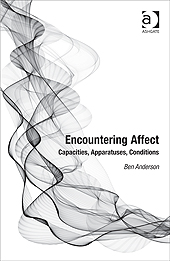
Ben Anderson, Encountering Affect: Capacities, Apparatuses, Conditions – first chapter online

The first chapter of Ben Anderson’s Encountering Affect: Capacities, Apparatuses, Conditions is available online. The book will be out in July.

9780754670247.PPC_Harrison

Since the mid-1990s, affect has become central to the social sciences and humanities. Debates abound over how to conceptualise affect, and how to understand the interrelationships between affective life and a range of contemporary political transformations. In Encountering Affect, Ben Anderson explores why understanding affect matters and offers one account of affective life that hones in on the different ways in which affects are ordered. Intervening in debates around non-representational theories, he argues that affective life is always-already ‘mediated’ – the never finished product of apparatuses, encounters and conditions. Through a wide range of examples including dread-debility-dependency in torture, ordinary hopes, and precariousness, Anderson shows the significance of affect for understanding life today.

Posted in Books, Politics | 1 Comment

Top posts this week on Progressive Geographies

Shakespeare in New York: Kenneth Branagh as Macbeth – a short review

The work of editing – adding references to translations

Books received – Nietzsche, Heidegger, Foucault, Lefebvre etc. (2 of 3)

Books received – territory, borders, architecture, government (1 of 3)

Critical Theory books that came out in May

Books received – Verso (3 of 3)

Mapping the world through its airport connections – excellent visualisation

The post mountain

Volume 32, Issue 3 now out

Gerry Kearns reviews The Birth of Territory – and a minor note on ‘land’

Posted in Uncategorized | Leave a comment

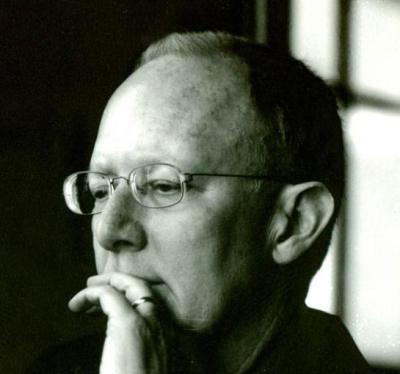
Paul Rabinow on Foucault & the Contemporary

Interesting interview with Paul Rabinow.

dmf's avatarsynthetic zerØ

Paul Rabinow on Foucault & the Contemporary

rabinow

– the host is a bit lacking but Rabinow is probably the most important intellectual of our time…

Paul Rabinow is Professor of Anthropology at the University of California (Berkeley), Director of the Anthropology of the Contemporary Research Collaboratory (ARC), and former Director of Human Practices for the Synthetic Biology Engineering Research Center (SynBERC). He is perhaps most famous for his widely influential commentary and expertise on the French philosopher Michel Foucault. He was a close interlocutor of Michel Foucault, and has edited and interpreted Foucault’s work as well as ramifying it in new directions.

Rabinow is known for his development of an “anthropology of reason”. If anthropology is understood as being composed of anthropos + logos, then anthropology can be taken up as a practice of studying how the mutually productive relations of knowledge, thought, and care are given form within…

View original post 110 more words

Posted in Uncategorized | 1 Comment