Intertexuality and Structure in Roberto Bolaño’s 2666

2666 has been sitting on my ‘to read’ shelf for too long. A great post has inspired me to move it to the top of the pile.

Edwin Turner's avatarBiblioklept

the-librarian1

•I had been reading William T. Vollmann’s enormous book Imperial. I bought the book in paperback and then put an illicit copy on my Kindle (this riff is not about the ethics of that move). It’s just easier to read that way, especially at night. At some point in Imperial, probably at some mention of coyotes or polleros—smugglers of humans—I felt a tug in the back of my brain pan, a tug that wanted to pull up Roberto Bolaño’s big big novel 2666—also on my Kindle (also an illicit copy, although I bought the book twice).

•This is how I ended up rereading 2666 straight through. It was unplanned.

•Like many readers, I aim to reread more than I actually end up rereading.

•Truly excellent novels are always better in rereading: richer, fuller, more resonant. Sometimes we might find we’ve thoroughly misread them. (Imagine my horror rereading 

View original post 2,297 more words

Posted in Uncategorized | 2 Comments

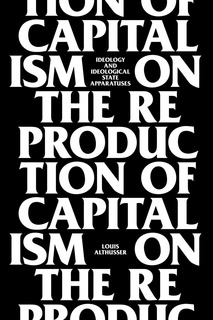
Althusser, On the Reproduction of Capitalism

AlthusserVerso have announced the publication of Althusser’s On the Reproduction of Capitalism: Ideology and Ideological State Apparatuses, for early 2014.

What is perhaps Louis Althusser’s most famous text, “Ideology and Ideological State Apparatuses,” published in 1970 and very influential ever since, was an extract of a much longer book published in French years after his death. Published now for the first time in English, On the Reproduction of Capitalism develops systematically Althusser’s conception of historical materialism, outlining the conditions of reproduction in capitalist society and the revolutionary struggle for its overthrow. Written in the afterglow of May 1968, the text addresses a question that continues to haunt us today: in a society that proclaims its attachment to the ideals of liberty and equality, why do we witness the ever-renewed reproduction of relations of domination? Both an activist and a conceptually innovatory text, On the Reproduction of Capitalism is an essential addition to the corpus of the twentieth-century Left.

Posted in Louis Althusser | Leave a comment

Grégoire Chamayou – books received

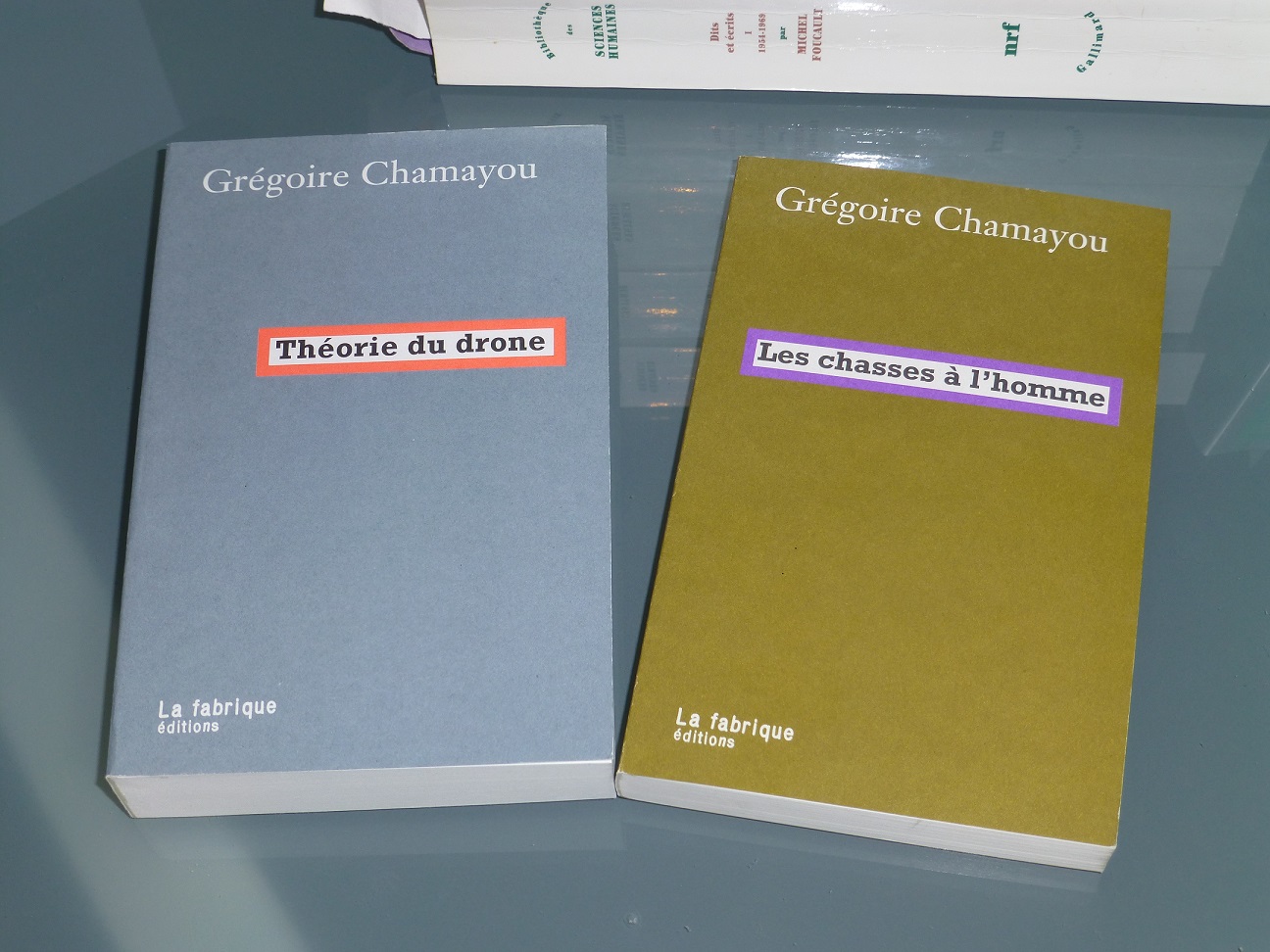
Derek Gregory has discussed Grégoire Chamayou, Théorie du drone in four detailed posts on his Geographical Imaginations blog – here, here, here and here. On the strength of the first two of these I picked up a copy of this book and Chamayou’s earlier Les chasses à l’homme. The latter is translated as Manhunts and a brief commentary entitled ‘The Manhunt Doctrine‘ is open access in Radical Philosophy. [Update – new posts by Derek here, here and here]

Chamayou

Posted in Derek Gregory, Grégoire Chamayou | 1 Comment

Derrida books received

I’ve done a couple of reviews for University of Chicago Press recently. I got most of the recent books I wanted for one review, and for the other filled in a few gaps in my Derrida shelf. His first seminar on The Death Penalty is pre-ordered.

Derrrida books

Posted in Jacques Derrida | 1 Comment

Sara Fregonese and Ralf Brand, The Radicals’ City

Sara Fregonese and Ralf Brand’s book, The Radicals’ City, is now out.

Posted in Uncategorized | Leave a comment

Arun Saldanha – Some Principles of Geocommunism

At Geocritique:

Concentration of CO2 has hit 400 ppm. The economic crisis has from the start been an opportunity for an entrenchment of the economic power of the global elite. Hiding their oxymoronic status, green capitalism, ethical consumerism and geo-engineering are convincing everyone ecological disaster can be averted. In the face of the apocalypse it predicts, science remains at worst corrupt and at best spineless, while the left remains hindered by humanist conceptions of political agency. Not the modern city or the nation-state, but the Anthropocene is now the horizon of revolutionary politics.

What follows are theoretical principles. Unlike in 1848 or 1917 there is no spectre of communism haunting any country. No concrete strategies to take over power can be formulated. A belief communism can be revived for the twenty-first century is nonetheless stirring in some academic and activist circles. An understanding that capitalism does not work is widespread. There is an appetite for revolution and experiment. And there is a historical resurgence of apocalyptic imaginations. These currents – anticapitalism, revolution, apocalypse – are now to be pushed to the point where their complicity with liberal democracy cedes to a properly communist project. The prefix geo is necessary to signal both a break with nineteenth- and twentieth-century communism, and that it is the Anthropocene itself that has inaugurated the desirability of a new mode of production.

Geocommunism consists in politicising science, denaturalising Marxism, minimising humanism, secularising eschatology, collectivising Stoicism and eternalising revolution. [more here]


Posted in Politics | Leave a comment

Conference: Borders and Boundaries in an Age of Global Urbanization

Interesting looking conference coming up – via Urban Cultural Studies.

Michele L's avatarUTS Urban Forum

2013-07-09_1138

Please have a look at the Annual Meeting of the Urban Affairs Association, San Antonio, TX, USA, March 19-22, 2014.

Urban areas have grown at an unprecedented rate in the last decade. More of the world’s population now lives in cities than in any other context. International trade, capital investment and divestment, migration, and porous economic, social and political boundaries fuel this global urbanization. Enormous governance challenges result for megacities and fast‐growing urban centers due to in‐migration and other trends, particularly in the global south. Ethnic, racial and economic disparities across the globe create new tensions and vehicles for exclusion, while also creating interesting possibilities for cooperation and collaboration. Economic, political, and environmental crises further burden governance and demand innovative solutions to problems unique to global urbanization. All of this raises old and new civic and policy questions about boundaries and borders of global urbanization. Consequently, the 2014 conference theme…

View original post 95 more words

Posted in Boundaries, Conferences, urban/urbanisation | Leave a comment

Routes, Roads and Landscapes reviewed

New review at the Society & Space open site.

Posted in Uncategorized | 1 Comment

Foucault in Rio 1973-74

The ‘Truth and Juridical Forms’ lectures

Between 21-25 May 1973, Foucault gave five lectures in Rio de Janeiro. These were under the collective title of ‘Truth and Juridical Forms’. They were published in Portuguese in 1974, in French in 1994 in Dits et écrits (text no 139); and in English in the ‘Power’ volume of Essential Works in 2000 (without the 23 page roundtable discussion that followed the fifth lecture). [Update: I translate a few bits of this here.]

The topics of the five lectures can be briefly summarised as

  1. Introduction and Nietzsche
  2. Oedipus – a variant of the ‘Oedipal Knowledge’ manuscript
  3. The Inquiry, Feudal law and the Carolingian Empire
  4. Panopticism
  5. Institutions

From the newly published and translated Lectures on the Will to Know (which includes ‘Oedipal Knowledge’ as an appendix), it’s clear that the overall framing of the lectures, and the content of the first two, were very closely related to this course.

The third lecture, on the inquiry, appears to be drawn from the 1971-72 Collège de France course, ‘Penal Theories and Institutions’. At least, so it would seem on the basis of the course summary of those lectures (DE II, 390-391; EW I, 18-19), since the full course is not yet published. It may well be that the course title is somewhat misleading as to the actual content of that course. From the summary, Foucault notes that “This year’s course was meant to serve as a historical preliminary [underlined SE] to the study of penal institutions (more generally, of social controls and punitive systems) in French society of the nineteenth century” (EW I, 17). Daniel Defert describes it as a course which “outlines, from antiquity to the nineteenth century, the juridico-political matrices of certain types of knowledge” (‘Chronology’, p. 48). The course summary suggests it had two parts—the first on the inquiry in the Middle Ages; the second on “new forms of social controls” since the 16th century.

Lectures four and five appear to be drawn from the 1972-73 Collège de France course, ‘The Punitive Society’. That course isn’t yet published, but will be out in French in autumn 2013. So we will see very soon how closely lectures 4 and 5 relate to the Collège de France course. This make sense—Foucault finished teaching in Paris in around March each year, and then took the lectures on the road with him. There are plenty of examples of his drawing on that work for lectures elsewhere.

But ‘Penal Theories and Institutions’ may not be out for another year or two – I’ve heard that the 1980-81 course will be next, and that was even scheduled before the 1972-73 one, which may suggest at least two years for 1971-72. So, along with the course summary, the third ‘Truth and Juridical Forms’ lecture is the best insight into that course that is currently published. It promises to be a really interesting course, especially since it discussed confession, the Middle Ages, and the inquisition. Foucault would return to these questions, with different emphasis, in 1974-75 and 1979-80.

The lectures on Social Medicine

Foucault gave three more lectures in Rio in October-November 1974

  1. Crisis of Medicine or Crisis of Anti-Medicine (Dits et écrits no 170; translated in Foucault Studies).
  2. The Birth of Social Medicine (Dits et écrits no 196; translated in Essential Works III: Power).
  3. The Incorporation of the Hospital in Modern Technology (Dits et écrits no 229; translated in Space, Knowledge and Power: Foucault and Geography).

These were published in 1976, 1977 and 1978, respectively. (Richard Lynch’s bibliography of English translations [in A Companion to Foucault] notes that he has made revised translations of these three lectures. But this needs to be done carefully. The original publication of the lectures was in Portuguese, then Spanish, and the French versions in Dits et écrits are themselves translations. So translating directly from the French would potentially create errors—the translation would be third generation, as opposed to second. A first generation translation would appear to be impossible without the original French version, which may be lost or simply locked in the archive.)

What is interesting about these lectures, for me, is that Foucault did not, as far as I can tell, draw on Collège de France lecture material. When I first wrote about these Rio lectures (here), I assumed that he had drawn on the Psychiatric Power lecture course on 1973-74. But when that course was published I discovered this was not the case (see my article on the course here). They are closer to work pursued in that year’s seminar. (He gave some lectures in Montreal in March-April 1974, the topic of which seems to be unknown. Defert notes that he rewrote “several parts of his ‘book on punishment’” in his apartment in Montreal on this trip. This book is of course Discipline and Punish, finally completed on 26 August 1974, and published in February 1975. It’s possible he lectured on that book material in Montreal, though he’d moved away from that in his Collège de France lectures.)

The closest relation to the material developed in these Rio lectures, in publications authorised by Foucault in French, was the essay ‘The Politics of Health in the Eighteenth Century’, published in the collaborative volume Les machines à guérir in 1976 (Dits et écrits no 168). There was a re-edition of the text in 1979, with significant variants in Foucault’s text (published in Dits et écrits as no 257). Only the first is available in English (in Power/Knowledge, The Foucault Reader and Power). Lynch has made a translation of the second version, but this is currently unpublished.

Posted in Foucault's Last Decade, Michel Foucault | 3 Comments

Adam Kirsch on Sloterdijk in the New Republic

Adam Kirsch discusses some of the recent Sloterdijk translations in the New Republic – thanks to Mark George for the link.

Posted in Peter Sloterdijk | Leave a comment